

BP seeks a compensation return from a “vast number” of firms that inflated the losses in their claims. The British oil and gas giant has told a US court that the administrator assigned to process the claims, Patrick Juneau, approved too many exaggerated applications.
In 2013, a US court accepted that the process was not fair. BP, which fought a long legal battle, however, says it wants the money returned “with interest”.
Apart from asking for the money back with interest, BP applied for an injunction in a court filing on Friday, to U.S. District Judge Carl Barbier in New Orleans, so that companies cannot spend their “windfall”. BP reminds the court of an updated policy for calculating damages that a US court approved in May. It wants the court to order a recalculation of the compensation awards before the policy was updated.
The oil company added that “there is no public interest in permitting dissipation of assets to which claimants had no right.”
BP wanted the payment of compensation claims to stop until its legal appeals had concluded, but the US Supreme Court said no.
The Deepwater Horizon disaster
On April 20th, 2010, the Deepwater Horizon rig was drilling at the Macondo Prospect off the coast of Louisiana when an explosion caused by a blowout killed 11 workers and ignited a massive fireball visible from 40 miles away.
The fire could not be put out and the Deepwater Horizon sank on April 22nd, leaving the well spurting out oil at the seabed. The explosion caused the biggest offshore oil spill in the history of the United States. The spill reached the wetlands and the beaches of the Gulf Coast.
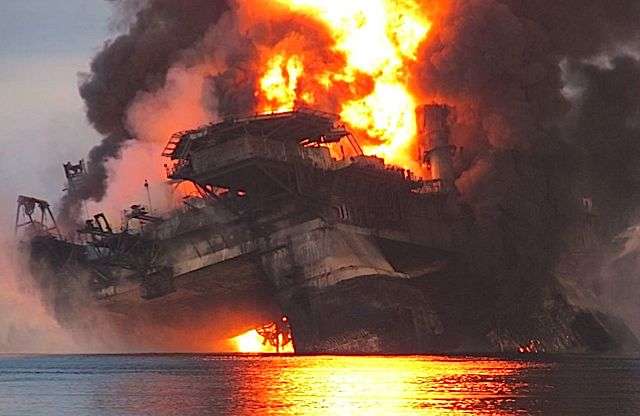
The Deepwater Horizon disaster, the worst (environmental disaster) in US history.
BP accepted an initial agreement for compensation
BP reached an agreement to pay out an estimated $7.8 billion in compensation to businesses that had been affected by the spill.
The British oil company now says that the terms of the compensation deal are being misinterpreted and that claims are exaggerating damages.
BP has put forward several examples:
- a building company based hundreds of miles from the coast received $8.4 million more than it should have,
- an animal-skin seller should have received $14 million less, and
- a company claimed that it purchased inventory at the beginning of 2009 and was not able to sell it until months later, giving the false impression of inflated profits during those months.
Overpayments are likely to total several hundreds of millions of dollars, BP says.
Another legal battle – the causation issue
In a separate legal fight, on whether firms must prove they were directly harmed by the spill to collect money, two US courts have ruled that proof of direct harm is not required under the settlement BP had agreed to. BP says it plans to appeal to the Supreme Court.
BP, which says it has consistently and publicly maintained that it will be entitled to claw back inflated payments as soon as the misrepresentation was corrected, says it would be unfair for other claimants whose compensation awards were calculated after the updated policy if the exaggerators kept all the money they received.
Lawyers representing the plaintiffs accuse BP of backing out of a commitment it had co-authored and signed. BP told the Supreme Court that it “will have no practical way of recovering (money paid),” the attorneys added.
If something is not done soon to control compensation abuse, BP says the uncapped settlement could end up costing it more than $9 billion, much higher that the original $7.8 estimate.
Even if BP does manage to claw back most of the over-compensation that was paid out, the eventual cost of the settlement will probably still exceed the original estimate.
According to federal court documents, since June 2012 the settlement program’s claims facility has processed 288,000 claims. A total of 65,700 claims have been approved, with awards totaling nearly $5 billion.
