

British economic growth in the third quarter (July to Sept) was just 0.5%, compared to 0.7% in the second quarter (Apr to June), the Office for National Statistics (ONS) announced on Monday.
Compared to Q3 2014, GDP (gross domestic product) grew by 2.3% in Q3 2015.
In the third quarter, output grew in three of the main industrial groupings within the economy. Production was 0.3% higher, agriculture grew by 0.5%, services were 0.7% up, but construction output declined by -2.2%. Construction currently accounts for around 5.9% of UK GDP.
Within production (currently accounts for about 14.9% of UK GDP), mining and quarrying registered a 2.4% increase, water and waste management expanded by 1.2%, while manufacturing fell by -0.3%.
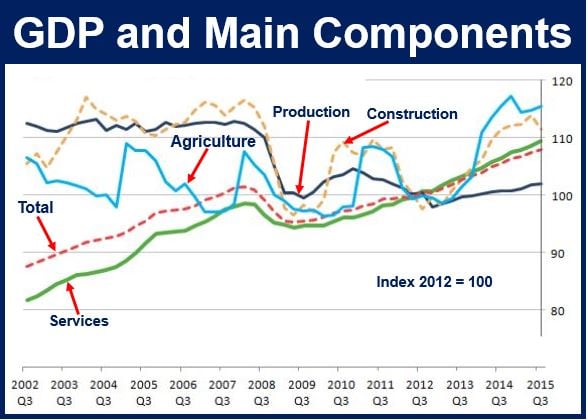 Image Source: Office for National Statistics
The services sector, which was the largest contributor to Q3 GDP growth, contributed 0.6 of a percentage point to the final figure.
The ONS estimated that GDP was 6.4% higher in Q3 2015 than in Q1 2008, the pre-crisis peak. From Q1 2008 to Q2 2009 the GDP shrank by -6.1%.
The BBC quoted Chris Williamson, chief economist at research firm Markit, who said:
“The slowdown is being led by the manufacturing sector, which is seeing a renewed recession as output has now fallen for three consecutive quarters, suffering a 0.3% decline in the three months to September. Manufacturing output has so far fallen 0.9% this year. Producers are struggling as weak demand in many overseas markets, notably China and other emerging nations, is being exacerbated by the appreciation of sterling.”
British economy since 2000
The British economy grew steadily during the 2000s until the global financial crisis hit in 2008/2009.
Towards the end of 2009, economic expansion resumed, but at a slower rate compared to the 2000 to 2008 period. This post-crisis growth was also erratic, with several quarters from 2010 to 2012 posting slow growth or contractions.
This erratic 2-year period coincided with a severe winter in Q4 2010, the Diamond Jubilee in Q2 2012, that the ONS believes ‘are likely to have affected growth’.
Since 2013, the economy has been growing steadily. In Q2 2015 GDP passed its pre-downturn peak.
