
According to the International Monetary Fund, the largest economy in the world today is China, while the United States, for the first time in nearly a century, is number two. However, economists say it depends on how you make the calculation.
The IMF recently stated that China goods and services production would reach $17.6 trillion, compared to the US’ $17.4 trillion.
According to MarketWatch, in the year 2000 the US economy was three times the size of China’s; that was just fourteen years ago.
The IMF argues that to accurately gauge a country’s GDP you have to convert everything into local currency and make adjustments, otherwise currency fluctuations make it impossible to know how big an economy really is.
The IMF’s argument goes along these lines. If Country A produces 100 cars a year and Country B also produces 100 cars per year, and that is all they produce, their economies are the same size. However, if Country A’s currency goes down 10% compared to Country B’s, but both continue producing exactly 100 cars per year each, is Country A’s economy now 10% smaller than B’s? The IMF says ‘No’, because they both continue producing the same amount.
Each nation reports its economic data in its local currency, says the IMF. To compare countries realistically, their statistics must be converted into a common currency. The problem is, there are so many ways to make that calculation and manage the conversion. And we all know that statistics can nearly always be manipulated to say whatever anybody wants.
One way to gauge a country’s economic strength is by using its PPP (purchasing power parity), which is the rate at which one country’s currency would need to be converted into another country’s to buy exactly the same list of goods and services.
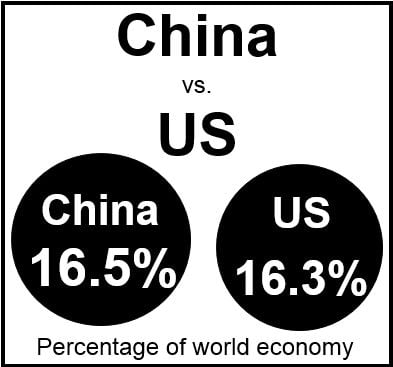
In PPP terms, the Chinese economy represents 16.5% of the world’s economy, versus 16.3% for the United States.
However, finding a realistic and accurate way of adjusting the currency and price variables between countries is extremely complicated. Many economists say it is impossible because everybody will use some degree of subjective interpretation.
On the other hand, you cannot ignore purchasing power. If a Chinese worker earns one quarter of his or her American counterpart, that does not mean he/she is 75%% poorer, because prices are much lower in China.
According to the IMF, it takes all the factors into account by measuring GDP in both PPP and market-exchange terms. As far as the PPP calculation is concerned, China has beaten the US for number one spot.
If you just use international exchange rate criterion, the US economy is nearly 70% bigger than China’s.
If China’s economy is only just bigger than the US’, but has more than four times the population, then GDP per head must be less than one quarter of the US level.
Would we use the same criterion when comparing companies? If Company A makes 100 cars and sells them at $20,000 each, while Company B makes 100 cars and sells them at $40,000 each, which one is bigger? Or are they both the same size? Most people would say Company B is bigger, wouldn’t they?
