
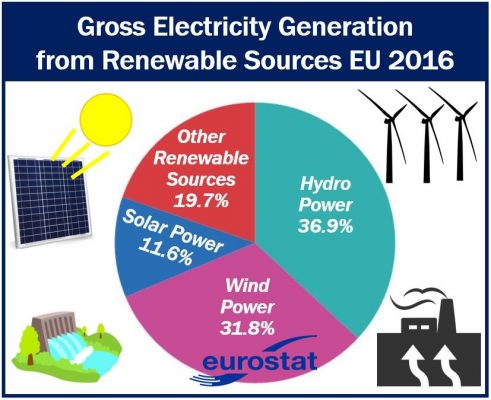
In 2016, thirty-percent of electricity that people and businesses in the European Union consumed came from renewable sources. According to Eurostat, the most important source was hydro power, followed closely by wind power. Solar power came in as the third largest contributor to total gross electricity consumption.
Eurostat is the European Union’s main provider of statistical information.
Hydro power or hydro energy captures the energy in flowing or falling water and converts it into electricity. We have used hydro power to grind grain for many centuries. We call the electricity that we generate from hydro power ‘hydroelectricity.’
A source that lasts forever
Electricity from renewable sources refers to electricity that comes from a source that lasts forever. In other words, that source never runs out – we can never use it up completely.
Electricity from renewable sources comes under the umbrella term ‘renewable energy.’ Renewable energy means energy of any kind that comes from sources that never run out. Renewable energy includes electricity and other types of energy.
Ethanol, for example, which we use for powering vehicles, is a type of renewable energy. We do not use ethanol, in the case of vehicle engines, to generate electricity.
Fossil fuels, on the other hand, are non-renewable sources. We will eventually run out of coal, oil, and gas.
Types of electricity from renewable sources
There are several types of electricity that we generate from sources that are renewable. Eurostat quotes solar power, wind power, biogas, wood, hydro power, and renewable waste. It also quotes geothermal energy.
Geothermal energy refers to using Earth’s inner heat to generate power. Solar power captures the energy from the sun and converts it into electricity, while wind power captures the energy in moving air, i.e., wind.
In five EU Member States, more than half of their electricity consumption in 2016 came from electricity from renewable sources. The five countries are:
– Austria 73%.
– Sweden 65%.
– Portugal and Denmark 54% each.
– Latvia 51%.
Contrastingly, in Malta (6%), Luxembourg (7%), Hungary (7%), and Cyprus (9%), the figure was lower than ten percent.
