

Germany’s central bank, the Bundesbank, reduced its growth forecast for the country’s economy for 2015 from 2% to 1%, despite factory orders jumping by 2.5% in October.
Following a strong start to the year, which was partly due to an abnormally mild winter, Germany’s economic growth lost momentum rapidly.
President of the Deutsche Bundesbank, Jens Weidmann, says he expects the current “sluggish phase” will be short-lived. He believes his country’s economy is in “remarkably good shape.”
Mr. Weidmann said:
“This (Germany is good shape) is not only benefiting the domestic economy but is also enabling German exporters to seize opportunities on foreign markets.”
He believes that such opportunities will increase again in 2015.
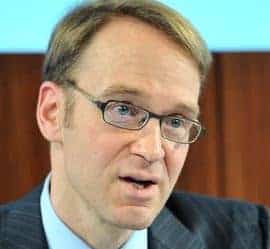
Mr. Weidmann says the German economy is in excellent shape.
According to the Bundesbank, German GDP should grow by 1.4% this year and 1% in 2015 (0.8% in calendar-adjusted terms), and then by 1.6% in 2016 (1.5% after calendar adjustment).
With the predicted economic growth at more than 1% annually, aggregate capacity utilization should thus remain within normal bounds across the entire forecast horizon, the central bank wrote.
The number of economically active people should continue growing. Bundesbank economists expect the government to post a small budget deficit in 2015, following stronger spending growth.
Thanks to the buoyant labor market and the new general minimum wage, wages should record a further marked increase.
Inflation is forecast to reach 0.9% in 2014, then 1.1% next year, and 1.8% in 2016. Excluding energy, prices are likely to rise by 2% in 2016.
Since the projection was finalized, crude oil prices have declined again considerably. They are now 11% below the assumptions underlying the forecast.
Mr. Weidmann said:
“A fall in the price of crude oil on this scale has the effect of a small stimulus package in that it reduces both households’ cost of living and companies’ production costs. If crude oil prices remain at this subdued level for an extended period of time, economic growth in 2015 and 2016 could turn out to be between 0.1 and 0.2 percentage point higher in each case.”
