
Google has assured the US Federal Communications Commission (FCC) that its plan to carry out airborne wireless tests, believed to be related to its “Project Loon”, will not pose a threat to anyone.
The company’s plan has raised concerns that it may emit radiation which could harm animals, plants, and humans. In addition, some companies have expressed concerns about possible interference with their own wireless operations.
In a letter to the FCC Google said: “Some commenting parties worry that the radio-frequency (RF) energy from Google’s proposed testing could harm humans, animals, or plants in the vicinity of the test operations,”
According to Google, the RF exposure from its proposed plan is ‘vastly’ less than other transmissions the FCC has authorized in the past.
“The proposed experimental operations in fact present vastly less risk from RF exposure than other transmissions the Commission routinely authorizes. Thus, although we respect that the commenters’ concerns are genuinely held, there is no factual basis for them,” Google wrote in the filing.”
“Even if an airborne transmitter were aimed precisely at a person on the ground directly below it, the signal strength received on the ground would be millions of times weaker than FCC limits,”
Google is asking the FCC for a license to conduct airborne wireless tests across all 50 states and Puerto Rico.
About Project Loon
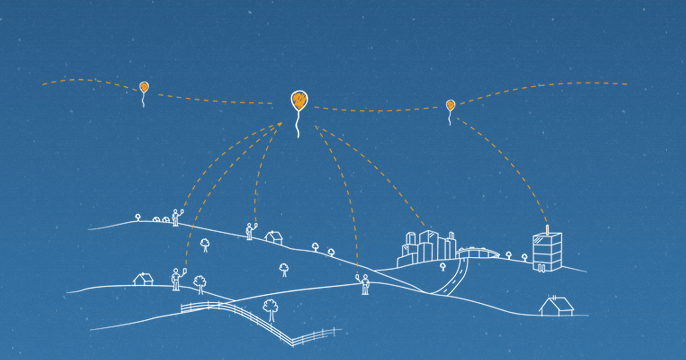
Google’s plans to test experimental radios appears to be related to its ongoing ‘Project Loon’. Project Loon, which is being developed by Google X, aims to produce Internet access to rural and remote areas. This will be achieved by using high-altitude balloons placed in the stratosphere at an altitude of about 18 km (11 mi) to create an aerial wireless network with up to 4G-LTE speeds.
Project Loon began in June 2013 with an experimental pilot in New Zealand, where a small group of Project Loon pioneers tested Loon technology. According to Google, “Project Loon will continue to expand the pilot, with the goal of establishing a ring of uninterrupted connectivity at latitudes in the Southern Hemisphere, so that pilot testers in these latitudes can receive continuous service via balloon-powered Internet.”
