
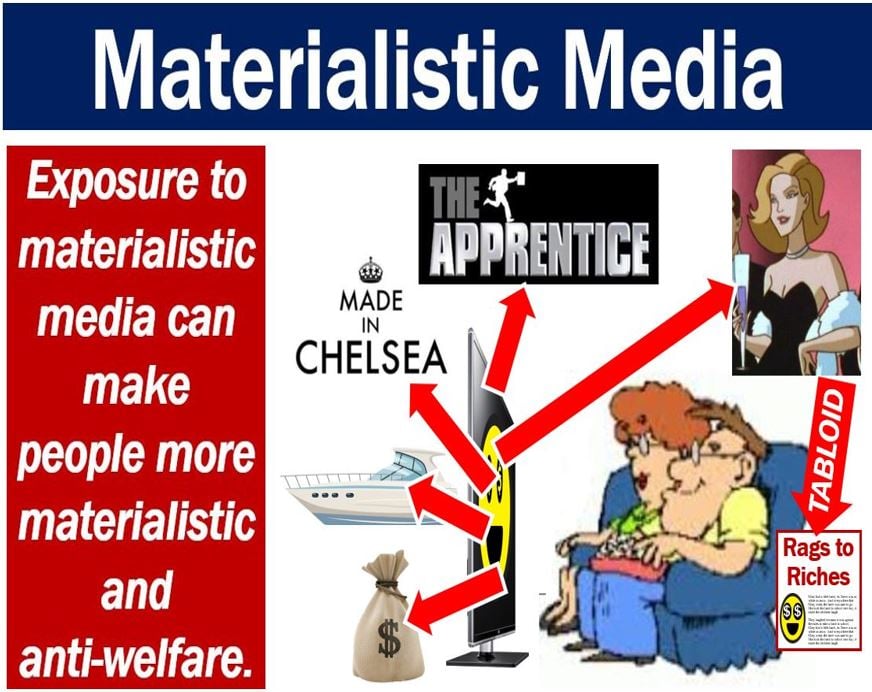
Materialistic media exposure makes us less sympathetic to the plight of people who live in poverty. It also makes us more materialistic and anti-welfare. Even one minute of exposure to materialistic media has an effect on most people. The effect is particularly strong for those who regularly watch TV shows that glamorize fame and wealth.
If you regularly watch shows that glamorize fame, wealth accumulation, and luxury, you may become more in favor of welfare cuts. Regular viewers of TV shows like Made in Chelsea are potentially more likely to favor punitive cuts to welfare payments. This is what a researcher at the London School of Economics (LSE) has found.
In this context, ‘welfare‘ refers to government financial assistance for vulnerable, poor, or disadvantaged people.
Dr. Rodolfo Leyva wrote about his study and findings in the academic journal Media Psychology (citation below). Dr. Leyva is an LSE Fellow at the Department of Media and Communications.
Materialistic media exposure study – 487 participants
Dr. Leyva studied the responses of 487 Britons aged 18 to 49. They took part in a randomized-control web-survey experiment. The organizers made the experiment look like an attention and memory test.
There were two groups: 1. The treatment group. They saw lots of materialistic media during the study. 2. The control group. They did not view materialist media during the study. In any experiment, trial, or study, the control group is the one that carries on as normal.
Treatment group
The treatment group saw four adverts of luxury goods and four tabloid pictures of famous celebrities showing off expensive products. They also saw four rags-to-riches newspaper headlines.
Control group
The control group, on the other hand, saw adverts about the London underground and pictures of natural scenery. They also saw newspaper headlines about prehistoric dinosaurs. In other words, the organizers exposed the control group to neutral stimuli.
The members of both groups saw each of their twelve images for five seconds. Therefore, their total exposure was 12 x 5 = 60 seconds.
The members of each group subsequently answered questions that measured their attitudes towards success and wealth. Their answers also revealed what their attitudes were towards poor people and government benefits.
The participants also had to give their opinions on the government enactment of public policies. According to the paper, these policies “were modeled after actual UK government tax cuts, austerity measures, and welfare reforms that according to extensive policy research, have had detrimental effects on welfare institutions and beneficiaries.”
Momentary exposure to materialistic media
The results showed what effect the momentary exposure to materialistic media had on the participants. It fueled their anti-welfare attitudes and also their support for anti-welfare policies.
The study results showed that just one sixty-second exposure to materialistic media messages increased anti-welfare sentiments.
TV watching habits
Additionally, the participants had to say how often they watched nine TV shows, including X-Factor, Keeping Up with the Kardashians, Made in Chelsea, and The Apprentice.
Tabloid reading habits
They gave information on their reading habits, particularly how often they read five daily tabloids. These tabloids regularly feature stories of rich celebrities who have expensive clothes, cars, and homes.
Magazine reading habits
They had to say whether they read any of ten magazines such as GQ, Esquire, Cosmopolitan, and Vogue. In other words, how often they read magazines that advertised luxury goods.
Materialistic media exposure – anti-welfare attitudes
The author found that those who also regularly watched shows such as X-Factor and The Apprentice were more anti-welfare.
Regular viewers of these shows tended to hold stronger anti-welfare and materialistic attitudes compared to the other participants.
Dr. Leyva wrote:
“In advanced market societies, cultural representations and endorsements of materialism, such as the promotion and glorification of fame, fortune, and conspicuous consumption, are particularly endemic in and promulgated by commercial media.”
“Indeed, the ubiquity of materialistic media messages (MMMs) is beneficial if not critical to the gross domestic product growth of contemporary capitalist economies, given that this ubiquity helps stimulate consumption.”
“Yet irrespective of the positive economic contributions of MMMs, frequent exposure to them is being increasingly connected to several troubling trends and adverse effects.”
“For example, UK psychology studies have found that internalising the media-culture ideals of materialism increases body dissatisfaction in women and decreases well-being in children. In a similar vein, US media studies show that heavy consumption of MMMs is related to increased levels of stress, life dissatisfaction, and anxiety.”
The results suggest that momentary exposure to materialistic media messages induces stronger anti-welfare and materialism attitudes, the author explained.
Shows such as The Apprentice are full of materialistic media messages. These messages are engineered to absorb viewers into the glamorous world of wealth. And also into the world of celebrities. They, therefore, have a strong potential to cultivate materialistic attitudes and values.
Sympathy for less fortunate people in UK declining
Dr. Leyva wrote:
“Humans are inherently materialistic but also very social and communal. The way this is expressed depends on our culture. If there is more emphasis on materialism as a way to be happy, this makes us more inclined to be selfish and anti-social, and therefore unsympathetic to people less fortunate.”
“This study can contribute to explanations for why the UK public’s support for welfare to aid the impoverished and unemployed has been decreasing during a time of rapidly growing wealth disparities, living costs, and rates of precarious and underemployment.”
Citation
‘Experimental insights into the socio-cognitive effects of viewing materialistic media messages on welfare support,’ Rodolfo Leyva. Media Psychology 2018. DOI: https://doi.org/10.1080/15213269.2018.1484769.
