
A mega supermoon – a once in a lifetime occasion – will appear in our night sky on 14th November. The Moon only ever gets this massive once every 68 years. The last one observed in the British night sky was in 1948.
Normal supermoons are fairly common. In fact, during the last quarter of 2016 there is one each month. However, the one we will be able to see on the 14th is much rarer.
On the 14th of this month (at the time of writing ‘tomorrow’), the Moon will appear fourteen percent larger and 30% brighter than normal. It will, in fact, still be the same size. The reason it looks bigger is because it will be much closer to the Earth’s surface.
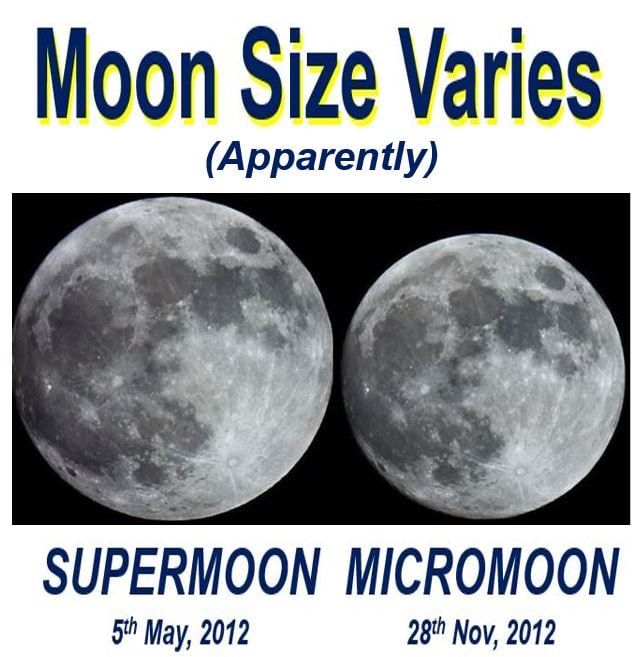 On 5th May, the Moon was 50,000 km closer to the Earth’s surface than on 28th November. That is why it was a Supermoon on the left and a Micromoon on the right. (Image: adapted from picture on apod.nasa.gov)
14th November – a super supermoon
Nasa says the term supermoon initially referred to a full or new Moon when our satellite was within ninety percent of its closest approach to our planet in a given orbit. These days, it refers more broadly to a full Moon which is closer than average to the Earth.
On 14th November, the Moon will be the closest to Earth so far this century. It won’t be so near to Earth and seem as large again until 25th November, 2034.
Richard Nolle, an astrologer, coined the term ‘supermoon’ in 1797. He arbitrarily defined it as:
“A new or full Moon which occurs with the Moon at or near (within 90% of) its closest approach to Earth in a given orbit (perigee). In short, Earth, Moon and Sun are all in a line, with Moon in its nearest approach to Earth.”
So – what is a supermoon?
A supermoon is a new or full Moon that is as close to our planet as it can be on its elliptical orbit. This makes us perceive it as much brighter and bigger than normal. Scientifically, it is called the Perigee-Syzygy of the Earth-Moon-Sun System.
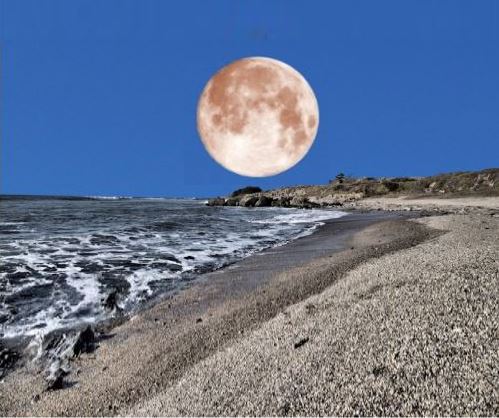 When it is close to the horizon, the Moon looks larger. It is still the same size, but we compare it to objects we know, which makes it seem bigger. This is known as Moon Illusion. (Image: eyeforlife.com)
Because of its elliptical orbit (an oval orbit, not a circular one), the Moon’s distance from the Earth’s surface varies, from 357,000 km (222,000 miles) to 406,000 (252,000 miles). The word ‘elliptical’ means egg-shaped (oval).
Naded eye and mega supermoon
Although the full Moon on 14th November appears considerably larger and brighter than normal, in most cases people won’t notice the difference with the naked eye, unless they know about the event and are watching it very carefully – even then, they might not notice anything.
According to Richard Talcott, writing in Astronomy Magazine, the casual glancer will probably see a normal Moon.
The Moon’s apparent diameter will be 33.5 arcminutes (0.56°), i.e. 7% larger than it usually is. It will also be brighter.
However, as far as the naked eye of a human is concerned, these differences are barely noticeable, even under the best conditions.
When the Moon is close to the horizon it always looks much larger than when it is high up in the night sky. That is because when it is near the horizon, we compare it with familiar objects.
When to see the supermoon in UK
The moon will become full in the UK at 13:52 GMT on Monday, 14th November. Therefore, the best time to look at it in the British sky will be when the Sun is setting in the late afternoon. The nearer to the horizon it is, the larger it will seem.
Find somewhere with the least light pollution. You will not need a telescope (weather permitting). If you don’t get a chance on the 14th, try again on the 15th – however, it will be slightly smaller.
Video – Rare Supermoon
In this video, Noah Petro, Deputy Project Scientist for Lunar Reconnaisance Orbiter, at NASA’s Goddard Space Flight Center, explains what a supermoon is.
