
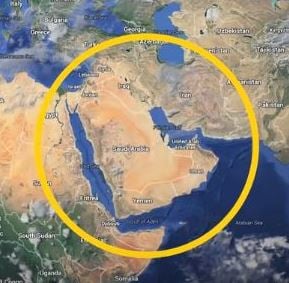
By the end of this century, parts of the Persian Gulf region may experience unparalleled events of deadly heat due to climate change, say researchers from the Massachusetts Institute of Technology (MIT) and Loyola Marymount University, who carried out a study of high-resolution climate models.
The study findings, which were published in the journal Nature Climate Change, show that this will occur if greenhouse gas emissions continue unabated. However, if we take measures now, the region could be saved.
Prof. Elfatih Eltahir from MIT, and Jeremy Pal PhD ’01 at Loyola Marymount University, wrote that given its shallow water and intense sun, the Persian Gulf region is “a specific regional hotspot where climate change, in absence of significant mitigation, is likely to severely impact human habitability in the future.”
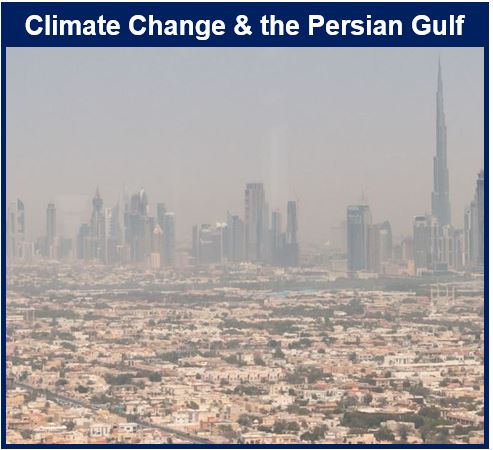 Intolerable heat in the Persian Gulf may make many parts of the region uninhabitable. (Image: Loyola Marymount University)
Too hot for humans, even in the shade
After running high-resolution versions of standard climate models, the scientists found that several major cities in the region could become too hot for human life, even in well-ventilated and shaded spaces.
Eltahir said that as far as he knew, this threshold has “never been reported for any location on Earth.”
The tipping point involves the ‘wet-bulb temperature’, a measurement that combines humidity and temperature, which reflects conditions the human body could maintain without artificially lowering the ambient temperature.
That threshold for human survival exceeding six unprotected hours is 35 degrees Celsius (95 degrees Fahrenheit), the research showed. This is the equivalent of a National Weather Service ‘heat index’ of about 165 F.
Close to the threshold already
In the summer of this year, during a weeklong heat wave in the Persian Gulf, this limit was almost reached. In Bandahr Mashrahr, Iran, the wet-bulb temperature was nearly reached for about an hour.
The serious danger to human health and life occurs when these temperature persist for several hours, the authors explain. According to the models, this will become quite common during the last three decades of this century if no measures are taken to reduce greenhouse gas emissions.
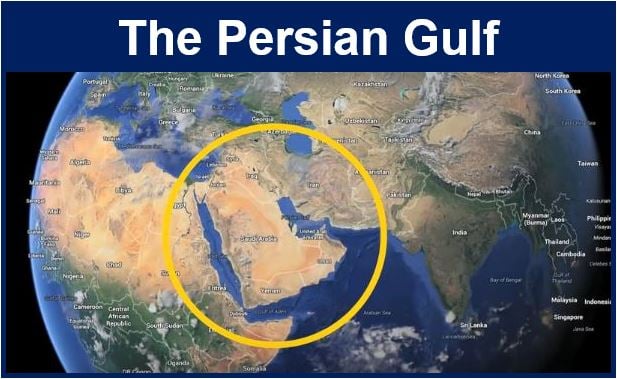 The Persian Gulf, also known as the Arabian Gulf, lies between Iran to the northeast and the Arabian Peninsula to the southwest.
The Persian Gulf region is especially vulnerable to extreme heat, the scientists say, because of a combination of clear sky, a water body that increases heat absorption, low elevations, and very shallow sea. The combination produces high water temperature, which leads to strong evaporation and very high humidity levels.
Several major cities, such as Bandar Abbas (Iran), Doha (Qatar), Abu Dhabi and Dubai (United Arad Emirates) could exceed the 35 C threshold frequently over a period of thirty years.
In addition, Eltahir says the hot summer conditions that currently occur about once every 20 days “will characterize the usual summer day in the future.”
Even on the other side of the Arabian Peninsula, next to the Red Sea, where less extreme heat is forecast, projections show that wet-bulb temperatures of 32 to 34 C are likely there – these are also dangerous for human health.
The annual Hajj, the Islamic pilgrimage to Mecca, when up to 2 million pilgrims stand outdoors all day praying, sometimes falls during these hot months.
Some of the richer nations in the area might find ways to adapt to new climate extremes, but poorer countries like Yemen will find it extremely difficult, the authors say.
Citation: “Future temperature in southwest Asia projected to exceed a threshold for human adaptability,” Jeremy S. Pal & Elfatih A. B. Eltahir. Nature Climate Change. October 26, 2015. DOI: 10.1038/nclimate2833.
