
Leaders are much more willing to take responsibility for making decisions, especially those that affect other people’s welfare. What determines whether somebody has leadership qualities? What makes somebody decide to delegate decision-making?
A team of researchers from the University of Zurich identified the neurobiological and cognitive processes that influence decision-making. Specifically, those that determine whether or not we become leaders.
Micah Edelson and colleagues wrote about their study and findings in the journal Science (citation below). Edelson, a Post-Doc researcher, works at the University of Zurich’s Department of Economics.
The other authors, Rafael Polania, Christian C. Ruff, Ernst Fehr, and Todd A. Hare, also work at the University of Zurich.
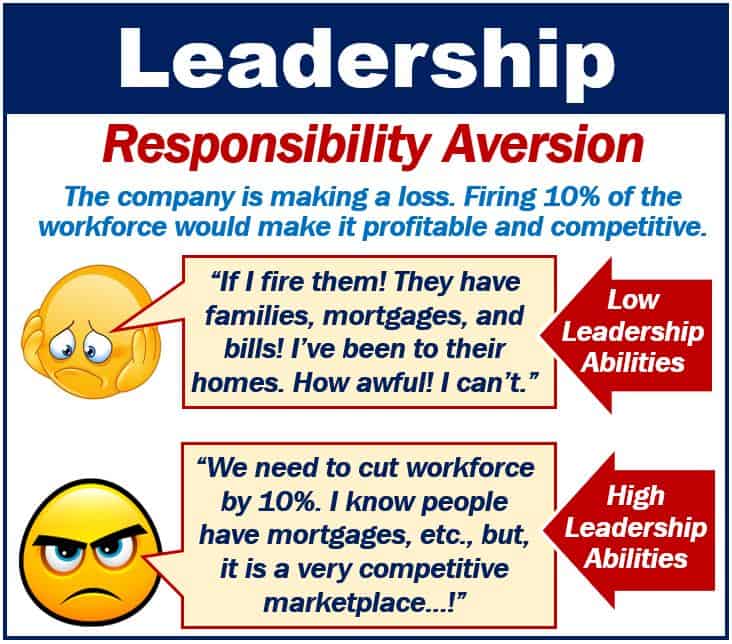
Leadership – decisions that affect others
Heads of state, teachers, and parents all have something in common. Army generals and company bosses also have this same thing in common. We all have to make decisions that affect not just ourselves but also other people.
Such questions as ‘Which school should I send my child to?’ or ‘Should we attack now?’ affect other people. A company boss, for example, may have to decide whether to reduce the size of the firm’s workforce.
Some decisions only affect one or two people. Other decisions, on the other hand, may affect whole companies, organizations, and even nations.
A manager’s decisions usually affect fewer people than, for example, a CEO’s. CEO stands for Chief Executive Officer. Management and leadership are not the same; the two are quite different.
Lack of leadership – responsibility aversion
First of all, the researchers tried to determine what it is that sets those with leadership abilities apart. What makes one person a leader and another a follower?
Non-leaders have ‘responsibility aversion.’ In other words, they are reluctant to make decisions that might also affect other people.
Experiment – decide or delegate
In this study, group leaders had two choices. They could either make a decision themselves or delegate it to the group members.
There were ‘self-trials‘ and ‘group-trials.’ Self-trials represented decisions that only affected the decision-maker. Group-trials, on the other hand, also affected the whole group.
The researchers used fMRI or functional magnetic resonance imaging to monitor the participants’ neurological processes. While an MRI just takes a picture of, for example, the inside of the brain, fMRI tracks blood flow. Imagine that MRI is a still photo and fMRI is a video.
Leadership qualities and desire for certainty
The researchers tested many common intuitive beliefs. For example, they tested the notion that people who are less afraid of taking risks are more likely to accept responsibility for others. Does the same also apply to those who like being in control or are less afraid of losses?
These features, however, could not explain why some participants had responsibility aversion while others didn’t.
They did find that those who wanted more certainty about the best course of action had greater responsibility aversion. Specifically, those wanting a greater degree of certainty when a decision would also affect others.
The stronger somebody’s aversion to responsibility was, the greater was their need for certainty, the authors reported.
Leadership types – theoretical concept
Dr. Edelson, who was also lead author, said:
“Because this framework highlights the change in the amount of certainty required to make a decision and not the individual’s general tendency for assuming control, it can account for many different leadership types.”
“These can include authoritarian leaders who make most decisions themselves and egalitarian leaders who frequently seek a group consensus.”
In an Abstract preceding the full article in the journal, the authors wrote the following regarding their results:
“These results suggest that many people associate a psychological cost with assuming responsibility for others’ outcomes.”
“Individual differences in the perception of, and willingness to bear, responsibility as the price of leadership may determine who will strive toward leadership roles and, moreover, are associated with how well they perform as leaders.”
Citation
Micah G. Edelson, Rafael Polania, Christian C. Ruff, Ernst Fehr, and Todd A. Hare. Computational and neurobiological foundations of leadership decisions. Science: August 2, 2018. DOI: 10.1126/science.aat0036.
