
Researchers in Finland have developed a new way to turn fungal material grown in fermentation tanks into flexible, leather-like sheets.
The method could make mycelium-based fabrics easier to manufacture in larger quantities. However, the material still needs improvements before it can match the full durability of leather used in handbags, shoes and furniture.
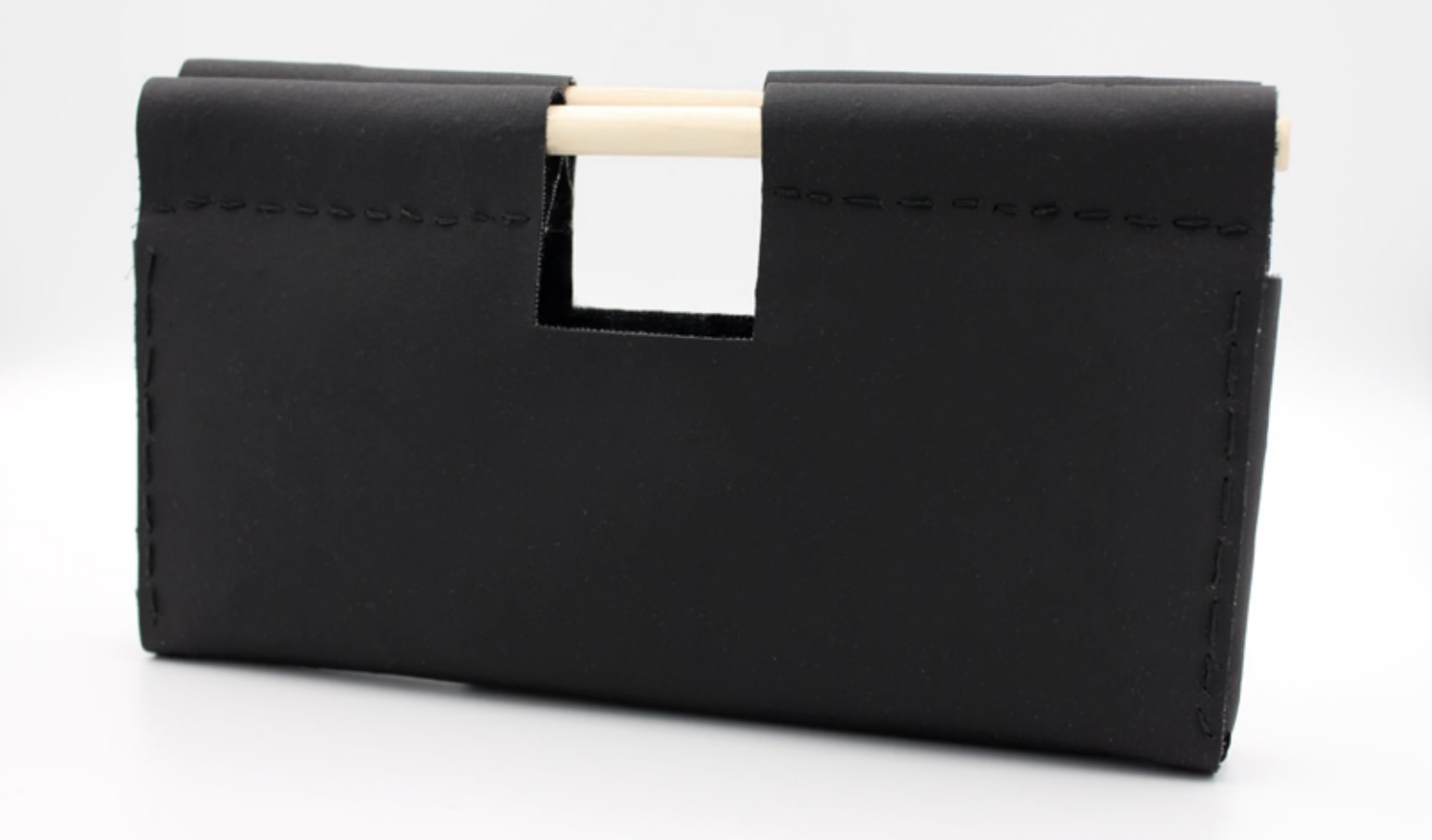
The researchers demonstrated the concept in two ways: they produced a continuous eight-meter sheet and, separately, used cotton-backed mycelium material to make a prototype handbag.
The peer-reviewed study was published in ACS Applied Bio Materials. The research team was based at VTT Technical Research Centre of Finland.
What is mycelium?
Mycelium is the thread-like network that forms the main growing body of a fungus. It is sometimes loosely described as a fungal root system, although fungi do not have true roots.
These microscopic threads can join together to form dense networks. That structure has made mycelium an attractive starting material for packaging, insulation and leather-like fabrics.
Many existing production methods allow fungi to grow across trays until the mycelium forms a complete sheet. This can work well for small batches, but expanding production can require more trays, more space and careful control of the growing conditions.
Growing fungal material in tanks
The Finnish team took a different approach. They grew a filamentous fungus called Trichoderma reesei in nutrient-rich liquid inside bioreactors.
This process, known as submerged fermentation, uses tanks similar to those already found in brewing and biotechnology. Rather than growing into a finished sheet, the fungus develops into a thick, pulp-like material that can be collected and processed.
The researchers washed the fungal pulp and mixed it with other ingredients. These included sorbitol, which helped make the finished material more flexible, and extremely fine plant-derived cellulose fibers, which improved its strength.
The mixture was then spread into thin layers and dried, creating a nonwoven fabric. Nonwoven means the material is formed without spinning the fibers into thread and weaving them together.
Because the material begins as a pulp, manufacturers could potentially adjust its ingredients, thickness, color and surface texture before it is dried.
Strong, but not yet equal to leather
The strongest formulations produced in the study reached tensile strengths of approximately 11 to 19 megapascals. Tensile strength measures how much pulling force a material can withstand before breaking.
Those results overlap with strength values reported for some types of conventional leather. However, this does not mean the fungal material performed like leather in every important way.
The sheets stretched by only around 9% to 10% before breaking. Products such as shoes, bags and upholstery must also withstand repeated bending, rubbing, tearing and years of everyday use.
The researchers identified tear resistance as one of the main properties that still needs to be improved. The study also did not establish the material’s long-term abrasion resistance or durability in finished consumer products.
A continuous eight-meter sheet
One of the most important parts of the research was a meter-scale continuous production trial.
The team used a roller-based system to spread the fungal mixture onto a moving plastic support. The process produced sheets approximately 22 centimeters wide and eight meters long.
This was an early demonstration of how the material could eventually be made using established continuous film-casting equipment.
It was not a complete commercial manufacturing line. The trial revealed practical problems that will need to be solved, including water separating from the mixture and uneven movement of the plasticizer toward the edges of the sheet.
Drying, winding, production consistency and operating costs would also need to be addressed before the process could be used for large-scale commercial manufacturing.
What the biodegradation tests found
The researchers also tested how selected samples behaved under controlled laboratory conditions.
In a controlled aquatic laboratory test, milled samples from a sheet made with 80% mycelium and 20% sorbitol reached 77% biodegradation after 28 days.
In a separate industrial composting experiment, samples physically disintegrated within approximately six weeks. They showed complete weight loss after six months.
These findings are promising, but they need to be interpreted carefully. The composting experiment measured the disappearance and physical disintegration of the material. It did not directly prove that every part had been completely converted into carbon dioxide, water and biological matter.
The tests were also conducted on selected material samples. They did not establish that every possible formulation or finished product would break down in the same way.
In particular, the researchers did not test the complete prototype handbag for biodegradation. The bag used fungal material reinforced with cotton fabric, meaning its construction differed from the simpler samples used in some of the laboratory tests.
Industrial composting also uses controlled heat and moisture. The results do not show how quickly the material would break down in a home compost pile, landfill or natural environment.
A handbag demonstrates the concept
The researchers showed that the fungal material could be colored, textured and combined with other fabrics.
They produced sheets in several colors and cast the mixture against patterned surfaces to create embossed finishes. They also added a woven cotton backing to make the material more resistant to tearing during handling.
The reinforced fabric was then cut and sewn into a prototype handbag.
The bag demonstrates that the material can be handled and assembled into a recognizable product. It should not be seen as proof that the fabric is ready for everyday commercial use, since the finished bag was not put through long-term wear, abrasion or consumer durability testing.
Why the research matters
Many experimental biomaterials can be produced successfully in a laboratory but become difficult or expensive to manufacture in larger quantities.
This study addresses that problem by combining two established ideas: growing microorganisms in fermentation tanks and forming sheet materials with continuous coating equipment.
“Many people are looking for alternatives to fossil fuel-based and animal-derived materials, yet scalable alternatives remain limited,” study co-author Manuel Arias-Barrantes said in an American Chemical Society release. “Our work has solved one significant bottleneck, enabling large-scale production of affordable mycelium-based fabrics.”
The results suggest that bioreactor-grown mycelium could provide a practical starting point for future leather-like fabrics. The study does not yet show that the process will be cheaper or environmentally superior to existing materials.
A full assessment would need to examine energy use, water consumption, emissions, production costs, product lifespan and end-of-life treatment. The research did not include a complete life-cycle or commercial cost analysis.
For now, the work represents an important manufacturing proof of concept. It shows that fungal pulp can be formed into meter-scale continuous sheets and made into a prototype product. Whether it can become a commercially competitive alternative will depend on improving tear resistance, durability, drying, consistency and production economics.
Cover image credit: Ahokas et al., ACS Applied Bio Materials, 2026, CC BY 4.0
