
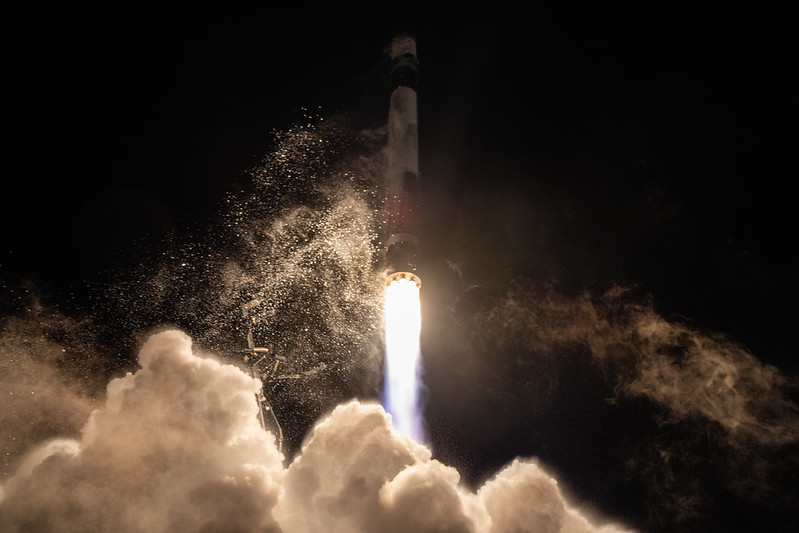
Rocket Lab reported record second-quarter revenue of $234.1 million, up 62% from $144.5 million a year earlier, as product sales almost doubled. Its backlog was 137% higher than a year earlier at a record $2.36 billion, although the space company remained unprofitable.
The net loss narrowed to $49.3 million, or $0.08 per share, from $66.4 million, or $0.13 per share, in the second quarter of 2025.
Rocket Lab’s adjusted loss before interest, taxes, depreciation and amortisation fell to $8.8 million from $27.6 million. Adjusted EBITDA excludes several expenses and other items and is not calculated under generally accepted accounting principles.
Founder and Chief Executive Sir Peter Beck said demand had increased across the company’s launch and space systems businesses. Revenue was approximately $34 million higher than the previous quarterly record set during the first three months of 2026.
Product sales drive revenue growth
Product revenue increased to $181.3 million from $92.7 million a year earlier, accounting for most of the company’s growth. Service revenue edged up to $52.7 million from $51.8 million.
Gross profit rose to $84.6 million from $46.4 million. That represented a gross margin of about 36%, compared with approximately 32% in the corresponding quarter last year.
Operating expenses also increased. Research and development spending climbed to $82.4 million from $66.1 million, while selling, general and administrative expenses rose to $59.7 million from $39.9 million.
Rocket Lab posted an operating loss of $57.5 million, slightly smaller than the $59.6 million loss recorded a year earlier.
Launch backlog reaches a record
The company said it secured more than $437 million in new launch contracts during the quarter and after the reporting period, including contract options. Its launch backlog now covers more than 90 missions across the Electron, HASTE and Neutron vehicles.
Rocket Lab also said contracts signed since the end of June had taken new third-quarter orders across launch and space systems above $1 billion. That figure includes options that customers may exercise under existing contracts.
Government work forms a substantial part of the pipeline. The company received a contract with a total potential value of $397 million, including options, to develop, launch and operate multiple Flatellite spacecraft for the US Space Force’s Space-Based Airborne Moving Target Indicator programme.
Rocket Lab also secured contracts worth more than $160 million to build three geostationary satellites, including two spacecraft for the Space Force. A geostationary satellite travels in a circular orbit above the equator once per rotation of Earth, making it appear fixed over one location.
Neutron adds first dedicated Kepler mission
Rocket Lab is assembling and testing hardware for Neutron, its reusable medium-lift rocket. The company said production of the first Stage 1 tank remained aligned with delivery to its Virginia launch pad during the fourth quarter of 2026.
This is a target for hardware delivery, not a confirmed date for Neutron’s first flight.
Rocket Lab also announced a dedicated Neutron mission for Kepler Communications. The flight is scheduled no earlier than 2028 and will carry several satellites into low Earth orbit.
Kepler used shared launches to deploy its first 33 satellites. The Neutron contract is its first dedicated mission on a commercial launch vehicle, giving the Canadian company more control over the timing and orbit of the deployment.
GHOST expands Rocket Lab’s launch network
Rocket Lab introduced GHOST, short for Global Hypersonic and Orbital Spaceport Technology, alongside its quarterly results.
The GHOST system packages complete rockets, launch equipment, ground systems and range-control technology inside standard shipping containers. It is designed to let Rocket Lab deploy Electron and HASTE launch equipment to additional locations.
Its first site, named Launch Complex 4, will have two launch pads at the Pacific Spaceport Complex in Kodiak, Alaska. Rocket Lab expects the system to make its operational debut with a suborbital flight in 2027. The new pads would increase its network to six across Alaska, Virginia and New Zealand.
Acquisitions broaden Rocket Lab’s business
During the quarter, Rocket Lab completed its acquisitions of laser communications company Mynaric and space robotics specialist Motiv Space Systems. Motiv has since been renamed Rocket Lab Robotics.
Rocket Lab also announced an agreement to acquire Iridium Communications. The proposed transaction would add an operational satellite communications network and subscriber revenue to Rocket Lab’s launch, satellite manufacturing and spacecraft component businesses.
The Iridium deal remains subject to shareholder and regulatory approvals. Rocket Lab and Iridium expect it to close in 2027 if the required conditions are met.
Rocket Lab has also established Rocket Lab Germany GmbH. The company is examining whether to manufacture satellites, payloads and spacecraft components in Germany, building on Mynaric’s existing operations in Munich. It has not announced a factory or production timetable.
Rocket Lab forecasts another record quarter
Rocket Lab expects third-quarter revenue of between $250 million and $265 million. At the midpoint, that would be about 10% higher than the second-quarter result.
The company forecasts a GAAP gross margin of 29% to 31%, below the approximately 36% recorded in the second quarter. It also expects an adjusted EBITDA loss of $17 million to $23 million, wider than the $8.8 million adjusted loss just reported.
Rocket Lab expects GAAP operating expenses of $143 million to $149 million and stock-based compensation of $18 million to $20 million.
The company’s immediate test will be converting its record backlog into revenue while funding Neutron, integrating its recent acquisitions and working towards completion of the proposed Iridium transaction.
Source: Rocket Lab’s second-quarter 2026 results, published August 10, 2026.
