
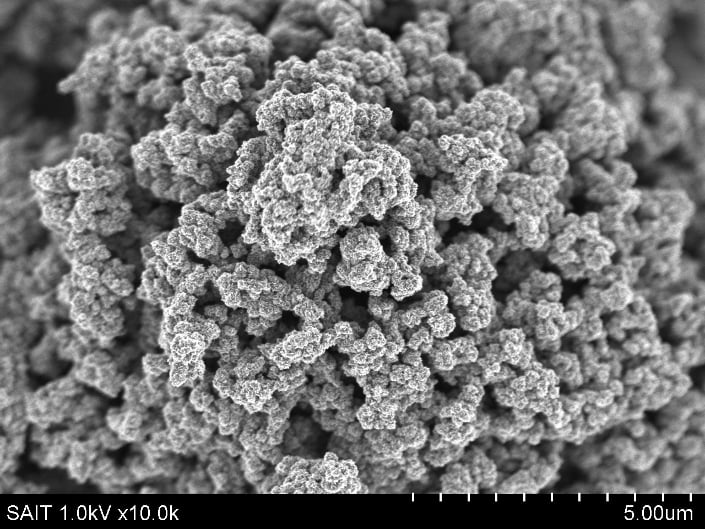
Incorporating “graphene balls” into lithium ion batteries could increase their charging speed by five times and their storage capacity by 45 percent, according to new research.
Should the success in the lab translate to the market, it would be a significant step toward a new generation of higher performing batteries that is much sought by developers of electric vehicles and mobile technology.
The graphene balls, which look like popcorn under a very powerful microscope, are the creation of a team that includes researchers from the Samsung Advanced Institute of Technology (SAIT) in the Republic of Korea.
In a recently published scientific paper, they describe how they combined graphene with affordable silica in a unique way to create the new material.
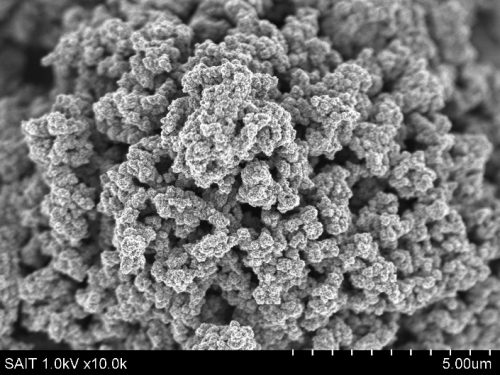 The graphene balls look like popcorn under a powerful microscope. Image: SAIT
Dr. In Hyuk Son, the SAIT team leader on the project, explains that an important result of their research is that it should enable the “multifunctional composite material graphene” to be mass-produced “at an affordable price.”
“At the same time,” he notes, “we were able to considerably enhance the capabilities of lithium-ion batteries in an environment where the markets for mobile devices and electric vehicles is growing rapidly.”
Graphene the ‘wonder material’
Graphene is an incredibly strong material made of a very thin layer of hexagonally-arranged carbon that is only one atom thick.
It has been described as “wonder material” because it has some extraordinary properties and offers “unlimited potential for integration in almost any industry.”
Among graphene’s unusual properties are the fact that it is extremely strong, it conducts electricity and heat, and absorbs light in an unusual way. It also readily combines with other elements to produce materials with unusual features.
As well as investigating its potential use in batteries, scientists and engineers worldwide are also looking to use graphene in many other areas, including one called “spintronics” that promises to make computers 1,000 times faster.
Improving lithium-ion batteries
Since they first became commercially available in 1991, lithium ion batteries have found their way into a wide range of devices, particularly where light weight, high energy density, and ability to recharge are important, such as mobile technology and electric vehicles.
However, there is pressure on the technology to improve the performance of lithium ion batteries – particularly for use in electric vehicles.
But, as the researchers explain, improving the performance of lithium ion batteries means “overcoming the trade-off” among key properties.
As far as electric vehicles are concerned, the key properties are: charging time; energy density (which impacts driving range); and safety (for instance, maintaining stable temperatures). It is “usually nontrivial to improve one property without sacrificing others,” they note.
Significant reduction in charging time
Graphene is a very interesting material for fast charging because, for instance, it is around 100 times more effective than copper at conducting electricity and it also allows electrons to travel through it some 140 times faster than they can in silicon.
Even with current fast-charging technology, conventional lithium ion batteries take around 1 hour to charge fully.
In the new study, the team found that incorporating graphene balls in the anode and cathode of lithium ion batteries resulted in vastly reduced charging time, increased charging capacity, and stable temperatures.
They found that “in theory,” lithium ion batteries incorporating graphene balls should be able to recharge fully in 12 minutes, increase capacity by 45 percent, and maintain a stable temperature of 60 degrees Celsius, which is key for electric vehicles.
SAIT have filed patent applications for the graphene balls technology both in the US and in Korea.
