

T-Mobile bogus charges to the tune of hundreds of millions of dollars were sent to customers, the Federal Trade Commission (FTC) says, according to a lawsuit filed last week. The FTC says T-Mobile has earned millions of dollars from third-party merchants offering non-existent “premium” SMS subscriptions for celebrity gossip, horoscopes, tips and flirting.
Many of those charges, allegedly hidden on customer’s phone bills, had not been authorized by them. This is known as “cramming”, i.e. the addition of unauthorized or unexpected charges to a mobile telephone service bill.
Charges concealed in the bill
According to the complaint, T-Mobile’s billing practices made it hard for customers to detect that they were being charged for the premium bogus service, and “much less by whom. When consumers viewed a summary of their T-Mobile bill online, according to the complaint, it did not show consumers that they were being charged by a third party, or that the charge was part of a recurring subscription.”
The charges were listed as “Premium Services” and could only be checked after clicking on a “Use Charges” heading. Even then, after clicking on the heading, customers were still not able to see the individual charges.
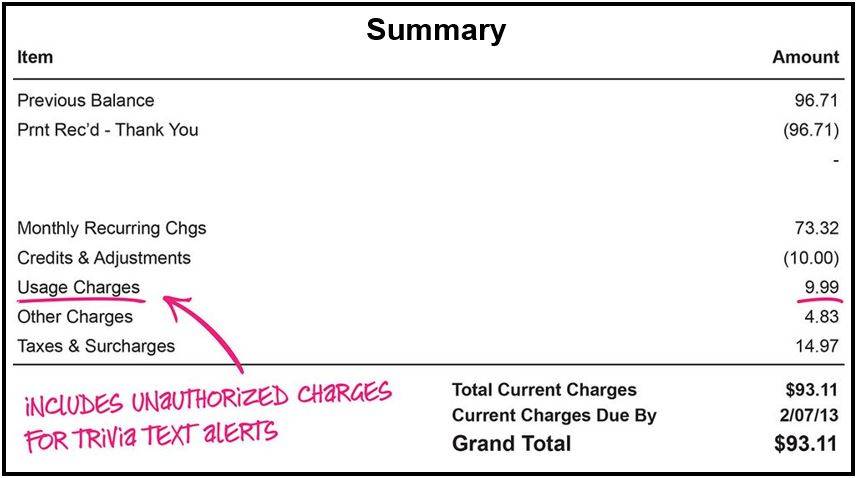
(Source: Federal Trade Commission)
T-Mobile bills can be more than 50 to over 100 pages long, says the FTC, making it virtually impossible for people to find or understand 3rd-party subscription charges.
Those who finally managed to see a breakdown of those “Premium” charges, would then need to be decoding professionals, because they would be listed in an abbreviated form, such as – 8888906150BrnStorm23918 – “that did not explain that the charge was for a recurring third-party subscription, supposedly authorized by the consumer. In addition, the complaint notes that consumers who use pre-paid calling plans do not receive monthly bills, and as a result the subscription fee was debited from their pre-paid account without their knowledge.”
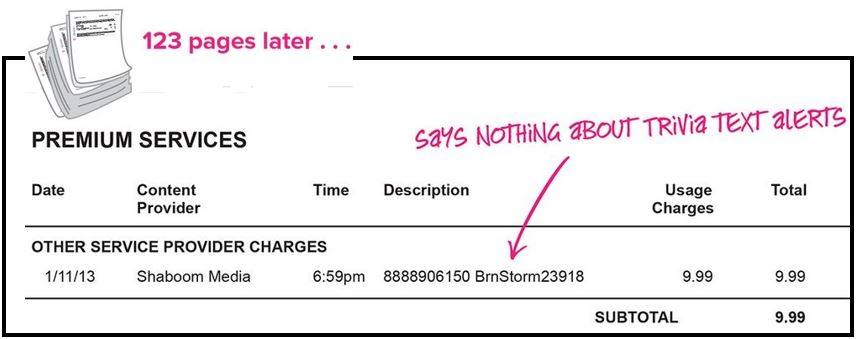
(Source: Federal Trade Commission)
In many cases where customers who complained that they were being charged for services they had never authorized, T-Mobile failed to provide them with a refund, the complaint alleges. Many T-Mobile customers were told to get their money back directly from the scammers “without providing accurate contact information to do so.”
T-Mobile is alleged to have received from 35% to 40% of the total amount charged to customers for these premium subscriptions, which typically cost $9.99 per month.
Billing continued after years of high complaint levels
When 4 in every 10 of those customers receiving the concealed monthly charges complained and asked for refunds, the FTC says T-Mobile should have realized that the charges were never authorized.
According to the complaint, which was filed in the United States District Court Western District of Washington, the charges were added to customers’ bills between 2009 and the end of last year. The FTC says the wireless network operator had documents showing very high level of complaints in 2012.
The FTC says T-Mobile in some cases carried on charging its customers for the bogus services offered by scammers years after knowing that the additional charges were fraudulent.
FTC Chairwoman Edith Ramirez, said:
“It’s wrong for a company like T-Mobile to profit from scams against its customers when there were clear warning signs the charges it was imposing were fraudulent. The FTC’s goal is to ensure that T-Mobile repays all its customers for these crammed charges.”
The FTC says it has made considerable efforts to eradicate mobile cramming. In the last twelve months, it has filed lawsuits against alleged mobile crammers Tatto Inc., Wise Media and Jesta Digital. The FTC’s complaint alleges that T-Mobile billed customers for services by these FTC defendants.
T-Mobile is also accused of telling complaining customers that they had authorized the additional charges, in spite of having no proof.
FTC exaggerating, says T-Mobile chief
John Legere, T-Mobile CEO, says the FTS is exaggerating how it benefitted from fraudulent charges added to customers’ bills.
“The FTC certainly did a good job of sensationalizing their story and their news at the expense of both T-Mobile’s reputation and mine. My frontline employees are upset about it and so am I. Their financial claims are incredibly overstated.”
Mr. Legere says that from 2009 through 2013, all the big wireless carriers began carrying Premium SMS services. They were all billing customers for these services on behalf of the providers of such content. The providers were responsible for getting customer authorization.
“There were some fraudsters in that bunch,” Mr. Legere added. “That is why, as we found them, we terminated them and, ultimately, made the decision in November 2013, as did all four of the wireless companies, to eliminate this from our service offerings. FULL STOP!”
