

The steep fall in inflation does not mean there is any risk of deflation, and the Bank of England does not need to stimulate the economy, Monetary Policy Committee (MPC) member Professor David Miles wrote in a British broadsheet newspaper. Deflation is when prices of goods and services decline; it is the opposite of inflation.
The MPC is a nine-member committee of the Bank of England that meets every month to decide the official interest rate in the UK.
Prof. Miles pushed hard for action during the global financial crisis. He wrote in the Telegraph that following the sharp fall in inflation there were calls for looser monetary policy.
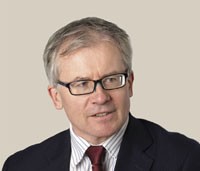 Prof. Miles has been an MPC member since June 2009. (Photo: Bank of England)
Prof. Miles said:
“This seemed wildly implausible just six months ago and I have my doubts even now. But it does mean that there is no great urgency in starting the process of moving monetary policy back towards a more normal setting.”
Fuel and food prices have fallen, making households better able to manage their debts. Consumers are not likely to postpone spending for the moment, Prof. Miles added.
Inflation in November fell to a 12-year low of 1%, versus 1.3% in October, the Office for National Statistics (ONS) reported earlier this week. The ONS explained that the decline was mainly due to falling oil and food prices.
Fuel and food prices fell by 5.9% and 1.7% respectively in November.
The Bank of England warned in November that inflation would continue falling over the next few months.
Most analysts now are betting on an interest rate hike either well into the second half of 2015 or even 2016.
Prof. Miles, whose term at the Bank ends in May 2015, says it is highly likely that he will not vote for an interest rate hike between now and then. He believes rates will rise later in 2015.
Oil prices have fallen for two reasons: 1. The US shale oil explosion. 2. Declining economic growth in China.
Prof. Miles wrote:
“It is relevant here, and in fact helpful, that the UK exports relatively little to China – we get the benefit of the boost to real incomes from lower commodity prices that weaker Chinese growth brings but we don’t pay much of a price in terms of weaker exports.”
MPC has 2 hawks and 7 doves
Prof. Miles is one of the seven so-called “Doves” in the MPC, unlike the two “Hawks” Ian McCafferty and Martin Weale, who since August have voted each month to raise interest rates.
Mr. McCafferty, who believes wages have reached a potential “turning point”, is concerned that the 5-year-long record low interest rate of 0.5% has been fueling inflation.
About Professor David Miles
Professor David Miles joined the Bank of England’s MPC in June 2009. He is Professor at Imperial College London, where he had been head of the Financial Economics Department.
As an economist he has specialized in the interaction between financial markets and the rest of the economy. From Oct 2004 to May 2009 he was Chief UK Economist at Morgan Stanley.
In Budget 2003, the Chancellor of the Exchequer commissioned him to head a review of the UK mortgage market.
He is a research fellow of the Centre for Economic Policy Research, a council member of the Royal Economic Society, and is also a fellow at the Munich-based CESIFO research institute.
