
Can you imagine our world in 2116 with underwater cities, underground skyscrapers, 3-D-printed meals and homes, regular commercial space travel for everyone, and personal drones instead of cars as our mode of transport? That is what the world will probably be like, according to The SmartThings Future Living Report.
The Report, commissioned by Samsung-owned SmartThings and created by a team of futurologists and academics, says that in one hundred years’ time our great-great-great grandchildren will be able to live in ‘Earth-scrapers’ – underground skyscrapers with at least twenty-five storeys.
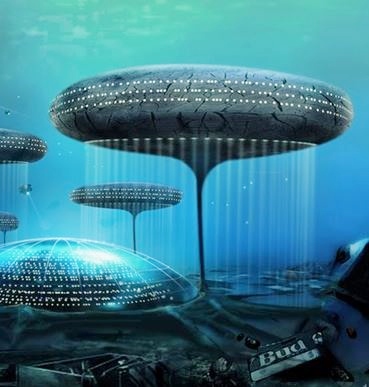
If climate change means sea levels will rise, one of the consequences will be less land available on which to live. Architects and town planners are likely to take an ‘if you can’t beat’em then join’em’ approach and build ‘bubble cities’ under the sea.
 Space scientist Dr. Maggie Aderin-Pocock believes it will be a very different world in 2116. (Image: Samsung/PA)
If seventy-one percent of the Earth’s surface is sea, and that percentage will be increasing due to global warming, it makes sense to consider living underwater.
We’ll travel around in personal drones
In 100 years’ time we won’t be driving cars any more. Most of us are aware of self-drive vehicles, like the one Google is testing. By 2116 we will have come a long way regarding personal transportation.
People will travel around in their personal drones. The drone will be automated, i.e. humans will not be at the steering wheel – artificial intelligence systems will. These personal drones will also be used as futuristic ‘mules’ that can carry your entire home to wherever you want.
Citizens of the twenty-second century will be able to go on holiday and take their homes with them. The mules will transport their homes. Imagine what a holiday resort in the Mediterranean or Caribbean will look like!
Report co-author, space scientist Dr. Maggie Aderin-Pocock, who co-presented the long-running astronomy TV programme The Sky at Night, says that our current lives are virtually unrecognizable compared to one hundred years ago. The Internet, for example, has completely transformed how humans communicate, learn and control their lives.
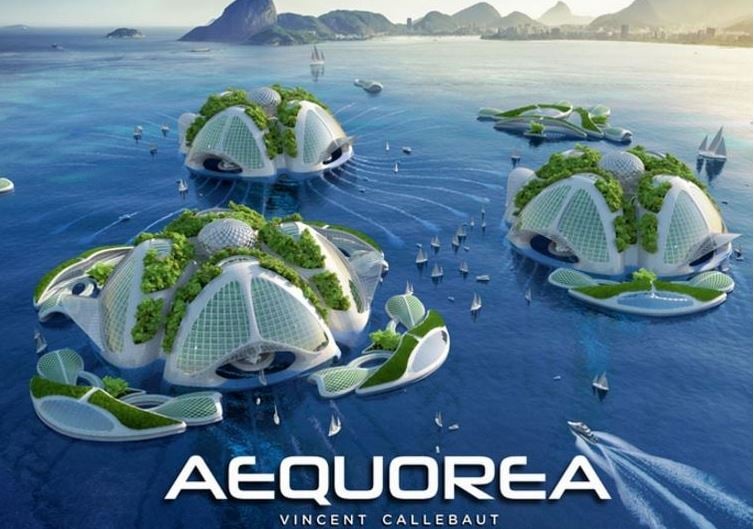 Building underwater cities is not a new concept. Last year, Belgian architect Vincent Callebaut designed an underwater village he named Aequorea. The village, which is mostly below sea level, has skyscrapers, is self-sufficient and non-polluting.
Dr. Aderin-Pocock said:
“Just 10 years ago, technology like SmartThings would have been inconceivable, yet today developments like this let us monitor, control and secure our living spaces with the touch of a smartphone.”
“Over the next century we will witness further seismic shifts in the way we live and interact with our surroundings – working on the SmartThings Future Living Report with a panel of industry experts has allowed me to explore what these could be.”
3-D printing will be at a different level
If 3-D printing blows your mind today, you ain’t seen nothing yet, say the authors. Our furniture, clothes, and even entire houses and structures will probably be printed.
3-D printing is a process for making a physical object from a 3-dimensional digital model – the printer lays down many successive thin layers of material.
The three-dimensional printing of food – a technology that today is being born – will be super-advanced by 2116. A bit like Star Trek’s replicator, you will be able to ask it to make dishes for you, if the recipe has been downloaded.
Cooking, dressmaking and tailoring, carpentry, and most other skills will be gone, or will just exist as hobbies, because of future 3-D printing, artificial intelligence and other technologies.
 Talk is already underway regarding using 3-D printers to build bases on the Moon using lunar materials. European Space Agency boss, Jan Woerner, would like to see a Moon Village succeed the International Space Station after it is shut down in 2024.
Space travel and other planets
Humans will have colonized the Moon and Mars. Settlements with all their infrastructure on other planets and our Moon will be constructed using 3-D printers and locally-sourced materials.
There will be regular commercial flights into space, including the Moon and Mars. Our aircraft and spacecraft will be able to travel at considerably higher speeds than they do today.
Rather than spending your holidays in Benidorm or Cancun, you will have the choice of going to Mars or the Moon, or perhaps orbiting Earth for a few days, staying at a state-of-the-art space station. Will there be a Martian Disneyland? Imagine a fun-fair on the Moon, which has just 16% of Earth’s gravity – some amazing rides could be built.
James Monighan, Managing Director of SmartThings UK, said:
“The smartphone revolution is already ushering in the smart home revolution, which will have massively positive implications on how we live.”
“Our homes are becoming smarter and can now detect the presence of things like people, pets, smoke, humidity, lighting and moisture. And this is just the beginning.”
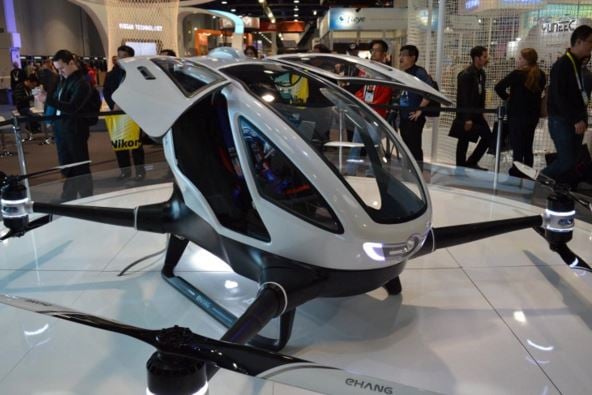 The EHang 184, a personal drone, was on display at CES 2016 in Las Vegas. Imagine what personal drones will be like in 100 years’ time!
In an interview with the BBC, Dr. Aderin-Pocock said:
“If you are living under water, you can actually take the water and break it down into oxygen and hydrogen – hydrogen is fuel, oxygen we use to breathe. We could farm in the oceans. So, I think it might be pretty nice, actually!”
“It would be like living in a tower block. You would have a large conurbation – lots of people – within this enclosure. Outside you’d have water, but inside you’d have urban life as normal.”
Predictions are often wrong
Things do not always turn out the way we expect. At the beginning of the last century, just as motor-vehicles were coming onto the market, people were asked what they imagined life in the twenty-first century might be like. Nearly of them predicted humans would be flying everywhere – that our personal vehicles would fly.
Our cars today may be different from those of 100 years ago, but they all still have wheels that touch the ground all the time, and use fossil fuels (most of them).
It is difficult to imagine what our world will be like in one thousand years’ time – that is, of course, if we are still around then.
