

In the Verizon versus Netflix row, the US telecommunications giant told Netflix in a “cease and desist” letter to stop telling its customers that Verizon’s crowded network is the sole cause of their slow download speeds.
In the letter, Verizon wrote:
“There is no basis to assert that issues with respect to playback of any particular video session are attribulate solely to the Verizon network. As Netflix knows, there are many different factors that can affect traffic on the internet, including choices by Netflix in how to connect to its customers and deliver content to them, interconnection between multiple networks, and consumer in-home issues such as in-home wiring, WiFi, and device settings and capabilities.”
In response to the letter, Joris Evers, a spokesman for Netflix tweeted on Thursday “This is about people not getting what they paid for from their Internet service providers. Netflix is transparent, (Verizon) is shutting that down.”
Verizon has demanded that Netflix provide evidence within the next five days demonstrating that it is responsible for the slow connection.
Update (June 15, 2014): The Federal Communications Commission says it is going to investigate the Netflix versus Verizon row. FCC Chairman, Tom Wheeler, says he has asked his people to collect data on the dispute to find out “What is going on and what can the FCC do on behalf of consumers?”
Netflix’ accusations bad for business
Verizon says that Netflix’ claim could undermine its business, making Verizon users think that any type of video, such as YouTube, would slow down their systems. It adds that the responsibility for its customers’ experience “falls squarely on Netflix itself.”
Verizon added that Netflix can connect to every broadband network in the US if it wants, but relies on a mish-mash of intermediary networks to reach its customers because it is much cheaper to do so that way. The resulting quality is one Netflix has chosen.
While being fully aware for some time now that some Internet middlemen have congestion problems with IP networks, Verizon emphasized that Netflix has chosen to carry on sending its traffic through those congested routes.
“Unfair business practice,” says Verizon
“To now accuse last-mile ISPs of being solely responsible for service issues that may relate to congestion on peering circuits stemming from network arbitrage by upstream providers is self-serving, deceptive, inaccurate and an unfair business practice,” Verizon wrote.
In March, Netflix CEO, Reed Hastings wrote in a blog that Netflix performance had been undermined by lack of sufficient interconnectivity by certain big ISPs (Internet service providers). It criticized Verizon and some other ISPs for demanding a fee to maintain video quality.
Despite complaining, Netflix agreed on a fee with Verizon so that a direct connection to its network could be maintained, thus ensuring its content was delivered to Netflix viewers. Verizon has hinted that Netflix’ current false accusations may call future deals into question.
If Netflix does not stop displaying messages to its viewers blaming Verizon for slow connections, Verizon said it may take legal action.
It is a pity that Netflix misleads customers and uses them as pawns in business negotiations and regulatory proceedings, Verizon wrote.
It all started with a tweet
The Verizon versus Netflix row started last Tuesday when Vox Media designer Yuri Victor, a Netflix customer, tweeted that when he tried to stream a movie Netflix placed a message on the buffering screen. Victor copied and pasted the message (below).
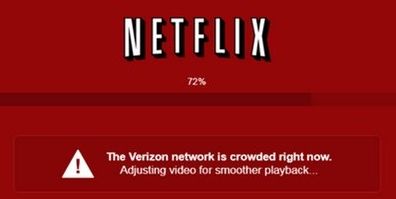
Verizon heard about the Netflix message through Twitter.
Netflix confirmed that the message came from them, saying that it is testing different ways of letting customers know how their Netflix experience is being affected by congestion on their broadband provider’s network.
“At present, we are testing in the US in areas serviced by many broadband providers,” Jonathan Friedland, a Netflix spokesman wrote via email.
Netflix says it started sending these message to customers early in May, and they only appear on computer screens, but not through other devices such as Internet-connected televisions, gaming consoles or Blu-ray players.
