
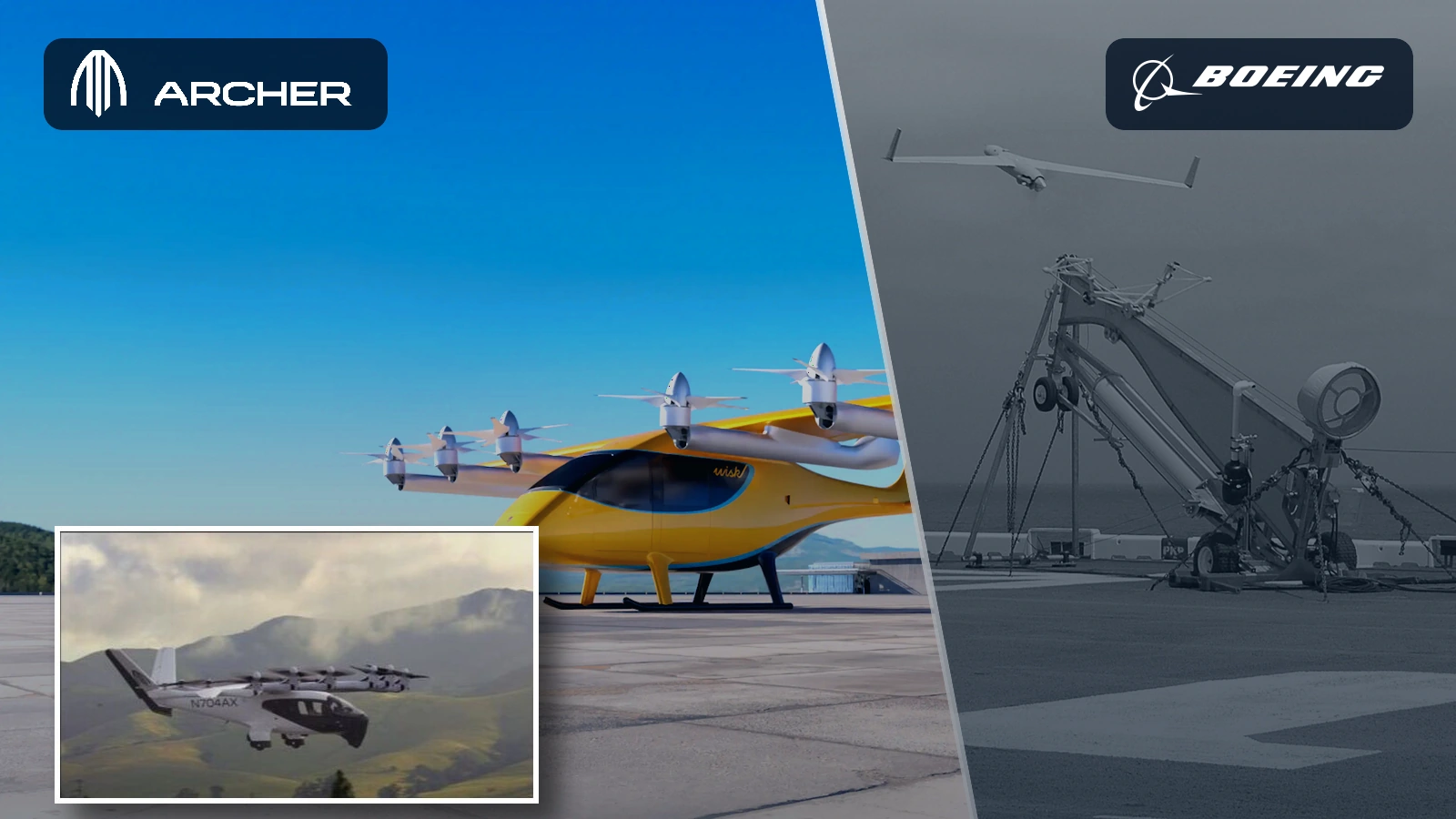
Archer Aviation has agreed to acquire Boeing subsidiaries Wisk Aero, Insitu and SkyGrid, adding an established defence drone business and autonomous-flight technology to its operations.
The proposed transaction will give Boeing a substantial stake in Archer, two share warrants and the right to nominate a director to Archer’s board.
Archer and Boeing announced the agreement on August 10. The companies expect to complete the transaction by the end of 2026, subject to antitrust, national security and foreign investment approvals.
Insitu brings more than $200 million in annual revenue
Insitu is likely to have the most immediate financial effect on Archer. The company manufactures unmanned aircraft used for intelligence, surveillance and reconnaissance missions.
According to Archer, Insitu is profitable and generates more than $200 million in annual revenue, based on its current financial information and estimates.
Insitu has manufactured and deployed more than 3,500 unmanned aircraft. It supplies customers in 35 countries and has offices in the United States, Australia, the United Kingdom and the United Arab Emirates.
That revenue would be a major addition to Archer’s existing business. Archer reported revenue of just $5 million for the second quarter of 2026, compared with $1.6 million in the previous quarter.
The company recorded a quarterly net loss of $263.2 million, while total operating expenses reached $284.2 million. Research and development accounted for $186 million of those expenses.
Wisk adds autonomous air taxi technology
Wisk develops autonomous electric vertical takeoff and landing aircraft, commonly known as eVTOL aircraft. These vehicles are designed to take off and land vertically while using electric propulsion.
Wisk has worked on six generations of eVTOL aircraft and completed more than 1,700 flight tests. Its latest aircraft is being developed to carry four passengers without a pilot on board.
SkyGrid develops software for managing drones and other autonomous aircraft in shared airspace. Its systems are intended to help operators plan flights and coordinate aircraft movements.
Archer plans to combine the technology from Wisk and SkyGrid with its own aircraft and ZEE aviation artificial intelligence system. The company describes the resulting business as an end-to-end “physical AI” operation for commercial and defence aviation.
However, Wisk’s autonomous passenger aircraft remains under development, while Archer is still working towards regulatory certification for its piloted Midnight air taxi.
Boeing expected to own about 16.5% of Archer
Under the equity purchase agreement filed with the US Securities and Exchange Commission, Boeing will receive Archer shares equal to 19.75% of the Class A shares outstanding immediately before the transaction closes.
Because Archer will issue new shares to Boeing, that amount would give Boeing approximately 16.5% of the enlarged Class A share base before any adjustments or warrant exercises.
The final number of shares may be adjusted to account for cash, debt and transaction expenses at the businesses being acquired.
Boeing will also receive two warrants. Each warrant will cover a number of Archer shares calculated by dividing $100 million by Archer’s average share price over the five trading days before closing.
The first warrant will have an exercise price of $13 per share. The second will have an exercise price of $17.88 per share.
Boeing will be entitled to nominate one member of Archer’s board while it continues to hold shares equal to at least 10% of Archer’s pre-closing share count.
Boeing retains access to Wisk technology
Boeing is not completely withdrawing from autonomous flight. It will retain access to Wisk’s core technology for use in current and future commercial and defence aircraft.
The two companies have agreed to grant each other worldwide rights to use certain intellectual property. Boeing will also provide transition services for a limited period after the acquisition closes.
The arrangement allows Boeing to reduce its direct involvement in the three subsidiaries while retaining exposure to Archer’s future performance and access to autonomous-flight systems developed by Wisk.
Agreement includes conditional funding arrangement
Archer ended the second quarter with $1.56 billion in cash, cash equivalents and short-term investments, according to its latest financial results.
That total fell by $215.3 million during the quarter. Archer used $156.4 million in operating activities, spent $37.1 million on property and equipment and paid $25 million to acquire a fixed-base operator business at Hawthorne Airport.
The Boeing agreement gives Archer an option to require Boeing to buy up to $55 million of Archer shares. This is not an immediate cash investment.
Archer can use the option only in connection with a third-party share offering expected to raise at least $400 million. Boeing would pay the same lowest price offered to other investors in that fundraising.
Former legal rivals brought together
The acquisition follows a legal dispute between Archer and Wisk that began in 2021. Wisk accused Archer of misappropriating trade secrets related to its aircraft designs. Archer disputed the allegations.
The companies settled the case in August 2023. As part of the settlement and a related financing arrangement, Archer issued more than 13 million shares and selected Wisk as its exclusive provider of autonomous-flight technology.
Archer is now set to own Wisk outright, along with Boeing’s established unmanned aircraft business and airspace management software operation.
The acquisition can be terminated if it has not closed by May 9, 2027. That deadline may be extended by three months if regulatory approval is the only remaining condition.
