
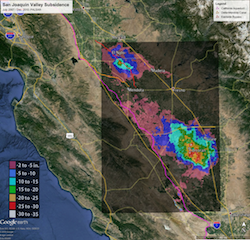
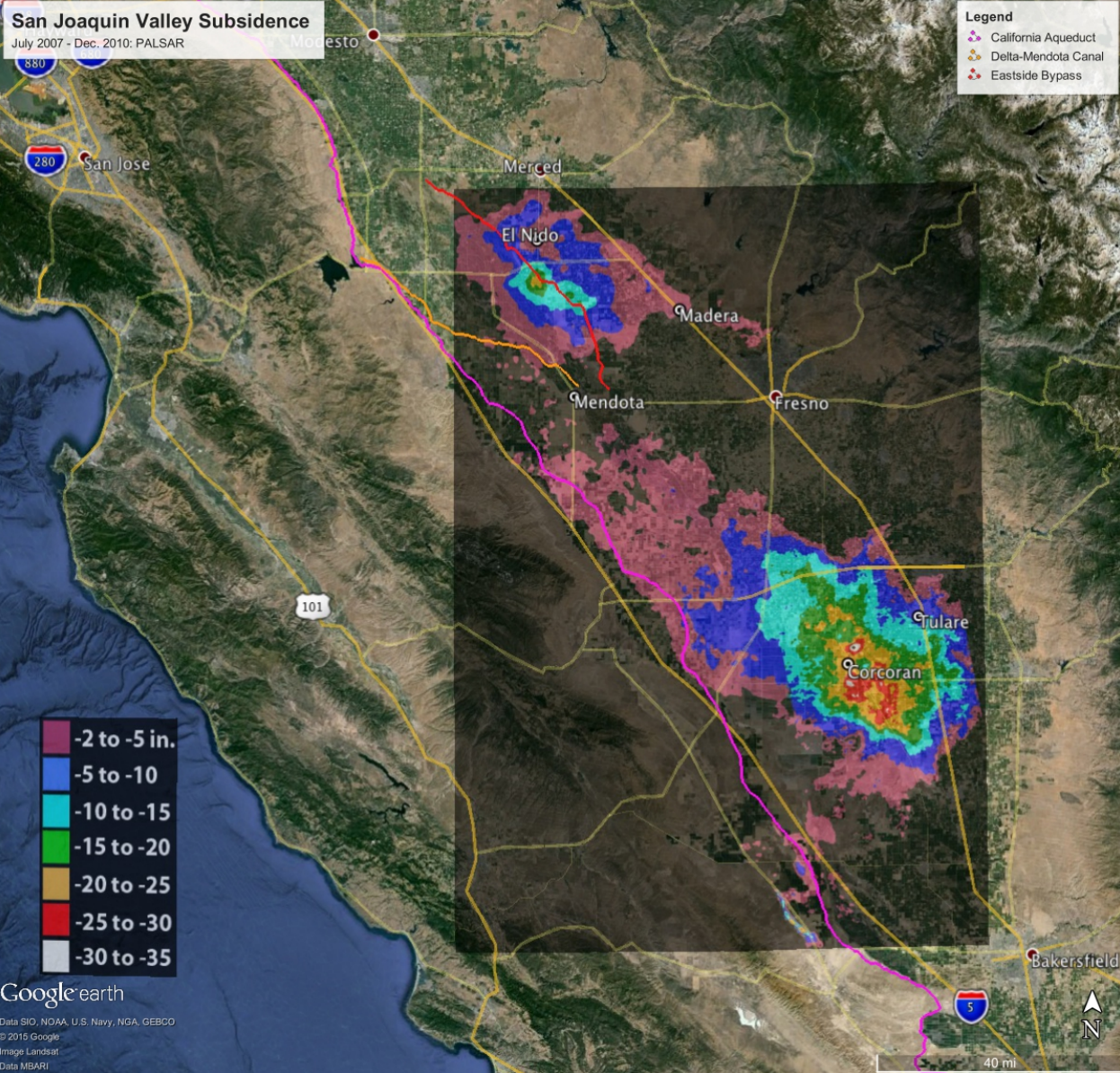
According to research by NASA, ground is sinking in across areas of California’s Central Valley at a record rate as farmers pump out as much groundwater possible during the state’s historic drought.
The ground in some areas is sinking by almost 2 inches every month.
This poses a serious threat to infrastructure on the surface, such as roads, buildings, and bridges.
Mark Cowin, head of the California Department of Water Resources, said that major canals in the state have been affected by the land sinking, adding that wells are being depleted.
“Because of increased pumping, groundwater levels are reaching record lows — up to 100 feet lower than previous records,” Cowin said in a statement.
“As extensive groundwater pumping continues, the land is sinking more rapidly, and this puts nearby infrastructure at greater risk of costly damage,” he added.
The four-year drought prompted groundwater pumping, causing aquifer levels to drop to new lows and subsidence rates to climb up to levels much higher compared to the last dry period.
“Groundwater acts as a savings account to provide supplies during drought, but the NASA report shows the consequences of excessive withdrawals as we head into the fifth year of historic drought,” Cowin added.
Data was collected in areas where state officials believe the problem is the worst. Land near the city of Corcoran sank 13 inches in eight months and part of the California Aqueduct sank 8 inches in four months last year, the research revealed.
The NASA report outlined the problem of subsidence:
“In general, if water levels are not drawn too low, when pumping causes water recharges the aquitards and their starker expands. However, if water levels are drawn too low, then an irreversible compaction of the fine-grained aquitards occurs. The water cannot recharge the layers, causing permanent subsidence and loss of some groundwater storage capacity”, the report said.
Source:
“Progress Report: Subsidence in the Central Valley, California”. Tom G Farr, Cathleen Jones, Zhen Liu. Jet Propulsion Laboratory, California Institute of Technology
