
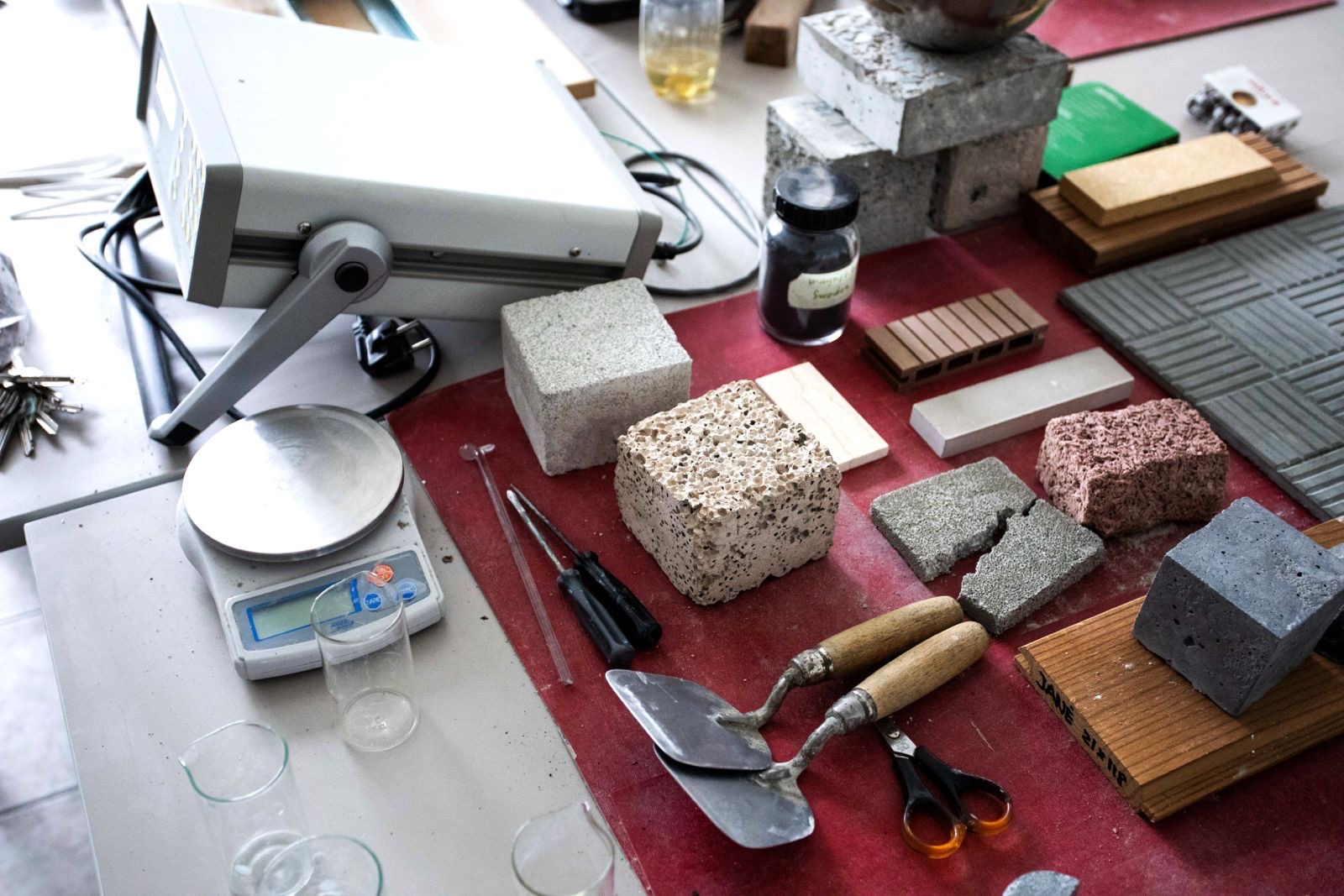
Every year, the world produces enormous amounts of construction waste. Broken bricks, demolished walls, damaged tiles, and other discarded materials often end up in landfills, where they occupy valuable space and represent a lost opportunity. At the same time, the construction industry faces another challenge: reducing its environmental impact while continuing to build homes, schools, hospitals, factories, bridges, and transport systems for a growing global population.
Scientists around the world are searching for materials that can address both problems at once. One promising approach involves transforming industrial and construction waste into new building materials that are not only environmentally friendlier but also capable of performing under extreme conditions.
Researchers in Lithuania have now added another piece to that puzzle. Their latest study suggests that certain waste materials can be turned into a cement-free mortar that remains remarkably strong even after being exposed to temperatures as high as 800°C. While the material is still at the research stage, the findings offer another example of how waste products might one day replace some of the most carbon-intensive materials used in construction.
Why Cement Matters
Concrete is the world’s most widely used construction material after water. Nearly every modern city depends on it. Roads, apartment buildings, tunnels, airports, ports, dams, and office towers all rely heavily on concrete because it is relatively inexpensive, durable, and versatile.
Concrete, however, contains cement, and producing conventional Portland cement requires heating limestone and other raw materials to extremely high temperatures. This process consumes vast amounts of energy while also releasing carbon dioxide both from fuel combustion and from chemical reactions inside the kiln. As a result, cement manufacturing is estimated to account for roughly 7% to 8% of global carbon dioxide emissions.
Reducing those emissions has become one of the construction industry’s greatest challenges. Engineers are exploring many solutions, including cleaner manufacturing methods, carbon capture technologies, recycled aggregates, lower-carbon cements, and entirely different types of binders.
One of the most promising alternatives is the geopolymer.
What Is a Geopolymer?
Unlike traditional cement, geopolymers use aluminosilicate-rich materials that react with alkaline solutions to create a hard, stone-like material. Many of the ingredients can come from industrial by-products or recycled construction waste instead of newly quarried raw materials.
That offers two potential environmental benefits.
First, valuable waste materials can be reused instead of discarded.
Second, replacing some or all Portland cement may significantly reduce the carbon footprint of certain construction products.
Scientists have been studying geopolymers for several decades, but researchers continue searching for mixtures that combine strength, durability, affordability, and consistent performance under demanding real-world conditions.
When Fire Becomes the Ultimate Test
Buildings are designed to withstand many different stresses, including heavy loads, earthquakes, storms, and long-term weathering. Fire presents a particularly difficult challenge.
Extreme heat can weaken conventional concrete, cause cracking, and reduce its structural integrity. In tunnels, industrial furnaces, power plants, chemical facilities, and other high-temperature environments, construction materials must continue performing even after prolonged exposure to intense heat.
That is why fire-resistant materials attract considerable research interest.
The Lithuanian team investigated whether waste-based geopolymer mortars could maintain their strength after exposure to temperatures reaching 800°C.
Turning Waste Into a Building Material
The researchers produced several geopolymer formulations using recycled ceramic brick waste together with metakaolin waste generated during glass manufacturing. Instead of relying on Portland cement, these waste-derived materials formed the main binding system.
The team also experimented with different fine aggregates, comparing ordinary sand with granite, basalt, ceramic waste, and corundum, an exceptionally hard mineral used in many industrial applications.
Each mixture was heated to progressively higher temperatures before its mechanical properties were measured.
Not all formulations performed equally well.
Some retained their strength better than others, while certain combinations showed particularly impressive resistance to heat-induced damage.
Surprisingly Strong After Extreme Heat
Among the most successful formulations, those containing corundum performed especially well.
Rather than suffering catastrophic deterioration after heating, some samples retained most of their original compressive strength. One formulation even exceeded its original strength after exposure to 800°C, suggesting that the heating process further strengthened the internal structure under the specific laboratory conditions tested.
Researchers also observed relatively limited cracking in the best-performing samples.
These findings do not mean that future buildings will become stronger during fires. Laboratory specimens differ greatly from full-scale structures, which experience complex loading conditions, moisture variations, reinforcement effects, and uneven heating. Nevertheless, the results demonstrate that carefully designed geopolymer systems can tolerate extremely high temperatures remarkably well.
More Than Recycling
The study illustrates an important shift in modern materials science.
For many years, recycling in construction primarily meant crushing old concrete for use as road base or low-value fill material. Increasingly, researchers are asking a more ambitious question: can waste become a high-performance engineering material instead?
If the answer is yes, the environmental benefits could extend beyond reducing landfill volumes.
Waste materials may replace newly extracted raw materials, reduce manufacturing emissions, lower energy consumption, and create new markets for industrial by-products that previously had little commercial value.
Such approaches fit within the broader concept of the circular economy, where materials remain in productive use for as long as possible instead of becoming waste after a single life cycle.
Challenges Remain
Despite encouraging laboratory results, considerable work remains before geopolymer materials become commonplace.
Construction is one of the world’s most highly regulated industries. New materials must undergo years of testing to demonstrate long-term durability, reliability, safety, and consistency under many different environmental conditions.
Researchers must also determine how these materials behave over decades rather than months, how they interact with steel reinforcement, whether they remain durable in freezing climates, how easily they can be manufactured at industrial scale, and whether they remain economically competitive.
Another challenge is the absence of comprehensive construction standards covering many geopolymer systems. Without widely accepted engineering codes, builders and regulators may hesitate to adopt unfamiliar materials even when laboratory evidence appears promising.
A Growing Global Effort
Lithuanian scientists are far from alone in this field.
Research groups across Europe, Asia, Australia, and North America are investigating alternative binders, recycled aggregates, industrial by-products, and low-carbon construction technologies. Some studies focus on reducing emissions, while others seek to improve durability, lower costs, or increase resistance to fire and chemical attack.
The growing international interest reflects a simple reality: the world will continue building vast amounts of infrastructure throughout the coming decades. Making even a modest improvement in the environmental impact of each tonne of construction material could produce significant cumulative benefits.
Looking Ahead
The Lithuanian study does not claim to have solved the construction industry’s climate challenge. Instead, it provides another encouraging example of how scientific research can uncover unexpected value in materials that many people simply consider waste.
Whether these particular formulations eventually find widespread commercial use remains uncertain. Further testing, industrial validation, economic analysis, and regulatory approval will all be required before such materials become routine on construction sites.
Even so, the research highlights an increasingly important direction for modern engineering: designing building materials that are both environmentally responsible and capable of meeting demanding performance requirements.
If future studies confirm these early findings, yesterday’s discarded bricks may help build tomorrow’s safer, more sustainable structures.
Citation
Vaitkevičius, V., Kairytė, A., Pundienė, I., et al. (2026). Influence of waste-based geopolymer binder and fine aggregate type on mechanical properties after high-temperature exposure. Scientific Reports, 16, Article 55067. https://doi.org/10.1038/s41598-026-55067-x
