

Social network multinational giant Facebook paid only £4,327 ($6,642) in corporation tax last year, according to its latest Companies House filing in the UK.
While registering a pre-tax loss of £28.5 million in 2014, the company managed to pay out £35.4 million in share bonuses to its 362 UK employees, i.e. £96,000 each.
The average British worker pays £5,392.80 each year in income tax and national insurance contributions, which is considerably more than the social media giant.
Fourth quarter worldwide profits in 2014 were $701 million (£462 million), which was 34% higher than in Q4 2013. Profits for the whole of 2014 globally reached $2.9 billion, nearly double its 2013 profit.
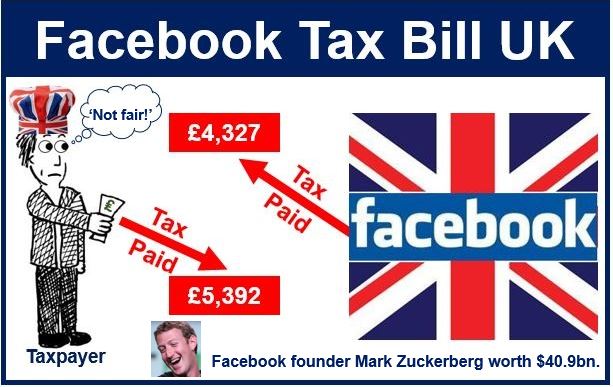 Low- and middle-income British employees are fed up with having to subsidize giant corporations.
According to the company, its advertising income increased by 53% to $3.59 billion, with most of it (70%) coming from mobile phone ad sales.
Facebook says it currently has 1.39 billion active users, i.e. a 13% increase compared to this time last year.
European Union investigation
Facebook’s tiny UK corporation tax payment will annoy members of the public who resent having to accept virtually no real wage increases for the past five years, plus high tax bills, while giant corporations manipulate the system and get away with what they see as daylight robbery.
The EU is currently investigation the corporate tax statuses of Starbucks, a FIAT division, Amazon and Google. Rumours coming out of Brussels suggest the probe may be widened after Facebook’s filing in the UK.
The probe followed Starbucks’ paltry £8.6 million corporation tax payment in the UK for the 1998-2012 period, which seemed ever so little given that it made in excess of £3 billion in sales during that 14-year period.
In 2014, the LuxLeaks scandal angered EU taxpayers. The scandal revealed that Luxembourg had made hundreds of tax regulation changes so that multinational corporations could dramatically reduce their EU tax bills by channelling their profits through the trade bloc’s smallest sovereign state.
The BBC quoted a Facebook spokesperson who said:
“We are compliant with UK tax law, and in fact in all countries where we have operations and offices. We continue to grow our business activities in the UK.”
Facebook said all its employees in the UK paid income tax on its bonus payouts.
Mark Garnier, MP for Wyre Forest (Conservative), and a member of the Treasury Select Committee, told the BBC that multinationals should think about their moral responsibility, and not just whether they are acting within the law.
Many people wonder why lawmakers have not simply changed the laws so that companies pay their fair share in taxes. There is widespread suspicion that politicians pay lip service to change, but when it comes to action, i.e. closing the loopholes … they do very little.
Last week, the finance ministers of the G20 nations, the world’s 20 major economies, signed a package of measures which they claim will make it much more difficult for multinationals to avoid paying corporation tax.
OECD Secretary-General, Angel Gurría, said:
“Base erosion and profit shifting is sapping our economies of the resources needed to jump-start growth, tackle the effects of the global economic crisis and create better opportunities for all. The G20 has recognised that BEPS is also eroding the trust of citizens in the fairness of tax systems worldwide, which is why we were called on to prepare the most fundamental changes to international tax rules in almost a century.”
