
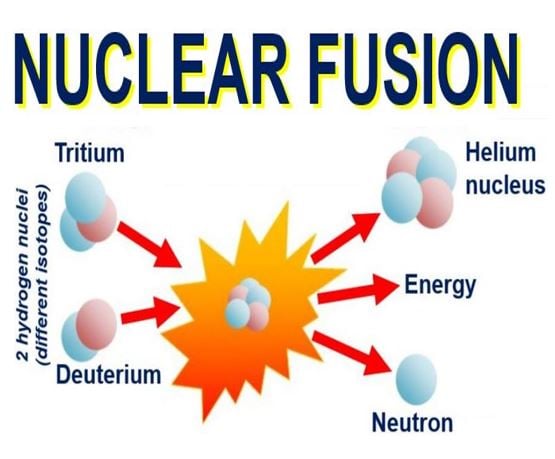
In the quest for nuclear fusion, a virtually infinite source of safe and clean energy, Germany made great strides last week and said ‘Beat that!’, and China did … handsomely! Germany managed a higher temperature, but its time was super short, while China managed a high but slightly lower temperature, but sustained it for considerably longer.
Last week, German scientists at at the Max-Planck-Institut für Plasmaphysik said they had used 2 megawatts of microwave radiation to heat hydrogen to 80 million °C for one quarter of a second, and then a team from the Chinese Academy of Sciences said it had managed to maintain 50 million °C (over three times the temperature of the Sun) for 102 seconds.
Nuclear fusion is seen as the Holy Grail of energy. It is a quest most of the advanced economies, as well as China and India are pursuing aggressively. The most important fusion process in nature is the one that powers stars.
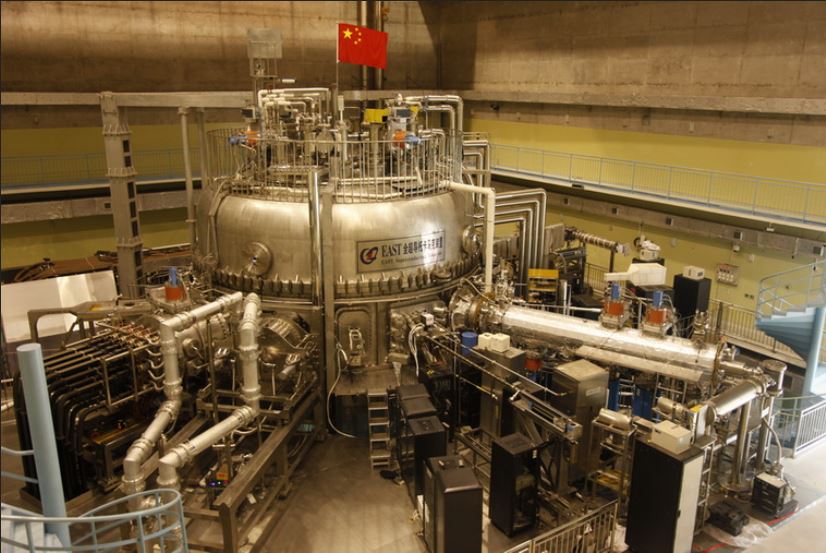 EAST tokamak is designed on the basis of the latest tokamak achievements of the last century, aiming at the world fusion research forefront. (Image: english.ipp.cas.cn)
The Chinese Academy of Sciences wrote on its website on Friday:
“A team of Chinese scientists in Hefei, capital city of east China’s Anhui Province, has made an unprecedented breakthrough on an energy generation device that will make it one step closer to transform energy into stable, sustainable and controllable resources.”
Chinese Tokamak called ‘Artificial Sun’
The fusion device, called EAST (Experimental Advanced Superconducting Tokamak) and nicknamed ‘Artificial Sun’, made a 102-second-long pulse plasma discharge at over the central electron temperature of 50 million Celsius in Hefei, the capital of Anhui Province in Eastern China, at the end of last month.
The scientific team says it was the longest plasma discharge time recorded in a Tokamak fusion device ever in the world.
The EAST fusion device is one step closer to the goal of a 1000-second-long pulse plasma discharge at over the central electron temperature of 100 million °C.
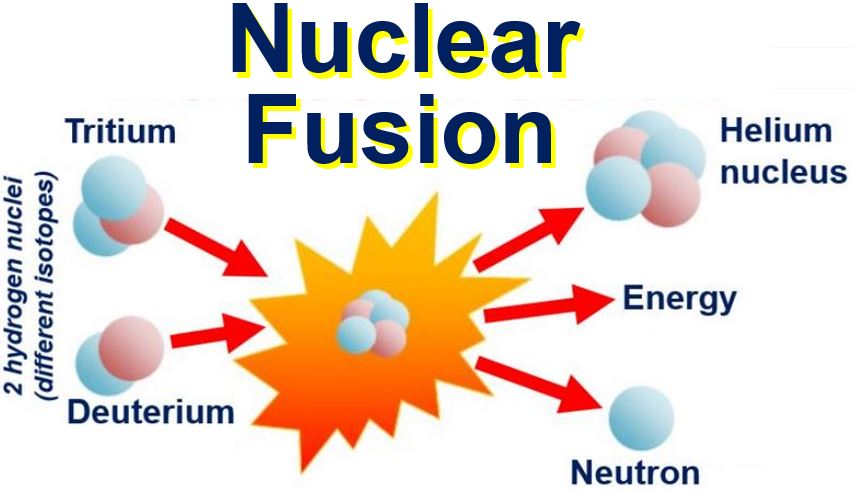 The two nuclei of hydrogen above are two isotopes called deuterium and tritium.
Aim to produce energy like the Sun does
The EAST device is nicknamed ‘Artificial Sun’ because the aim is to get it to generate energy like the Sun does – through nuclear fusion.
Under ultra-high pressure and extremely high temperatures, the fusion reaction that occurs in the Sun is what makes it shine so brightly – as well as billions of other stars in the sky.
The Chinese Academy of Sciences added:
“Such fusion reactions will give rise to a great deal of energy to enable to sun to continuously emit light and heat.”
“However, fusion reactions on the sun are uncontrollable and destructive, just like h-bomb explosion seen on the earth. EAST serves to transform such energy into a stable, sustainable and controllable resource.”
From one litre of seawater you can get a hydrogen isotope that can produce the energy equivalent of 100 litres of gasoline with nuclear fusion.
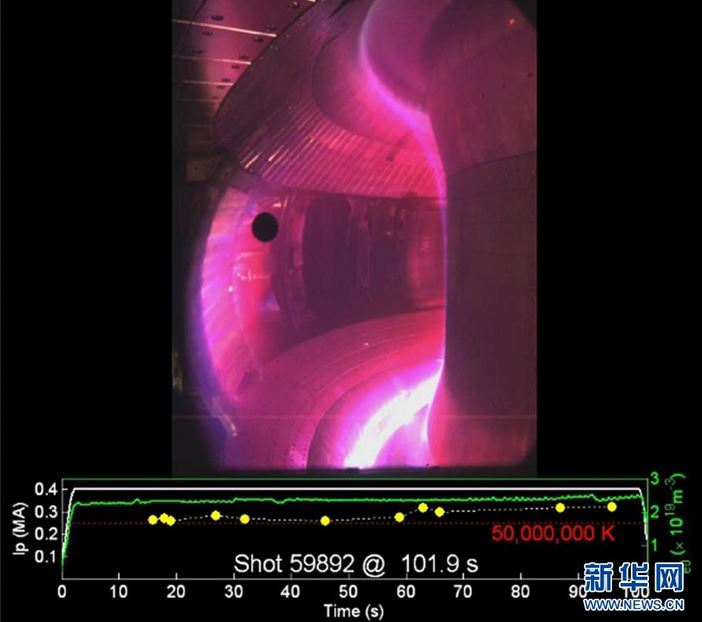 The Experimental Advanced Superconducting Tokamak (EAST) heated hydrogen gas to about 50 million°C. For comparison, the interior of the sun is about 15 million°C. (Image: english.cas.cn)
Nuclear fusion – a virtually inexhaustible supply of energy
In terms of resources available here on our planet, nuclear fusion offers the prospect of an almost inexhaustible supply of energy for generations to come.
It would solve all our energy problems forever, as well as our greenhouse gas emissions which cause global warming.
Even though the technology is probably some decades away, supporters of nuclear fusion way that when we have it, conventional nuclear fission reactors and fossil fuel infrastructure will be replaced entirely.
With nuclear fusion, our planet would literally become a safer, cleaner and better place.
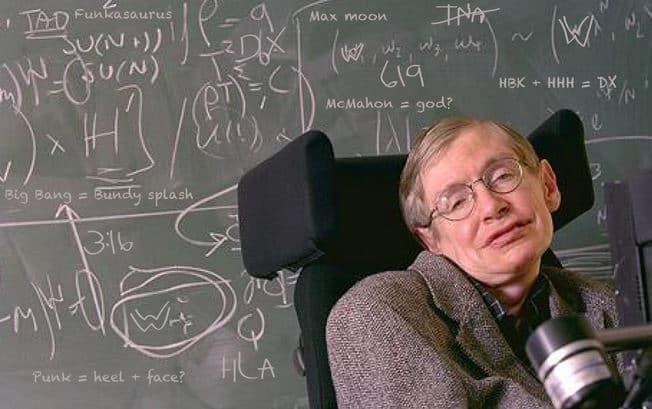 Regarding nuclear fusion, Professor Stephen Hawking said: “I would like nuclear fusion to become a practical power source. It would provide an inexhaustible supply of energy, without pollution or global warming.” (Image: hawking.org.uk)
What is nuclear fusion?
Nuclear fusion is a process in which two light atomic nuclei fuse together and form a larger nucleus – the process gives off a colossal amount of energy.
It is the energy source that makes stars ‘shine’ and hydrogen bombs explode.
For nuclear fusion to occur, the positively-charged nuclei have to collide at ultra-high speed to give the short-range gravitational forces that pull nuclear particles together the chance to overcome the electrostatic forces that are trying to repel positively-charged particles.
Video – What is nuclear fusion
This physics animation video explains how two or more nucleons fuse (merge) together to create something more powerful and meaningful.

Comments are closed.