
Preliminary interim results showing a pre-tax RBS profit jump to £2.65 billion ($4.5 billion) for H1 2014, compared to £1,374 in H1 2013, surprised and pleased investors. Operating profit for the same period is estimated to be £2.601 million, up from £708 million last year.
RBS (Royal Bank of Scotland), which is 81% owned by the British taxpayer after a 2008 government bail out costing £45.5 billion ($77.2 billion), set aside only £269 million for bad loans compared to £2.15 billion in H1 2013.
There are 40% fewer struggling businesses being moved to its restructuring unit this year.
RBS shares on Friday increased by over 10% to 364.20p, a 4-year record rise. However, it still has a long way to go before reaching the 500p the UK government paid in 2008. It will be several years before the taxpayers’ stake is sold back to private investors.
RBS investors will now be looking for strong upward momentum, like the one achieved by Lloyds Banking Group, which was also bailed out by the government during the crisis. Lloyds shares rose sharply, enabling the government to start selling off some of its stake.
Economy and confidence improving
The Edinburgh-based bank said it was benefitting from a stronger British and Irish economy and steadily improving business and consumer confidence. Figures published on Friday showed that the UK economy is now bigger than in Q1 2008, its pre-crisis peak.
The bank, which usually releases H1 results on August 1, was doing so one week early this year because they were considerably stronger than the market had been expecting.
RBS CEO, Ross McEwan, the New Zealander who took the helm in October 2013 from Stephen Hester, said:
“The results we are posting today show the steady progress we are making as we take the steps to be a much simpler, smaller and fairer bank. These results show that underneath all the noise and huge restructuring of recent years, RBS is a fundamentally stronger bank that can deliver good results for customers and shareholders.”
Mr. McEwan, who previously headed the bank’s retail division, added that the bank has progressed in all its key restructuring priorities:
- costs are lower,
- capital is stronger,
- customer activity is improving.
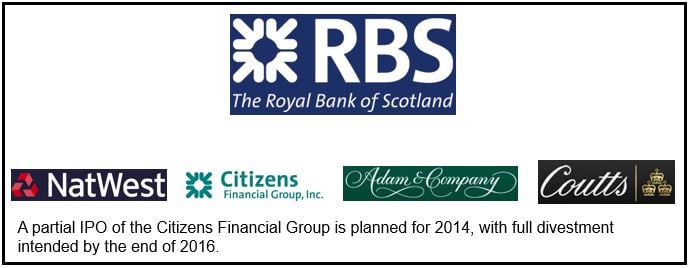
The RBS Group owns several well known financial institutions.
Litigation settlements
Mr. McEwan cautioned that conduct and litigation issues will probably hit the company’s results going forward. “I am pleased we have had two good quarters, but no one should get ahead of themselves here – there are bumps in the road ahead of us.”
While settling a Libor rate-rigging probe, RBS still faces several claims, including:
- manipulating the foreign exchange market,
- the sale of US mortgage-backed securities (settlement unlikely before 2016),
- the mis-selling of payment protection insurance and interest-rate swaps,
- UK small business lending.
Litigation and conduct costs have declined to £250 during H1 2014 from £650 in H1 2013.
Its equity Tier 1 capital ratio, a key indicator of the bank’s financial strength, increased to 10.1% in the second quarter of 2013, compared to 9.4% in Q1 2014 and 8.6% in Q4 2013. In Europe, banks are required to have a common equity Tier 1 of at least 4% (under the Basel III regulatory scheme). Larger banks are required to have a higher minimum level.
RBS has an equity Tier 1 capital ratio target of 11% by the end of next year and 12% by the end of 2016.
It is going to take at least five years to regain trust in the industry, which has been severely eroded, Mr. McEwan noted. The better profit outlook is another encouraging sign for the CEO as he tries to steer the company away from global investments towards becoming a British-market-focused high-street bank.
