
Twenty-one percent of shareholders voted against the proposed HSBC pay policy on Friday, in the latest show of growing anger among banking investors worldwide at how financial institutions have managed bonuses since the global financial crisis.
Even though one fifth is a sizable minority, it was not enough to block HSBC’s bonus policy for the next three years. The pay policy includes bonuses of up to 200% of salaries.
The proposal to raise a European Union cap on bonuses from 100% to 200% of basic pay was approved by 98% of shareholders.
Shareholders revolt grows
A growing number of investors wonder why banking executives should be paid bonuses when they are not delivering. The argument that key personnel would leave the bank if they were not compensated as much as their rivals is convincing a declining proportion of shareholders throughout the banking sector globally.
The Taipei Times quote a private shareholder, John Farmer, who said to the applause of other investors “If these people want to walk away, let them, and find someone else who will do the job for them.”
Within HSBC’s pay policy proposal, bonuses would be in the form of shares and would be deferred for five years, i.e. they could be clawed back.
Initially, HSBC chairman Douglas Flint was to have received a bonus of £2.25 million. Following investor criticism, the bank said it could limit his bonus to a maximum of £1 million.
HSBC pays less than US banks
HSBC remuneration committee chairman, Simon Robertson, warned investors that HSBC pays less than what banks in the US, such as JP Morgan, pay and that they should be careful not to undermine the very business from which they earn an income.
Mr. Robertson said of the Chairman “Douglas is underpaid for what he does, and he does an extremely good job.”
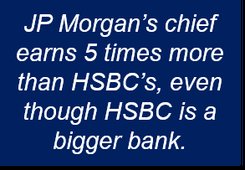
Jamie Dimon, Chairman and Chief Executive of JP Morgan, was awarded a 74% pay rise to $20 million, despite profits falling by 16%. HSBC is the second largest bank in the world while JP Morgan is the sixth. HSBC Chairman Flint was paid £2.25 million ($3.8 million), which is considerably less than what JP Morgan’s boss received.
Mr. Flint said more needs to be done to win over the support of shareholders. He pointed out that although there was “vast majority support” for the remuneration plan, “we need to understand what particular aspects (they are unhappy with). We will have a dialogue with shareholders; we need to do more on dialogue.”
CEO Stuart Gulliver said HSBC will not scale back its investment banking divisions, like RBS and Barclays are doing. He said “I don’t see any need to exit large chunks of the business.”
Shareholder opposition in whole banking sector
Many banks this year have faced shareholder opposition to remuneration at their Annual General Meetings.
In April, Barclays’ proposal to increase its staff bonus pool to £2.38 billion (+10%) faced stiff opposition from Standard Life, a major institutional investor. The bank had announced a 30% decline in profits and a job-cutting program to save money.
Alison Kennedy, a governance and stewardship director at Standard Life Investments, said:
“We are unconvinced that the amount of the 2013 bonus pool was in the best interests of shareholders, particularly when we consider how the bank’s profits are divided amongst employees, shareholders and ongoing investment in the business.”
The Barclays proposal was eventually approved despite 24% of investors voting against it.
At Standard Chartered’s and Lloyds’ Annual General Meetings, 41% and 12.7% of shareholders respectively voted against the proposed bonus plans.
