
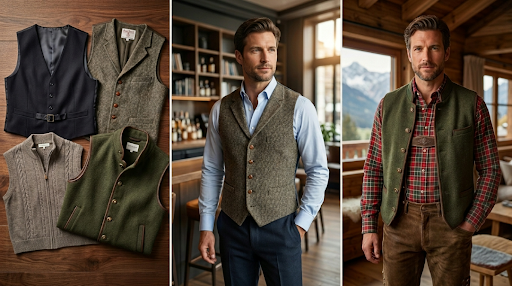
Menswear has a shortcut it keeps forgetting: the third piece. Add a vest to almost any two-piece outfit — shirt and trousers, tee and denim, shirt and leather — and the whole build jumps a register, gaining structure, a visible center and the finished quality stylists chase with far more effort elsewhere. The menswear vest delivers that effect across an unusually wide map: formal waistcoats, casual knit and canvas builds, the western family, and the traditional wool and loden vests that have anchored Alpine dress for generations. This guide covers the whole category: the register map, the third-piece logic, the fit rules every vest obeys, the traditional branch worth knowing, and the wardrobe order that builds vest range fastest.
The Register Map
The vest family sorts on one formality axis. The formal end: suit waistcoats and evening vests — matched or deliberately contrasted under tailoring, the three-piece tradition’s engine. The smart middle: odd vests in wool, tweed and textured weaves worn over shirts with trousers or dark denim — the register where the third-piece effect does its most visible work. The casual end: knit vests, canvas and workwear builds, quilted outdoor vests — structure without ceremony. And the heritage branches: the western vest’s frontier line and the Alpine tradition’s wool, loden and leather vests — the Gilet worn over checked shirts beside leather trousers — where the vest remains a codified part of living traditional dress rather than a styling flourish.
The map’s use is occasion-first: name the rooms you actually dress for, and the correct entry register names itself.
The Third-Piece Logic
Why the vest upgrades outfits is worth understanding, because the logic guides the styling. Structure: a fitted vest gives the torso a defined line that a shirt alone can’t, sharpening posture and proportion. Focus: the vest creates a visible center — buttons, texture, a V of shirt — that organizes the outfit the way a tie once did, without the tie. Layering economics: it adds register and warmth with less bulk than a jacket, survives indoors where jackets come off, and keeps an outfit “finished” through a full day of transitions. And versatility: one good vest restyles across many shirt-and-trouser combinations, which is the highest outfits-per-garment ratio in the wardrobe.
The logic’s one demand: the vest must fit precisely — a third piece that gaps or balloons subtracts more than it adds, which is why the rules below are strict.
The Fit Rules Every Vest Obeys
Across every register, four rules hold. Length: the hem meets the trouser waistband — covering the belt line completely, never riding up to flash shirt, never swallowing the hips; the waistband handshake is the category’s defining line. Body: trim over its intended shirt layer — fitted without button strain, straight without ballooning, with back cinches fine-tuning where present. Armholes: high and clean beside the shoulder, preserving the free-arm silhouette every vest tradition shares. Shoulders (where constructed): seams at the natural point.
Sizing runs by chest measurement over the layer the vest will actually cover — and the register note that saves returns: vest attire for men headed for dressed occasions should be fitted over the dress shirt it will accompany, because a vest fitted over a tee disappoints over anything thicker.
The Traditional Branch: The Alpine Gilet
The category’s most codified branch deserves its own section, because it demonstrates every rule at full strength. The Alpine vest tradition — wool and loden Gilets in grey, loden green and charcoal, plus the leather and brocade builds of formal Trachten — layers by a fixed order (shirt tucked, braces beneath where worn, vest carrying the visible line) and pairs by a fixed palette (the loden-green-over-brown-leather combination being the tradition’s canonical image). Worn at festivals, weddings and Alpine occasions for generations, the branch shows the third-piece effect in its purest form: the same five-piece outfit reads standard without the vest and elevated with it — one garment, one full register jump.
For the modern wardrobe, the branch is also the crossover opportunity: a quality loden or wool Gilet serves the traditional calendar and the contemporary smart-casual one from a single hanger.
Building Vest Range: The Wardrobe Order
The efficient vest wardrobe builds in occasion order. First: the versatile middle — a textured wool or tweed odd vest in grey or brown, the piece that upgrades the most existing outfits immediately. Second: the register your calendar actually holds — the suit waistcoat for the tailoring wearer, the loden Gilet for the festival calendar, the western or workwear build for the rugged one. Third: the casual layer — knit or canvas — that carries the effect into weekends. Quality screens identically throughout: materials named (wool content, full-grain leather, real canvas), functional buttons and pockets, finished backs with real cinches, and the fit rules passed over the intended layer.
The economics close the case: vests are low-consumption garments — no cuffs to fray, no knees to wear — and a correct purchase serves for many years, which makes the third-piece shortcut one of the cheapest register upgrades menswear sells.
Frequently Asked Questions
What does a vest add to an outfit? Structure, a visible center and a full register jump — the third-piece effect that turns two-piece builds into finished ones.
How should a menswear vest fit? Hem meeting the trouser waistband, trim body over its intended shirt, high clean armholes — fitted precisely, because a gapping vest subtracts.
Which vest should a wardrobe buy first? A textured wool or tweed odd vest in grey or brown — the versatile middle that upgrades the most existing outfits.
What is the traditional Alpine vest? The Gilet — wool and loden vests worn over checked shirts beside leather trousers, layered shirt-braces-vest, with loden-over-brown as the canonical pairing.
Can vests be worn casually? Across the whole casual end — knit, canvas, quilted and workwear builds carry the effect without ceremony.
Do vests and suspenders work together? In the traditional order, yes — braces beneath, vest above — one visible waist story at a time.
