
Canada along with several other countries would be better off if fishing in the high seas were banned, a study led by researchers from the University of British Columbia reported this week.
Canada has large Exclusive Economic Zones (EEZs) around both its coasts.
Fishing today occurs in both the high seas and EEZs of countries with coastlines. Closing the high seas to fishing has recently been proposed and is currently an issue of debate in several international fora.
Co-author Isabelle Côté, who works in the Department of Biological Sciences at the Simon Fraser University (SFU), Burnaby, Canada, said her country would stand to gain approximately $100 million to $125 million if the high seas were closed to fishing.
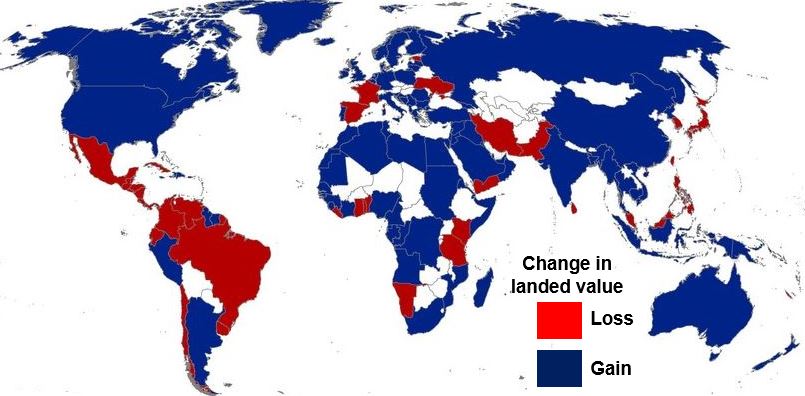
Very few countries would lose out if fishing in the high seas were banned. (Image: Scientific Reports)
The study, published in the academic journal Scientific Reports (citation below), found that the vast majority of countries would benefit from such a measure, and only very few would suffer.
Legally, the high seas are classed as international waters outside the EEZs. According to the United Nations (UN), an EEZ is a sea zone, 200 nautical miles wide, prescribed by the UN Convention on the Law of the Sea over which a nation has special rights regarding the exploration and use of sea resources, including energy production from water and wind.
Professor Côté and colleagues gathered and analyzed data to determine what the economic impact might be if the high seas were closed to fishing.
In an interview with the Vancouver Sun, Prof. Côté said:
“People have been talking about this for a while. What had been missing was an economic analysis. It’s fine to say, ‘Let’s close the high seas to fishing, there are likely to be some great ecological benefits to doing this.’ But at the end of the day, what’s going to happen economically to the countries no longer allowed to fish there?”
The team first had to find out what types of sea life were caught and where. How many species are caught only in the high seas, how many in the EEZs, and how many in both?
They found that most species were caught in both zones. Surprisingly, only a tiny number of fish stocks can only be caught in the high seas.

Isabelle Côté is Professor of Marine Ecology and Conservation at the Department of Biological Sciences, Simon Fraser University. (Image: SFU)
Prof. Côté said:
“Closing the high seas would remove all the fishing effort on those stocks, but that’s a tiny proportion – something like less than 0.1 per cent of catch-landings, the fisheries landings, in the world.”
Most catches occur in both regions
The vast majority of fishing profits come from species that can be caught both in the EEZs and the high seas, the researchers found.
Even if fishing in the high seas were banned, the fish would still keep crossing the artificial boundary, the authors pointed out.
However, if there were no fishing in the high seas, stocks of fish such as swordfish and tuna would be able to replenish outside of the EEZs.
As soon as stocks are plentiful in the high seas, the fishes start spilling over into the EEZs, resulting in greater catches there.
The authors hope their findings will provide the United Nations with stronger ammunition to adopt measures to ban high seas fishing.
Citation: “Winners and losers in a world where the high seas is closed to fishing,” U. Rashid Sumaila, Vicky W. Y. Lam, Dana D. Miller, Louise Teh, Reg A. Watson, Dirk Zeller, William W. L. Cheung, Isabelle M. Côté, Alex D. Rogers, Callum Roberts, Enric Sala & Daniel Pauly. Scientific Reports. Published 12 February 2015. DOI: 10.1038/srep0848.
