
Argentina defaults again, the second time the country says it cannot meet its debt obligations in thirteen years, after eleventh-hour negotiations with a group of bond-holders in New York got nowhere.
A deadline for 04:00 GMT Thursday had been set by a US judge for a deal to sort the crisis that started in 2001, when Argentina initially defaulted on its international debt.
Bond and stock prices are expected to decline, making it much more likely that the current recession will worsen.
The ‘vulture fund’ investors wanted a full payout on bonds they hold totaling $1.3 billion. Something Argentina says it cannot afford because other creditors could then line up asking for a full return of all debts.
Latin America’s third-largest economy accuses the bond-holders of profiting from their financial problems.
One hundred economists from around the world have written to the US Congress warning about the fallout from the New York court’s decision.
Bond holders reject Argentina’s proposal
Axel Kicillof, Argentina’s Economy Minister, announced Wednesday night that the bond-holders had rejected his government’s latest proposal.
Daniel Pollack, who was appointed by the court to mediate in the case, said no agreement had been reached and that Argentina would imminently be in default. He added that the full consequences of the default are difficult to predict, but he is sure they will not be positive.
Mr. Pollack said:
“Default is not a mere ‘technical’ condition, but rather a real and painful event that will hurt real people, these include all ordinary Argentine citizens, the exchange bondholders (who will not get their interest) and the holdouts ( who will not receive payment after the court judgments).”
This second default, although bad for Argentina’s economy, is unlikely to be as devastating as the one in 2001 which led to a banking crisis, customers’ accounts being frozen, violent street demonstrations throughout the country, and millions of job losses. During the first default the Argentinian government was insolvent. This time round it is solvent.
Even if the default is short lived, companies’ borrowing costs will rise, piling more pressure on the local currency, which in turn will drain foreign reserves further and push up an already high inflation rate (40%).
Foreign reserves refers to foreign currency that a government or central bank holds.
Reuters quotes Camilo Tiscornia, former governor of Argentina’s central bank, who said “It is going to complicate life for businesses like YPF which were going to look externally for financing.”
YPF, the state-controlled energy company, urgently needs funds to develop the country’s massive Vaca Muerta shale formation.
The investors, often referred to as ‘holdouts’, are American hedge funds that purchased debt at a discount following Argentina’s economic crisis. While most bond-holders agreed to a new restructuring deal, these so-called ‘vulture fund’ investors did not.
Exploiting a crisis for profit, says Argentina’s President
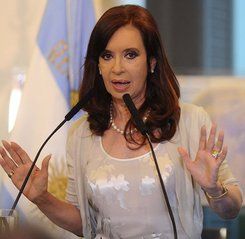
President Cristina Fernández de Kirchner describes the group of hedge funds led by Elliott Management Corp., which includes NML capital and Aurelius Capital Management, as vultures. She says they have exploited Argentina’s debt problems to make huge amounts of money.
The hedge funds are demanding that Argentina make interest payments on the debts it defaulted on thirteen years ago, even though they were bought at a discount.
The US courts will not allow the other bondholders who made a separate deal with Argentina to be paid until there is an agreement with the ‘holdouts’.
Argentina has approximately $29 billion of bonds denominated in foreign currencies and sold in international markets. The terms dictate that the country would have to pay back the whole balance (plus unpaid interest) if 25% or more of the holders demand that their money be returned. In such a scenario, the liabilities would be equal to the country’s eight-year-low foreign reserves.
Argentina not in default, says Kicillof
Ratings agency Standard & Poor’s downgraded Argentina’s long- and short-term foreign currency credit rating to ‘selective default’, which will remain until the country makes its overdue June 30 coupon payment on its discount bonds which mature in 2033, S&P said.
In a news conference, Mr. Kicillof described the judge as unfair and criticized S&P, saying that his country had posted money to make the interest payment. To declare Argentina in default made no sense, he added.
Mr. Kicillof said:
“Argentina paid, Argentina has money, and we’re going to keep making our future debt payments because we want to.”
He explained that his country could not pay the $1.5 billion verdict to the holdouts, because if it did it would also have to improve the terms for all the other investors who had previously agreed on a debt-restructuring deal, which might lead to claims exceeding $120 billion.
In an interview with Bloomberg, Alberto Bernal, head of research at Bulltick Capital Markets, said he believes the Argentine government will most likely wait until the beginning of 2015 before reaching an agreement with the hedge funds.
Mr. Bernal said “In the worst-case scenario, this probably will be fixed in the next six months. Argentines need the money, they need to come back to the market, and the holdouts want to get paid.”
