
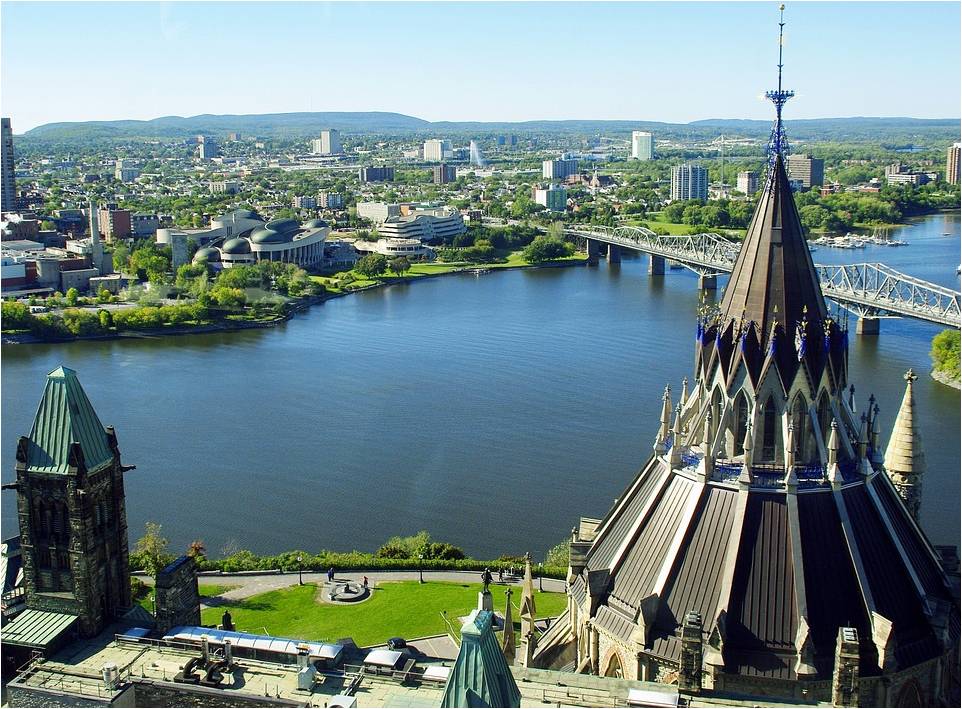
The government of Canada says that by 2025, all its buildings will be powered by green electricity.
The pledge is part of a wider plan for the federal government to cut its own greenhouse gas emissions by 40 percent by 2030, which it aspires to accomplish by 2025.
 Updating heating and cooling systems in over 80 government buildings in Ottawa is expected to cut their emissions by nearly 50 percent. Image shows view of river Ottaoutais and parliament in Ottawa. Credit: pixabay
Scott Brison, President of the Treasury Board, announced the plan in the House of Commons on 2 November.
The Treasury Board Secretariat is also setting up a Centre for Greening Government to track government emissions, coordinate efforts, and drive results.
Moving toward a cleaner, more innovative economy, not only reduces emissions and protects the environment, it also creates better-paid jobs for the middle class, the government maintains.
The reduction in emissions will come from using clean energy to power government buildings – which are owned and run by the government’s main landlord Public Services and Procurement Canada (PSPC) – and also from a range of other green strategies. These include investing in infrastructure and vehicle fleets, purchasing more sustainable products, and supporting clean technology.
“These actions demonstrate our leadership and dedication to improving the environment and the quality of life of Canadians,” says Judy Foote, Minister of Public Services and Procurement.
The federal government has already announced $2.1 billion in Budget 2016 will be set aside for repairs and retrofits of government buildings.
Greener and more efficient
The intention is not only to make building greener, but also more efficient, so they use less energy overall.
Improving the energy efficiency of government buildings will make a big difference. For instance, in Ottawa, modernizing the heating and cooling systems in more than 80 buildings is expected to cut their emissions by nearly 50 percent.
Joyce Murray, Parliamentary Secretary to the President of the Treasury Board, outlined the Canadian government’s plans to reduce its own greenhouse gas emissions in a speech to the Zero Waste 2016 Conference in Vancouver on 3 November.
Canada is well-endowed with sources of renewable energy
Renewable energy sources currently provide nearly a fifth of Canada’s total primary energy supply.
With its large land mass and diverse geography, Canada is well-endowed with sources of renewable energy, such as moving water, wind, biomass, geothermal, solar, and ocean.
At present, moving water provides nearly 60 percent of Canada’s electrical energy – in fact Canada is the second largest producer of hydroelectric power in the world.
Wind and solar – which currently account for less than a twentieth of the country’s electrical power – are the fastest growing renewable energy sources of electricity in Canada.
Shift toward a greener economy
Last year, the Green Economy Network (GEN) set out a plan for the greening of Canada’s economy. GEN members include Canadian-based environmental, social justice, and labour organizations such as the Canadian Labour Congress.
They maintain if the plan is fully enacted in the next 10 years, Canada could create over 2 million new person-job years and reduce total national greenhouse gas emissions by over 100 million tonnes a year by 2025.
The GEN plan includes detailed proposed strategies for: renewable energy development; green homes and green buildings; and national public transportation.
GEN note that not only would implementing such a plan result in the creation of many jobs, and make a substantial contribution towards Canada’s emissions reductions, it “would generate opportunities for the transition towards a more equitable as well as a more sustainable economy.”
Canada’s announcement follows recent news that Sweden is on target for generating 100 percent of its electricity from renewable energy by 2040.
Canada’s mining companies are also considering investing in renewable energy to bring down greenhouse gas emissions and stabilize energy costs.
