

The Destination Maternity Mothercare bid is over, says the world’s largest designer and retailer of maternity clothing. The US chain said in a statement that Mothercare shareholders would only be interested in “a very significant increase.”
Destination Maternity had sent Mothercare’s Board of Directors two written proposals for a possible merger of the two companies. Both were rejected.
The second proposal was worth £266 million ($456.5 million), which gave the UK retailer a market capitalization ($391 million) higher than that of Destination Maternity ($316 million).
Shareholders wanted much more money
Following its proposed bid on July 2, 2014, the US company’s financial adviser questioned a number of major Mothercare shareholders. It became clear that the stockholders would only consider a considerably increased offer, something Destination Maternity was obviously not willing to do.
The Board of the UK company and a number of its stockholders expressed concerns regarding Destination Maternity’s ability to finance the takeover.
Destination Maternity’s CEO, Edward Krell, said he was disappointed that Mothercare’s shareholders had not backed their proposal and that Mothercare’s Board was not willing to allow them to carry out customary due diligence and talk about the proposal.
He felt that a merger of the two companies made strategic sense, with two highly complementary firms combining to enhance their product range, spanning the pregnancy to toddler life-cycle.
Mr. Krell added:
“We further believe the combination would have created a global leader in maternity, baby and children’s apparel and products capable of accelerating the growth and long-term development of both businesses across channels and in markets around the world. In addition, we believe that Destination Maternity’s management expertise and strong maternity apparel offering would have provided an attractive enhancement to the Mothercare UK turnaround plan.”
Destination Maternity has 1,900 retail outlets and owns the brands Motherhood Maternity and A Pea in the Pod.
Mothercare has 191 shops and 40 Early Learning Centre stores in the UK. It also operates in fifty-nine countries with over 1,200 outlets.
Mothercare struggling with fierce competition
Mothercare’s new CEO, Mark Newton-Jones, who took over at the beginning of this year after a profit warning and the resignation of Simon Calver, admits that his company needs to modernize and that it has been struggling recently.
Mothercare is facing fierce competition from online retailers and supermarkets. More than 80 stores across the UK have been shut down while several have been revamped. The company says it has overhauled its Internet presence.
Last year, the UK chain said it expected to start making a profit again in 2014, but in January this year this was pushed back 2017.
Tax inversion concern
Mothercare’s Board of Directors expressed concern regarding Destination Maternity’s “proposed financing arrangements, and the significant transaction execution risks given the proposed transaction structure and tax inversion.”
Tax inversion is when a company in a high-taxed country becomes a subsidiary of a new parent company abroad so that it may fall under the corporate tax rate of that company, i.e. it moves its headquarters abroad in order to pay less corporate tax. This can be done if a US-based firm buys a foreign company.
At 40%, US has by far the highest corporate tax rate in the world, even higher than left-wing France, Venezuela, or Argentina.
Mothercare believes Maternity Destination’s main motive for the acquisition is to move its head office to the UK with its 21% corporate tax rate.
Several US based multinationals have been trying to buy companies abroad because of America’s high tax rates.
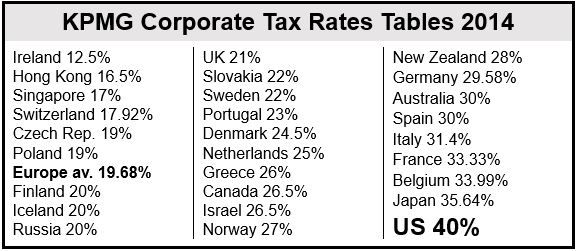
(Illustration data source: KPMG) What used to be the flagship of minimal government intervention and a free-market economy – the United States – has today become the one nation large companies are trying to flee from.
At a technical college in Los Angeles yesterday, President Barack Obama attacked companies that use cross-border acquisitions to flee from US taxes, accusing them of being “corporate deserters who renounce their citizenship to shield profits.”
Perhaps he should consider more seriously revising the country’s tax code, rather than resorting to political comments typically used by populist socialist leaders.
