

Google has announced it is to build self-driving cars. The Google Self-Driving Car Project team will build about 100 prototypes and will start testing them late this summer. The aim is to have a small pilot program of self-testing cars within the next two years.
Chris Urmson, Director of the Google Self-Driving Car Project, invites readers to imagine what it would be like to travel downtown at lunchtime without having the 20-minute ordeal of searching around for a parking space. “Seniors can keep their freedom even if they can’t keep their car keys,” he explains.
According to the project’s team, driving under the influence of alcohol, and even distracted driving would be history.
What would they look like?
Google says it is currently exploring what totally self-driving cars might look like by building a series of prototypes. The aim is to have safe and fully automated vehicles with no need for human intervention.

Google’s self-driving car will have no steering wheel or brake/accelerator pedals, because they will not be needed. All the stopping, starting, accelerating and steering will be done by the vehicle’s software and sensors.
Initially, the cars will be very basic. “We want to learn from them and adapt them as quickly as possible,” Urmson explains. But, at the push of a button, they will take you wherever you want.
Google self-driving car project – safer roads
The team believe a self-driving car would make the roads safer and transform the lives of millions of people who currently cannot drive.
Urmson says:
“It was inspiring to start with a blank sheet of paper and ask, ‘What should be different about this kind of vehicle?’ We started with the most important thing: safety.”
The vehicles will have a series of sensors that remove blind spots. Objects will be detected as far as two football fields away, and in every direction, a vital feature when going down busy streets with many intersections.
According to Google, the pictures show the city-car like features give the vehicle a “friendly face”, its non-threatening appearance will help people accept the self-driving technology.
Pedestrian safety
The front of the car is designed with pedestrian-safety in mind. Instead of a traditional bumper there will be a soft foam-like material. The windshield will be flexible, thus reducing the risk of injuries.
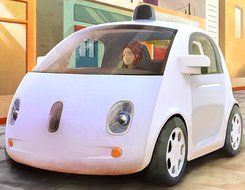
Google’s self-driving car will initially have a speed limit of 25 mpg (40.2 kph).
The Self-Driving Car Project team will focus on learning rather than luxury when designing the interior.
It will have two seats, two seat belts, space for your belongings, stop and start buttons, a screen displaying the route – “and that’s about it.” Creature comforts are currently not a top priority for the research and development team.
The 100 or so prototypes that will be tested later this year will have manual controls, but the aim is to eventually launch a car with no conventional controls at all.
Urmson wrote:
“We’re going to learn a lot from this experience, and if the technology develops as we hope, we’ll work with partners to bring this technology into the world safely.”
Readers are invited to visit the Self-Driving Car Project’s Google+ page where they can follow updates and share their thoughts.
Will it exacerbate traffic congestion?
A number of researchers working in self-driving R&D wonder whether these vehicles might actually heighten traffic and urban sprawl.
One of the reasons people avoid driving and take the train, bus or use a bicycle is stress and fatigue. Sitting behind a wheel in traffic jams every day amid other stressed and frustrated drivers is tiring if you drive conventional cars.
How many more of us will opt for the car if we can just lie back, read a book, do a crossword puzzle, or even go to sleep while the fully automated vehicle takes us to our destination?
Will we lose our driving skills?
Another downside could be that we forget how to drive properly if we do not do it regularly. The BBC quotes executive director of the Center for Automotive Research at Stanford, who worries that diminishing driving skills “could be particularly dangerous in emergency situations where the computer does not know how to react.” The computer might ask a human for input, but that person may not be paying attention.
Beiker said “You will not be able to fiddle around looking for the instruction manual in the glove box that you’ve never looked at before.” When cars with automatic gearboxes arrived, many people soon forgot how to drive manual cars, he added.
