
Right and left wing

Right wingers think they are morally superior

Published: 18:50, October 3, 2015

Contrary to popular belief, it is not the so-called sanctimonious left winger who thinks he or she is morally superior to others, but the right wingers, according to a study published this week by YouGov, an international online-based market research firm headquartered in the UK.

Most Brits today if asked would probably point to left-wingers, such as the Labour leader Jeremy Corbyn, as examples of people who believe they are morally superior to others. They tend to be the ones who talk the most about decency, compassion and caring for society’s most vulnerable people.

However, the new YouGov study shows the opposite is true – it is those on the right who are more likely to see themselves as morally superior.
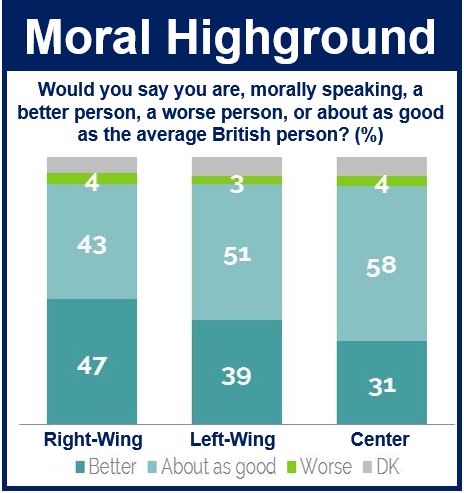
Moral HighgroundThe researchers were surprised with the results. (Source: YouGov)

Forty-seven percent of people who describe themselves are fairly or very right-wing or right-of-center see themselves as more of a good person than the average Brit, while 43% believe they are ‘about as good’.

Only 39% of left-winger believe they are morally superior to the national average, while 51% say they are about as good as others.


Fifty-eight percent of those in the center of the political spectrum claim to be about the same as others.

Good and bad people

Right-wingers are more likely to think that some of us are born evil – 39% of them, compared to 25% of left-wingers and 32% of the general population. So, it seems that those on the left are less likely to believe that in-born evil exists.
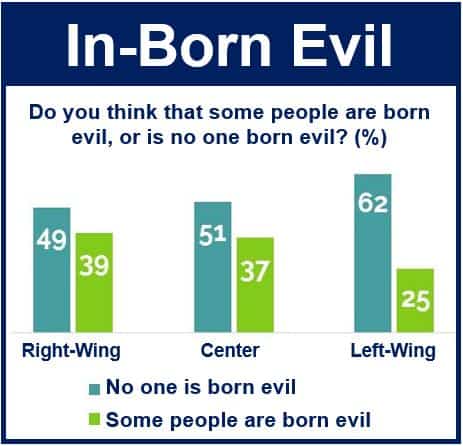
In born evilRight wingers are more likely to believe that some people are born evil. (Source: YouGov)

On the positive side, sixty-eight percent agree that there are more good people than bad ones in the world. The majority of people believe between 21% to 30% of individuals are bad and 61% to 70% are good.

Veronica Salvador Avatar

Other News

Free shipping and returns brought more shoppers back in a retail experiment

Nov 20, 2026

Learning about rivals’ robot use changed Italian firms’ investment plans

Nov 20, 2026

Automated lead nurturing does not improve every sales pipeline

Nov 20, 2026

Seeing competitors’ prices changed how nail salons set their own

Nov 20, 2026

Marketing mentors helped Ugandan small businesses grow in a field experiment

Nov 20, 2026

Customer reviews can influence the price negotiated for a new car

Nov 19, 2026

Why an ad A/B test can compare audiences as well as creative

Nov 19, 2026

Personalized AI video ads drew more clicks in a WhatsApp experiment

Nov 19, 2026

Restaurant advertising results can depend on an existing reputation

Nov 19, 2026

Search suggestions can help shoppers find less familiar products

Nov 19, 2026

AI-generated shoppers can give misleading pricing estimates, study finds

Nov 19, 2026

The design of a discount label can change how shoppers judge an offer

Nov 19, 2026

What virtual shopping tools can change before and after a purchase

Nov 19, 2026

Game-like loyalty features drew more engagement in an online grocery study

Nov 18, 2026

A delivery cue helped more shoppers move to the next checkout step

Nov 18, 2026

Small changes in a store can bring promotions back to repeat customers’ attention

Nov 18, 2026

Some sellers accept less when a buyer shares an item’s heritage

Nov 18, 2026

Changing a marketplace trust badge can change what sellers prioritize

Nov 18, 2026

Referred customers may bring in more customers of their own

Nov 18, 2026

An extra option can make an attractive menu less appealing, experiments find

Nov 17, 2026