

A merger is a fusion, a marriage, of two or more independent companies into a new single entity. In many cases, but not all, mergers involve the absorption of one or more enterprises by a dominant one. However, often it is simply a marriage of absolute equals.
There is a certain amount of overlap between the meanings of merger and acquisition. However, strictly speaking, a merger refers to two businesses of more or less equal size, while an acquisition is the purchase of one company by a larger one.
In a merger, the deal usually involves the total fusion of assets (shares). In an acquisition, there could be a straight purchase of the other company with cash, or cash plus some kind of share deal. In some cases, a merger may also involve cash with shares.
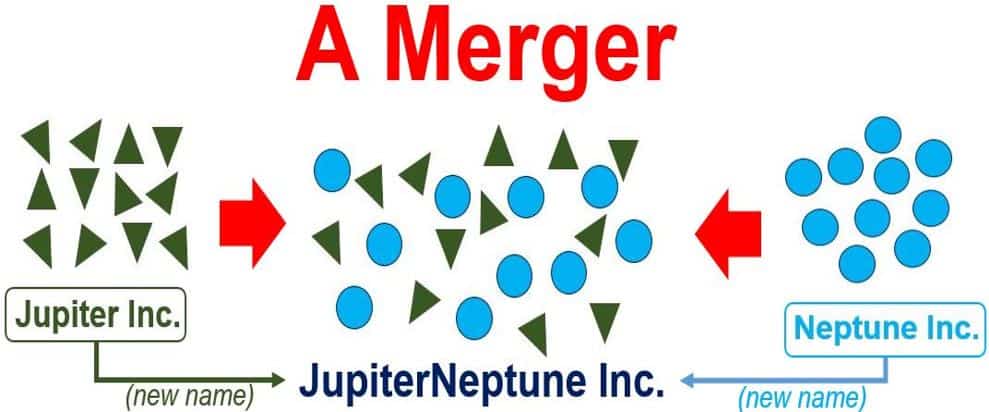 When a merger occurs a new entity (company) is formed, with a new name.
A merger may be vertical – where, for example, one company is the producer and the other is the supplier. It might be horizontal, where both companies produce the same product or service for identical markets.
In a market-extension merger, the two firms produce the same product or service for different markets, e.g. one dominates the European and the other the North American markets.
If the two merging businesses are not related to each other at all, the new entity is generally called a conglomerate.
Why do companies merge?
Perhaps to solve a problem of bitter competition – two rivals may decide their resources would be more effectively used if they got together and became one company, rather than wasting time and energy fighting each other all the time.
Others may feel that by joining together their tax bill would be lower, especially if one of the companies is based in a country with lower corporate tax rates.
Costs are often a strong motive – if two companies join, their different departments can get more work done per employee – this usually involves firing loads of staff.
Another major reason companies might merge is to widen their product portfolio. In many industries, research and development can take several years, even decades, to yield lucrative results. In the pharmaceutical industry, for example, two companies with different but complementary drug portfolios may feel that together they have a better chance of maintaining and/or gaining market share.
Two companies may merge because together they would have a wider geographical reach (market extension merger). If one multinational is strong in Europe, Asia and Africa, while the other has a strong North and South American presence, combining resources would make them truly global.
What is the difference between a merger and an acquisition?
There are several ways so called ‘experts’ describe the difference between a merger and an acquisition. The main difference between the two is that after a merger a new entity, a new company with a new name, is created, but after an acquisition the buying company keeps its original name.
For example – many years ago one merger occurred, followed by another several years later. Accounting firm Cooper Brothers & Co merged with Lybrand, Ross Bros & Montgomery to form Coopers & Lybrand. In 1998, Price Waterhouse merged with Cooper & Lybrand to form PricewaterhouseCoopers, which today is a huge multinational professional services network.
The examples above are mergers, because after each fusion, the name of the new company changed.
When Facebook bought WhatsApp last year for a whopping $19 billion, there was no new company called FacebookWhatsapp or anything like that. The larger company, Faceook Inc., kept its name. That was an acquisition. With acquisitions, the larger company does not change its entity – its name stays the same.
