
The German Leading Economic Index declined in June after rising marginally in May, while its Coincident Economic Index increased, says The Conference Board.
The Leading Economic Index (LEI) indicates the future direction of economic activity, the higher the number the greater the likelihood of growing economic activity. The Coincident Economic Index (CEI) measures current economic conditions – it helps investors and economists pinpoint where an economy is in the business cycle.
Leading Economic Index (LEI)
Germany’s LEI fell by 0.1% in June compared to May. The LEI in May had risen by 0.1% and by 0.2% in April.
June’s largest negative contributions came from consumer confidence and new orders in investment goods industries.
During the first half of 2014, the LEI grew by 1.5% (equivalent to 3% annually), approximately the same rate as in the second half of 2013. In recent months, the strengths among the leading indicators have become more widespread.
Of the seven components that make up the LEI, three contributed positively. Below is a list of the seven components and how they contributed to June’s result:
- yield spread (positive),
- stock prices (positive),
- inventory change (positive),
- new residential construction orders (negative),
- consumer confidence (negative),
- new orders in investment goods industries(negative),
- gross enterprises and properties income (unchanged).
The LEI for Germany stood at 110.1 at the end of June (2004=100).
Coincident Economic Index (CEI)
Germany’s CEI improved by 0.2% in June compared to May. It has been improving moderately during the first six months of 2014. Taken together, figures accumulated so far this year point to moderate economic expansion during the second half of 2014, at a pace that is unlikely to speed up.
CEI had increased by 0.1% and 0.2% in April and May respectively.
Of the four components that make up the CEI, three contributed positively to June’s figure:
- industrial production (positive),
- employed persons (positive),
- retail trade (positive).
- manufacturing sales (negative).
June’s CEI stood at 108.4 (204=100). During the first half of 2014, Germany’s CEI rose by 0.6%, with three of the components contributing positively.
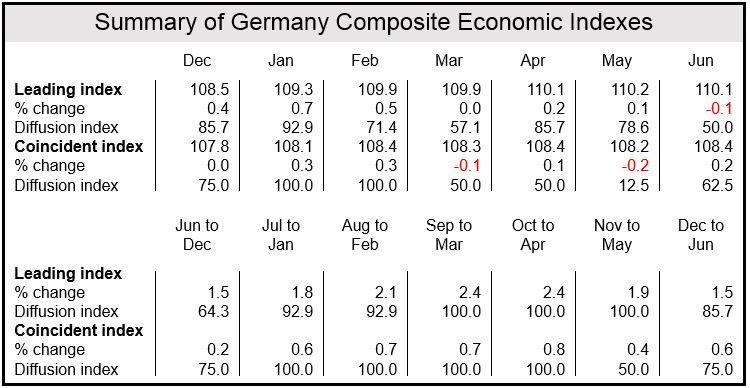
(Data source: The Conference Board)
Earlier this month, Germany’s Federal Statistical Office reported that factory orders plunged by 3.2% in June compared to May (which fell 1.6%). The same office posted a 1.8% decline in industrial production in May.
