
Today, many companies, organizations, and employment agencies use artificial intelligence (AI) to help them in the recruitment process. According to a new study carried out by German and Swedish researchers, most job applicants trust the avatars conducting their interviews. This trust, however, deteriorates if they do not get the job.
How fair applicants think this decision is depends on the identity characteristics of the avatar. The test subjects, consisting of 220 volunteers from the UK, Germany, and the US, who were most similar to their avatars in terms of skin color or gender, were more likely to feel that they had been treated unfairly. The ones who differed the most, on the other hand, were also less likely to feel they had been unfairly treated. This finding surprised the researchers, who had expected the opposite.
The number of employers who use AI in their hiring processes is rising rapidly. Initially, these tools just evaluated candidates’ CVs. Today, however, they can conduct interviews and decide who to hire or turn down.
“Avatars” are computer-generated people who interact and behave like human beings. Today, they can move, smile, frown, talk, make eye contact, nod, ask questions, and respond to answers. Apart from saving a lot of time, many experts say that AI is more impartial than human beings.
Enkelejda Kasneci, professor of Human-Centered Technologies for Learning at the Technical University of Munich, who was involved in the study, said:
“What has been largely overlooked so far is that we all unconsciously react to the avatars’ appearance, even when we know we’re talking to a machine. That’s why a conversation with artificial intelligence becomes a social interaction as soon as it behaves like a human.”
Simulated interviews
Lead author Ka Hei Carrie Lau, a doctoral researcher at the Technical University of Munich, and colleagues wanted to find out how job applicants perceive AI decisions in job interviews. They focused on how an avatar’s appearance might influence applicants’ perceptions of fairness if they didn’t get the job.
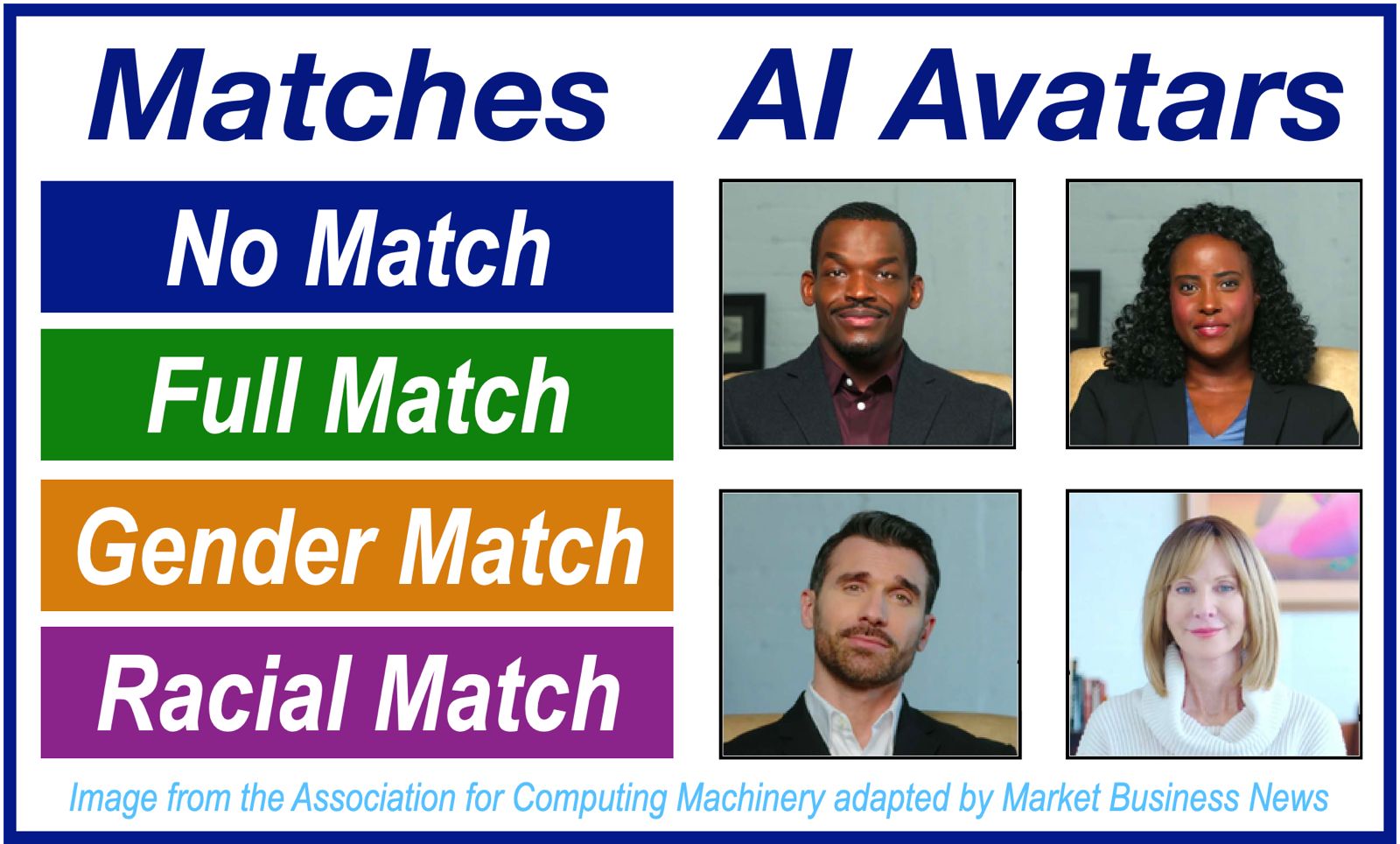
The volunteers took part in short simulated job interviews. They pretended to apply for a position in a fictional company’s customer support department. A photorealistic avatar capable of reacting to their answers and asking follow-up questions in a human-like way interviewed them.
The avatar could appear as:
- Male with light skin
- Female with light skin
- Male with dark skin
- Female with dark skin
The researchers also monitored the volunteers’ eye movements with eye-tracking technology. They completed a questionnaire after the interview.
Eye Tracking Differences
That the eye-tracking analysis revealed that volunteers focused more closely on the avatar’s face when it had a different skin color from their own.
When the avatar and the volunteer had different skin colors, the eye-tracking analysis showed that the volunteer looked more closely at the avatar’s face. At this point, trust in the artificial intelligence was consistently high regardless of whether the avatar’s and volunteer’s gender and skin color matched.
However, after all applicants were rejected for the job position and were interviewed again, perceptions changed in the following way:
- The volunteer was more likely to think the AI’s rejection was biased if the avatar had a different skin color.
- Those who matched their avatar in just one feature—either gender or skin color, but not both—felt the rejection was the least fair.
- Those who matched their avatar in both gender and skin color were less likely to think the decision was unfair.
- Volunteers with no features matching their avatar, in other words, their skin color and gender were both different, were also less likely to think the decision was unfair.
Prof. Kasneci said:
“The discussion about fairness in the use of artificial intelligence has so far revolved mainly around whether the models are programmed and trained without bias. But even if that is the case, AI may still be perceived as unfair. And this effect can arise for reasons other than what we might assume at first glance.”
“That’s why insights into our social behavior must be given greater consideration in the design of AI if these technologies are to fulfill their purpose – such as a recruitment process whose quality is recognized by all involved.”
Citation
Lau, K. H. C., Stark, P., Bozkir, E., & Kasneci, E. (2026). Skin-Deep Bias: How Avatar Appearances Shape Perceptions of AI Hiring. In Proceedings of the 2026 CHI Conference on Human Factors in Computing Systems (CHI ’26’). Association for Computing Machinery. https://doi.org/10.1145/3772318.3790379
