
Scientists have managed to replay a movie encoded in bacterial DNA for the first time. The researchers encoded the primitive film in bacterial DNA and then replayed it, in what the US National Institutes of Health (NIH) describes as a major step toward a molecular recorder that could lead to one day making it possible to get read-outs, for example, of the changing internal states of neurons during their development.
Seth Shipman, Ph.D., a post-doctoral fellow at Harvard Medical School in Boston, USA, said:
“We want to turn cells into historians. We envision a biological memory system that’s much smaller and more versatile than today’s technologies, which will track many events non-intrusively over time.”
Dr. Shipman, along with Dr. George Church, Dr. Jeffrey Macklis, and Dr. Jeff Nivala, all from Harvard, wrote about their proof-of-concept for a futuristic molecular ticker tape in the prestigious journal Nature (citation below).
Their study was funded by the National Institute of Mental Health (part of the NIH), the National Human Genome Research Institute, and the National Institute of Neurological Disorders and Stroke.
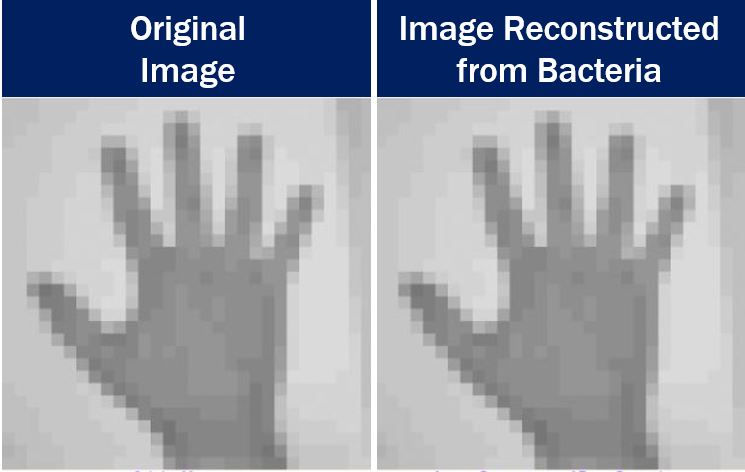 The image of a human hand (left) was encoded into bacterial DNA and then extracted (right) after several generations of bacterial growth. (Image: adapted from nature.com)
Bacterial DNA used to record sequential events
The authors explained that the ability to record such sequential events like a movie film at the molecular level is key to the idea of reinventing the concept of recording using molecular engineering.
Cells themselves could, in this scheme, be induced to record events at molecular level – such as gene expression changes over time – in their own genomes.
The data could be retrieved by simply sequencing the genomes of living cells it is stored in.
Dr. Shipman added:
“If we had those transcriptional steps, we could potentially use them like a recipe to engineer similar cells. These could be used to model disease – or even in therapies.”
Scientists used CRISPR technology
The scientists first had to show that bacterial DNA can be used to encode not just genetic data, but any arbitrary sequential data into a genome. For this, the researchers turned to the cutting-edge gene editing technology CRISPR.
First, they demonstrated that they were able to encode and retrieve an image of a person’s hand in DNA inserted into a bacterium. Then, they similarly encoded and reconstructed frames from a vintage Race Horse in Motion movie from the 1870s – the sequence of photos was an early forerunner of moving pictures.
Dr. Shipman and colleagues had previously shown that they were able to use CRISPR to store DNA sequences in bacteria.
CRISPR is a group of DNA and proteins that acts as an immune system to a number of bacteria, vaccinating them with the genetic memories of viral infections. When a bacterium is infected by a virus, CRISPR cuts out a part of the foreign DNA and stores it within the bacterium’s own genome.
This stored DNA is then used by the bacterium to recognize the virus and defend against future infections (attacks).
Dr. Shipman explained:
“The sequential nature of CRISPR makes it an appealing system for recording events over time.”
The scientists then similarly translated five frames from the racing horse in motion photo sequence into the DNA. They sequentially treated bacteria with a frame of translated DNA over the course of five days.
They were then able to reconstruct the motion picture with ninety percent accuracy by sequencing bacterial DNA.
Recording data in bacterial DNA has many potential uses, the authors explained. However, they would ultimately like to use it to study the brain.
Dr. Shipman said:
“We want to use neurons to record a molecular history of the brain through development. Such a molecular recorder will allow us to eventually collect data from every cell in the brain at once, without the need to gain access, to observe the cells directly, or disrupt the system to extract genetic material or proteins.”
Citation:
Shipman SL, Nivala J, Macklis JD, Church GM. CRISPR-Cas encoding of a digital movie into the genomes of a population of living bacteria. Nature, July 12, 2017, DOI:10.1038/nature2301.
Video – Bacterial DNA stores data for movie
The original images of the galloping horse (below left) are shown next to images encoded into bacterial DNA and recovered (below right) using CRISPR, a gene-editing tool.
