
Google says its quantum computer works a hundred million times faster than a conventional computer with a single processor. Quantum computing, seen as the Holy Grail of supercomputers, harnesses the power of atoms and molecules to perform processing and memory tasks infinitely faster than any silicon-based computer. Put simply, Google says its quantum computer is 100 million times faster than any current PC.
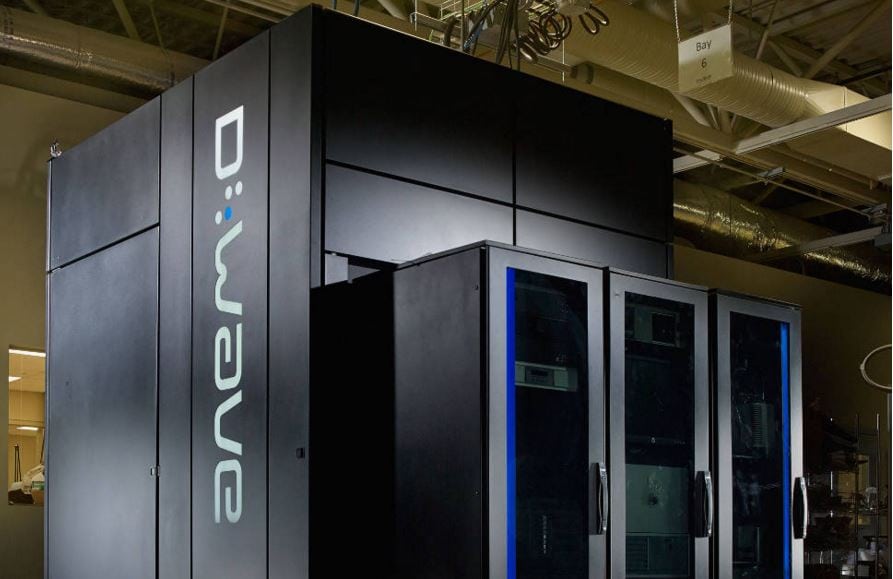
Google Inc. bought a controversial machine two years ago from Canadian startup D-Wave Systems Inc., which it now claims uses quantum physics to work through a type of mathematics that is essential for next-generation artificial intelligence.
Google posted its research paper in a Cornell University Library archive for studies that have not yet been formally peer-reviewed (citation below). The company says its research and results will soon be published in an academic journal.
Global quantum computer race
Governments across the world, research centres and major companies such as Google, IBM and Microsoft, are competing to become the first to develop quantum computers’ quantum mechanics to represent data.
Whoever gets there first will have the data-crunching powers we can currently only dream about.
NASA QuAIL (Quantum Artificial Intelligence Laboratory) says the following regarding quantum computing:
“Quantum computing is based on quantum bits or qubits. Unlike traditional computers, in which bits must have a value of either zero or one, a qubit can represent a zero, a one, or both values simultaneously. Representing information in qubits allows the information to be processed in ways that have no equivalent in classical computing, taking advantage of phenomena such as quantum tunneling and quantum entanglement.”
“As such, quantum computers may theoretically be able to solve certain problems in a few days that would take millions of years on a classical computer.”
Quantum computing technology the next milestone in hi-tech
Quantum computing could make artificial intelligence (AI) software so incredibly powerful that anything produced by current technology would seem like Stone Age devices in comparison. It would also take materials science to a new level.
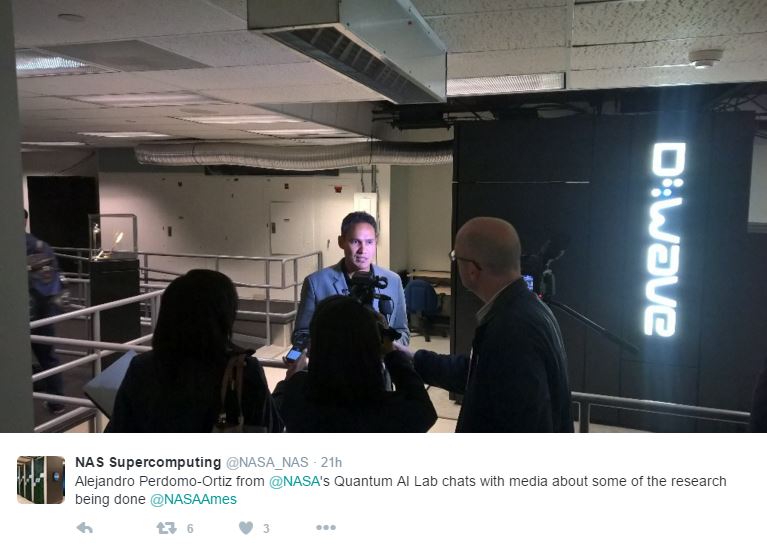
That is why NASA is so interested in the technology. The US space agency says it could would transform how it launches rockets and carries out future space missions.
Deepak Biswas, director of exploration technology at NASA’s Ames Research Center in Mountain View, California, said at a media briefing regarding quantum computing:
“It is a truly disruptive technology that could change how we do everything.”
The machine bought in 2013 is installed at the Ames Research Center and functions on data using a quantum annealer, a supercomputing chip that is hard-coded with an algorithm suited to so called ‘optimization problems’, which are commonly found in AI and machine-learning software.
D-Wave’s chips, however, are controversial among quantum physicists, which have not been able to provide compelling evidence of their ability to tap into quantum physics to operate faster than silicon-based computers.
Google says its device was 100 million times faster than a PC
According to Google’s Quantum AI Lab’s Director of Engineering, Hartmut Neven, he and his team have delivered some proof that quantum computing is possible.
German-born Neven and colleagues set up a series of races between a conventional computer with a single processor and the D-Wave computer at NASA.
According to Neven, the D-Wave computer was 100 million times faster!
Writing in MIT Technology Review, Tom Simonite describes Google’s results as ‘striking’, but adds that even if verified and confirmed, they would only represent partial vindication of D-Wave.
The conventional computer used in the race was running code using an algorithm similar to the one baked into the D-Wave chip. Had it used an alternative algorithm it would have been a much fairer race – it may even have won, by exploiting what Mr. Neven called a ‘bug’ in the design of D-Wave.
Even so, Mr. Neven pointed out, the test is still significant because that shortcut will not be available to traditional computers when they compete against future quantum annealers capable of working on considerable larger amounts of data.
Hopeful breakthrough will have commercial relevance
Mr. Neven added:
“We are optimistic that the significant runtime gains we have found will carry over to commercially relevant problems as they occur in tasks relevant to machine intelligence.”
VP of engineering at Google, John Giannandrea, who coordinates all research, said that if quantum annealers could be put into practical use, they could, for example, power up Google’s machine-learning software.
Mr. Giannandrea said:
“We’ve already encountered problems in the course of our products impractical to solve with existing computers, and we have a lot of computers. It may be several years before this research makes a difference to Google products.”
Quantum computers have incredible potential
Quantum computing has infinite potential, making light work of some of the most challenging tasks, such as simulating the human body’s response to medications, predicting weather patterns, analyzing colossal datasets, creating super-intelligent robots that can learn and continue upgrading themselves, etc.
Bloomberg Businessweek spoke with Brad Pietras, Lockheed’s vice president in charge of technology, about quantum computing’s value to his employer’s business and its future:
“Quantum computing is a practical tool for extremely complex predictive analysis, and machine learning where you need to assess many variables and many patterns and test models against it.”
“This is relevant in the area of drug discovery, cybersecurity, business, finance, investment, health care, logistics, and planning. There are a number of business applications—those that involve solving complex optimization problems—that today would be too difficult to address with silicon computing.”
Conventional computing will prevail
He does not believe quantum computing will do away with conventional computing altogether. We would not want to use a quantum computer to, for example, balance our checkbook.
Quantum computing, he explains, best addresses those extremely complex computational problems – for example, in drug discovery, when you have many trillions of combinations of amino acids to cycle through to find that single protein. That’s where quantum computing comes in. “That’s the power of it, in a nutshell,” he said.
Citation: “What is the Computational Value of Finite Range Tunneling?” Vasil S. Denchev, Sergio Boixo, Sergei V. Isakov, Nan Ding, Ryan Babbush, Vadim Smelyanskiy, John Martinis, Hartmut Neven. Cornell University Library. 7 December, 2015. arXiv:1512.02206 (quant-ph).
Interesting related article (2019): “Researchers demonstrate a way to improve quantum key distribution over fiber networks.”
Video – Google & NASA’s Quantum Artificial Intelligence Lab
This video, released by Google in 2013, lets us take a peek at the early days of the Quantum AI lab, a partnership between Google, NASA and USRA.


Comments are closed.