
Russia’s energy giant Rosneft needs money, specifically 1.5 trillion rubles ($42 billion), and is having problems getting it because sanctions imposed by the US and its allies have severely undermined the company’s ability to raise long-term financing.
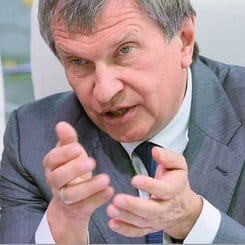
CEO Igor Sechin has requested a $42 billion loan from the National Wealth Fund, which finance’s Russian state pensions.
In a statement to journalists today, Deputy Prime Minister Arkady Dvorkovich said the government will consider Rosneft’s request and respond within the next two weeks.
Local newspaper Vedomosti quoted an unnamed person claiming to be familiar with the matter who doubts the request will be approved. The paper quotes another person who described Sechin’s request as “horrible”.
The Moscow Times quotes brokerage Okritie, which said in a note “The state’s financials have little room to accommodate a request for funding on such scale. Enthusiasm to support the country’s largest tax payer via a reversal of the cash flow will be limited.”
The National Wellbeing Fund has an $86 billion pool. Most of the money has already been assigned to a series of projects. How it would be able to fund Mr. Sechin’s request is unclear.
Sanctions starting to hurt
Evidence is starting to emerge of the effectiveness of Western economic sanctions against Russia. Today, the Kremlin said it is planning to provide aid to the tune of 40 billion to 50 billion rubles ($1.1 billion to $1.4 billion) in the wake of an import ban on foods and agricultural products from certain countries – a bizarre tit-for-tat ban response because it appears to hurt Russians more than foreigners.
One of President Vladimir Putin’s most trusted economic advisers, ex-Finance Minister Alexei Kudrin, who quit in protest in 2011, commented on Twitter that Rusneft’s request for financial help confirms that Russia is and will suffer economically as a result of Western sanctions. He predicts the economic toll for his country will exceed $200 billion over the next 36 months.
In the new wave of sanctions imposed by the US and its allies, following the shooting down of flight MH17 in Ukrainian airspace, extra pressure has been brought to bear on Russia’s energy industry.
Sanctions have been imposed on the country’s largest and second largest energy companies – Rosneft and Novatek. Restrictions have also been placed on the sales of technology to Russia’s oil & gas industry.
Over 50% of Russia’s government revenues come from its energy industry.
Rosneft heavily indebted
Following the purchase of TNK-BP last year, Rosneft, which pumps 40% of Russia’s oil, is up to its ears in debt (net debt of almost 1.5 trillion rubles or $42 billion). By the end of 2015, the company has to pay back 1.1 trillion rubles – 440 trillion of that by the end of 2014.
The huge chunk of money Rosneft will likely get from China’s CNPC, after the two companies signed a long-term natural gas mega-deal earlier this year, might help pay off most of the debt, but would be nowhere near enough to see through a series of projects in the Arctic the company has planned.
Rosneft is 69.5% owned by the Russian government, while UK multinational BP owns the remaining 19.75%.
Other sanctions-hit Russian companies have come to the government asking for financial help via state funds, including the Russian Agricultural Bank, VEB (Vnesheconombank), and Gazprombank.
