
The potential for “rotor sails” to cut fuel consumption of ocean-going vessels is being tested in a new project. It will be the first installation of the wind-powered energy technology on a product tanker vessel.
The project is a partnership between Energy Technologies Institute, Norsepower Oy Ltd, Maersk Tankers, and Shell Shipping and Maritime.
In this article, ‘shipping’ refers to the transportation of cargo/freight by sea.
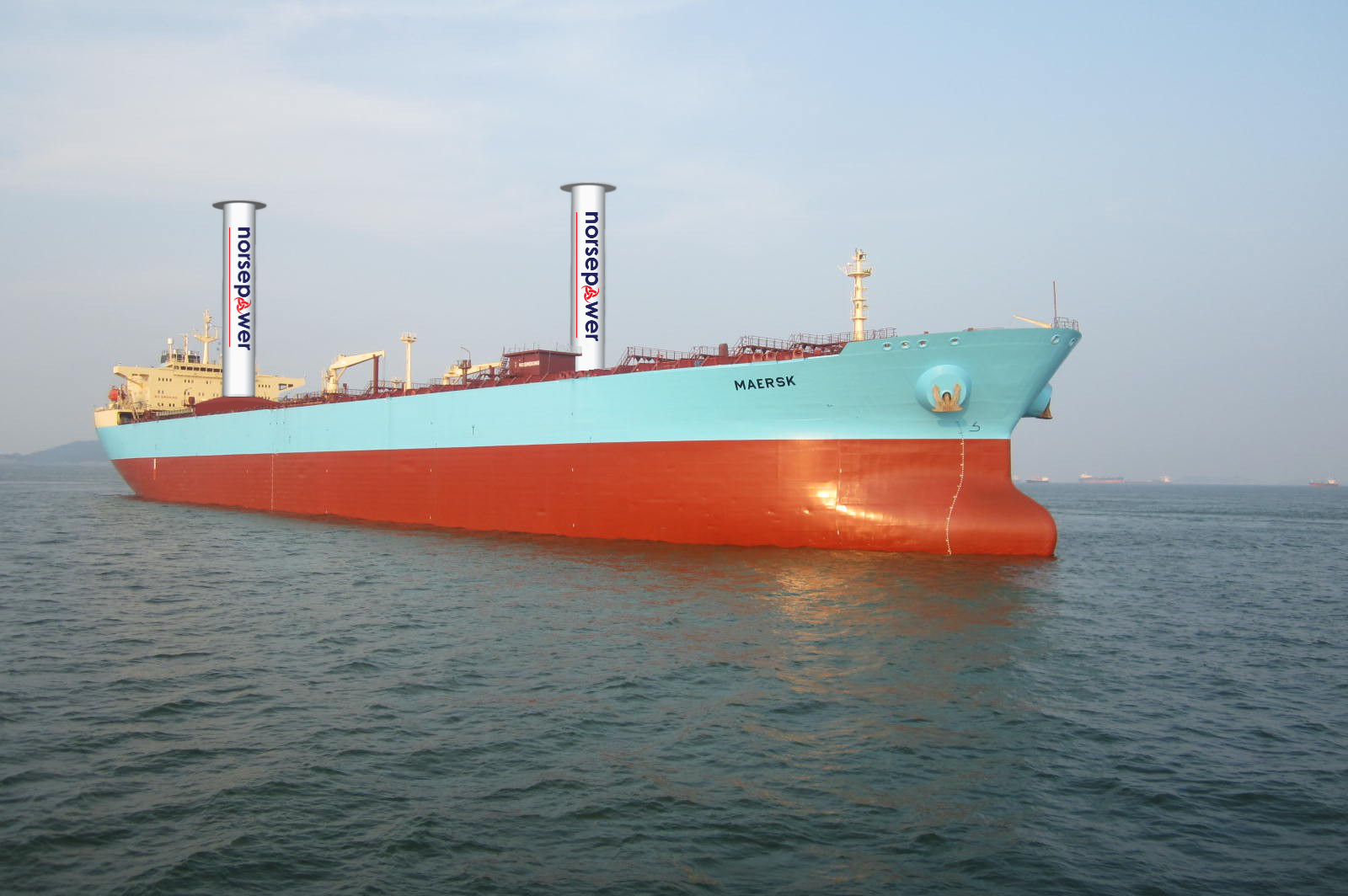
The plan is to retrofit Norsepower rotor sails to a Maersk tanker during the first half of 2018 and then test their performance and operation as the tanker undertakes various voyages until the end of 2019.
The rotor sails will be 30 metres tall and 5 metres in diameter and will be fitted to a 109,647-deadweight tonne (DWT) Long Range 2 (LR2) product tanker vessel.
When wind conditions are favourable, the rotor sails allow the ship’s main engines to be throttled back without losing the power needed to maintain the required speed and journey time. The result is lower fuel consumption and emissions.
Shipping industry under pressure to reduce emissions
The shipping industry is coming under increasing pressure to reduce fossil fuel consumption and emissions. Ocean-going ships have a large impact on CO2 emissions because of the length and speed of their voyages.
The International Maritime Organization (IMO) suggests that by 2050, maritime emissions will be 250 percent higher than they were in 2011 – unless action is taken now.
Tankers, bulk carriers, and container ships are the biggest culprits. However, it seems unlikely that the shipping industry will eliminate fossil fuel consumption, so the next best option is to cut CO2 by reducing fuel consumption.
Rotor sails could cut global shipping fuel consumption by up to 10 percent
The project partners anticipate that two rotor sails on such a tanker could potentially reduce average fuel consumption on typical global shipping routes by up to 10 percent.
The rotor sails are a modern version of the Flettner rotor – a spinning cylinder that harnesses wind power.
The technology works because of the Magnus effect – the force that allows golfers, cricket bowlers, baseball pitchers, and other ball players to curve a ball’s flight. It is also the principle that Barnes Wallis applied to his bouncing bomb.
Rotor sails could significantly improve environmental impact of shipping
ETI – a partnership between UK industry and government that focuses on low carbon energy – are the main backers of the project, with Maersk Tankers and Norsepower also contributing funds.
Shell are coordinating the project and providing operational and terminal/port expertise to the team, with Maersk consultants also giving operational and technical advice.
Andrew Scott, ETI programme manager for HDV Marine & Offshore Renewables, says that the project is the first to provide an opportunity to prove the benefits and test the operation of the rotor sails on a suitable ocean-going marine vessel, and adds:
“Flettner rotors have the potential to reduce ship fuel consumption substantially, especially on tankers and dry bulk carriers.”
The hope is the project will demonstrate the benefits of fitting rotor sails to shipping companies and investors. The technology “could play a significant role in reducing the fuel costs and improving the environmental impact of shipping in the future,” says Scott.
Tuomas Riski, CEO of Norsepower, says they are optimistic that having the backing of leading organizations such as Maersk Tankers, Shell, and the ETI, will “open up the market for our technology to a larger number of long-range product tanker vessels – paving the way for ship fuel efficiencies, and ultimately reducing emissions, including greenhouse gases.”
Video – rotor sails in action
The following video introduces the idea of Norsepower’s rotor sails and shows them in operation on Bore’s Ro-Ro vessel Estraden.
