
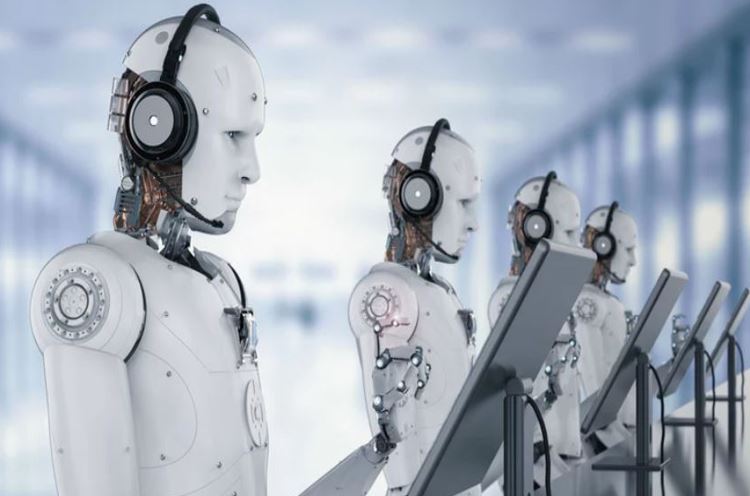
Could AI robots one day develop prejudice on their own? It is not necessary to have a high level of cognitive ability to show prejudice towards others. New research suggests that machines with AI could easily exhibit it.
AI stands for artificial intelligence. The term refers to software technologies that make robots and computers think like humans. It also makes them behave like humans.
Psychology and computer science experts from MIT and Cardiff University have demonstrated the existence of prejudice in autonomous machines. They demonstrated prejudice by simply identifying, mimicking, and learning this behavior from their peers.
The researchers wrote about their study and findings in the journal Scientific Reports (citation below).
Prejudice, seemingly a human-specific phenomenon
Prejudice, it may seem, is a human-specific phenomenon that requires human cognition to form an opinion of somebody or a specific group. It also requires human cognition to stereotype specific people or groups.
Some computer algorithms have already exhibited signs of prejudice, including sexism and racism. They learned prejudice based on learning from public records and other data that humans had generated.
However, in this latest study, the researchers demonstrated that AI may evolve prejudicial groups on their own.
The new findings are based on computer simulations of how like-minded people or virtual agents can form a group. They also subsequently interact with each other. In this case, the like-minded individuals had similar prejudices.
In an Abstract that precedes the main article in the journal, the authors wrote: “The results also demonstrate that prejudice is not dependent on sophisticated human cognition and is easily manifested in simple agents with limited intelligence, having potential implications for future autonomous systems and human-machine interaction.” Image: cardiff.imgix.net
Game of give and take
The researchers set up a game of give and take. Each individual had to decide whether to donate to somebody within the group or to an outsider. The decision was based on the individual’s reputation, and also their donating strategy. Their donating strategy included their levels of prejudice towards others.
The game unfolded and a supercomputer played thousands of simulations. Each individual started to learn new strategies. They learned them by copying others either within their specific group or the whole population.
How prejudice evolves
Regarding how prejudice evolves and also the conditions that impede or promote it, Prof. Roger Whitaker said:
“By running these simulations thousands and thousands of times over, we begin to get an understanding of how prejudice evolves and the conditions that promote or impede it.”
Prof. Whitaker works at Cardiff University’s Crime and Security Research Institute and the School of Computer Science and Informatics. Co-authors were Gaultiero B. Colombo and David G. Rand. Gaultiero and Rand are from Cardiff University and MIT respectively.
The individuals updated their prejudice levels by preferentially copying those that gained a higher short-term payoff. This means, therefore, that advanced cognitive abilities are not necessary to make these decisions.
Prof. Whitaker continued:
“It is feasible that autonomous machines with the ability to identify with discrimination and copy others could in future be susceptible to prejudicial phenomena that we see in the human population.”
“Many of the AI developments that we are seeing involve autonomy and self-control, meaning that the behaviour of devices is also influenced by others around them.”
“Vehicles and the Internet of Things are two recent examples. Our study gives a theoretical insight where simulated agents periodically call upon others for some kind of resource.”
Conditions that impede prejudice
The researchers also found that under certain conditions, prejudice was less likely to take hold. More distinct populations existing within a population, for example, made it more difficult for prejudice to take hold.
Prof. Whitaker concluded:
“With a greater number of subpopulations, alliances of non-prejudicial groups can cooperate without being exploited.”
“This also diminishes their status as a minority, reducing the susceptibility to prejudice taking hold. However, this also requires circumstances where agents have a higher disposition towards interacting outside of their group.”
Citation
“Indirect Reciprocity and the Evolution of Prejudicial Groups,” Roger M. Whitaker, Gualtiero B. Colombo, and David G. Rand. Scientific Reports, Volume 8, Article number: 13247 (2018). https://doi.org/10.1038/s41598-018-31363-z.
