
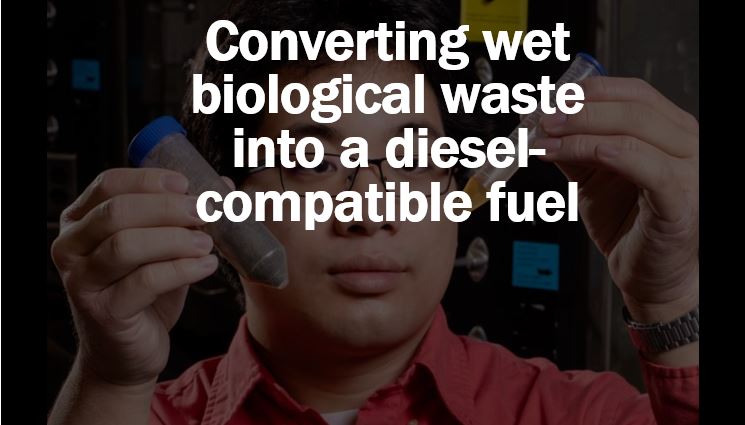
A team of scientists has converted wet biological waste into diesel-compatible fuel. We are now a step closer to producing renewable engine fuels from wet biological waste that are compatible with current diesel fuel infrastructure.
Renewable fuel or renewable energy is energy that comes from an everlasting source. Solar energy, wind energy, and biomass energy, for example, are renewable sources of energy. Coal, oil, and gas, i.e., fossil fuels, on the other hand, are non-renewable. We may completely run out of fossil fuels one day, but not the energy from the Sun, wind, or biological waste.
Biological waste includes, for example, food scraps. Pig manure is also a kind of biological waste. This new renewable fuel shares the combustion efficiency of diesel as well as its emissions profile.
The researchers reported their study and findings in the prestigious journal Nature Sustainability (citation below).
Co-author Brajendra K. Sharma wrote:
“The demonstration that fuels produced from wet waste can be used in engines is a huge step forward for the development of sustainable liquid fuels.”
Dr. Sharma is a Research Scientist at the Illinois Sustainable Technology Center at the University of Illinois’ Prairie Research Institute.

The US produces lots of biological waste
According to the authors, the USA produces approximately 79 million tons of wet biomass annually. This biomass comes from animal production and food. As urbanization increases, the amount of wet biological waste will increase, they said.
Water content is one of the biggest obstacles to extracting energy from biological waste.
A potential solution to this problem is hydrothermal liquifecation or HTL. HTL uses water as the reaction medium and converts even non-fatty (non-lipid) biological waste components into biocrude oil. The biocrude oil can then be further processed into engine fuels, say the authors.
Combining distillation with esterification
In previous studies, researchers stumbled into attempting to distill the biocrude generated through HTL into stable, usable fuels. In this new study, the scientists combined distillation with esterification to convert distilled biocrude’s most promising fractions into a liquid fuel. Specifically, a fuel that we can blend with diesel.
The fuel the researchers produced in this latest study meets current specifications and standards for diesel fuel.
Wan-ting (Grace) Chen said:
“Our group developed pilot-scale HTL reactors to produce the biocrude oil for upgrading. We also were able to separate the distillable fractions from the biocrude oil.”
“Using 10-20 percent upgraded distillates blended with diesel, we saw a 96-100 percent power output and similar pollutant emissions to regular diesel.”
Chen, who was Prof. Zhang’s graduate student, is now an Assistant Professor at the University of Massachusetts..
Making a pilot-scale reactor
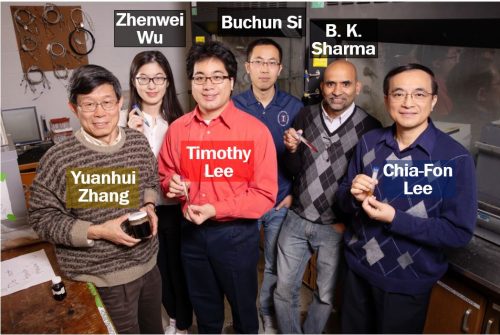
Co-author, Yuanhui Zhang, is leading a team that is building a pilot-scale reactor. They will mount the reactor on a mobile trailer.
Zhang is a Professor at the University of Illinois at Urbana-Champaign’s Department of Agricultural and Biological Engineering.
Prof. Zhang said:
“(The pilot-scale reactor) has the capacity to process one ton of biowaste and produce 30 gallons of biocrude oil per day.”
“This capacity will allow the team to conduct further research and provide key parameters for commercial-scale application.”
Citation
“Renewable diesel blendstocks produced by hydrothermal liquefaction of wet biowaste,” Alice Lin, Wan-Ting Chen, Yuanhui Zhang, Chia-Fon F. Lee, Timothy H. Lee, Zhenwei Wu, Buchun Si, & Brajendra K. Sharma. Nature Sustainability, Volume 1, Pages 702–710 (2018). DOI: https://doi.org/10.1038/s41893-018-0172-3.
