
CERN’s Large Hadron Collider (LHC), the world’s most powerful particle collider, has undergone a $151 million upgrade and is set to be operational again in March 2015.
CERN (Organisation Européene pour la Recherche Nucléaire, or European Organization for Nuclear Research) says the LHC, which is located near Geneva in Switzerland, has been undergoing a comprehensive two-year overhaul.
The world’s largest particle physics laboratory says the particle collider will resume circulating proton beams in March and expects the first collision to occur in May 2015.
The LHC was temporarily switched off in 2012 after it had discovered a subatomic particle called the Higgs boson, nicknamed the ‘God Particle’, which is believed to give mass to matter. It was a crowning achievement and said to justify the cost of creating the LHC.
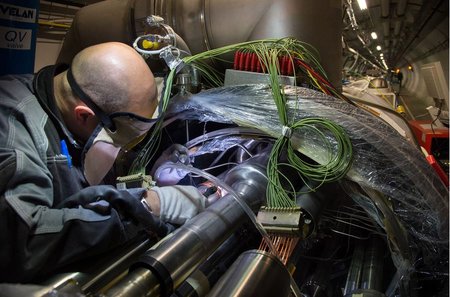
After the upgrade, the Large Hadron Collider will have more than twice the power. (Photo: Science & Technology Facilities Council)
Following its latest upgrade, the particle collider will be able to function at double its previous power, which will help physicists gain a deeper understanding of the Universe, including dark matter and dark energy. According to scientists, dark energy and dark matter account for 27% and 68% of the Universe respectively, while what we can visibly detect in galaxies, such as planets and starts, only represent 5%.
Experimental particle physicist Gabriella Sciolla said:
“Doubling the energy will have a huge impact on the search for new particles at LHC. The higher the energy, the heavier the particle one can possibly produce.”
Scientists hope the LHS will prove that every particle we know about has an identical and unidentified super-particle (theory of Supersymmetry).
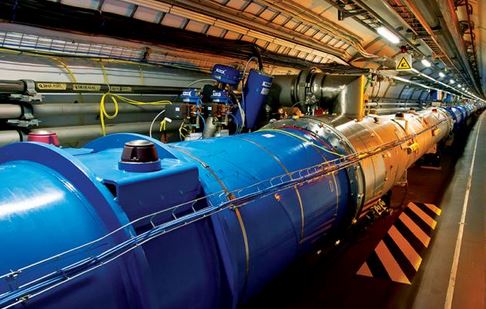
The Large Hadron Collider is the world’s largest and most powerful particle accelerator. (Photo: CERN)
The LHC this time round will carry out four experiments: Alice, CMS, Atlas and the LHCb.
Head of the University of Liverpool LHCb group, Professor Tara Shears, said:
“We have unfinished business with understanding the universe. We expect to gather additional evidence in order to know more about antimatter, and why there’s so little in the universe. We want to chase the hints we’ve seen in previous measurements, whose behavior didn’t quite match our expectations, in case these hints turn into discoveries. We’ve spent the shut-down readying and improving the LHCb detectors so that we can explore this new data with precision.”
Professor John Womersley, particle physicist and Chief Executive of the Science and Technology Facilities Council said:
“There’s been a huge amount of work done on the LHC over the past two years – for example, every single one of the electrical links between the thousand magnets in the accelerator ring has been reworked.”
“This means that it will be able to operate at almost double the previous beam energy, bringing huge potential for major new discoveries beyond the Higgs boson that was found in 2012. But it also means that the machine that’s now being started up is almost a new LHC, and it’s not a trivial challenge. Nonetheless, everything is on track for the LHC experiments to start collecting data in this new era by May 2015.”
Video – About CERN
