
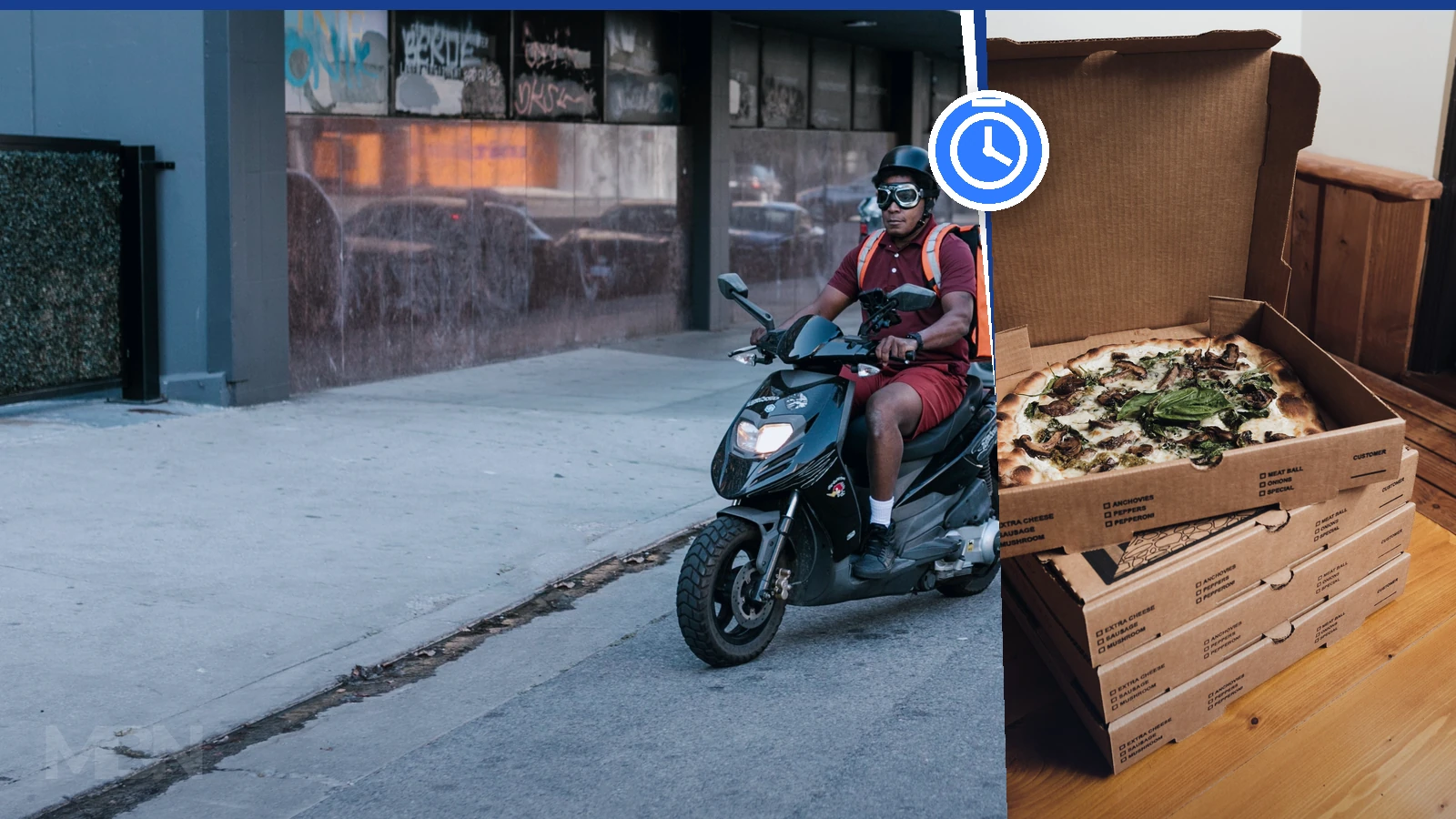
Customers in an Italian pizza-delivery market placed enough weight on speed that, for the median consumer, cutting the wait by half was worth more than 20% of the order price. The researchers found that impatience can protect nearby sellers from price competition, although very large delivery improvements may eventually remove that protection.
The research was published online in Marketing Science on 4 June 2026. Chaewon Seol and Federico Rossi of Purdue University worked with Sara Valentini of Bocconi University and Elisa Montaguti of the University of Bologna.
The team analysed nearly 98,000 orders placed by more than 6,800 customers with 51 independently owned pizzerias in a major Northern Italian city. The orders date from 2010 and 2011.
The age of the data limits what the study can say about today’s delivery apps. Its main contribution is an estimate of how waiting time affected real purchasing decisions, followed by modelled scenarios showing how faster delivery might alter competition.
Waiting time becomes part of the price
A customer comparing two restaurants sees more than menu prices. The order also carries a time cost: how long the customer expects to wait before eating.
The researchers estimated that the median customer valued a 50% reduction in delivery time at more than one-fifth of the order price. That does not mean every customer would pay the same premium. It shows that speed carried a substantial monetary value in this market.
That preference narrows the set of sellers a customer is likely to choose. A distant pizzeria may have a lower price or stronger appeal, but the extra wait makes switching less attractive. The nearby restaurant consequently faces less pressure to reduce its price.
The paper describes this as reduced substitution. Substitution occurs when customers move from one seller to another because the alternative offers a better combination of price, product and service.
Seol said impatience “fragments the market”, protecting providers that rely on proximity while limiting the reach of more attractive competitors, according to an INFORMS summary of the research.
The paper uses “quality” as part of its economic analysis of seller appeal. Readers should not interpret the label as the result of a blind pizza tasting. The study examined purchase choices and estimated the attraction of each pizzeria after accounting for factors such as price and delivery time.
Faster delivery first spreads demand more widely
The researchers then used their model to estimate what might happen if technology reduced delivery times.
Moderate improvements initially lowered market concentration, meaning orders were distributed across a wider range of pizzerias. Central restaurants lost some of the advantage created by being close to many customers, while suburban sellers became able to compete across a larger area.
The direction reversed when the model cut delivery times by more than 75%. Distance then mattered much less, allowing the pizzerias with the strongest underlying appeal to reach customers who had previously chosen a closer option.
Demand became more concentrated among those sellers, while the model projected that many weaker and mid-ranking pizzerias would leave the market.
These business exits were not observed in the order data. They are counterfactual results, produced by changing delivery times inside the model to estimate how customers and sellers might respond.
The sequence explains why a small improvement in delivery and a dramatic one need not produce the same competitive outcome. A modest gain helps more sellers reach customers. A much larger gain weakens the local protection that proximity once provided.
Platforms may be able to sell speed separately
Customers did not all place the same value on a shorter wait. That gives a delivery platform a way to charge impatient buyers more without raising the standard price for everyone.
In one modelled scenario, the platform offered a service that was 10% faster and charged an extra fee equal to 10% of the basic menu price. Estimated platform profit rose by 18.7%.
The result is an example of price discrimination, which means charging different customers according to how much they are willing to pay. The premium customer is buying the same meal but paying extra to receive it sooner.
The 18.7% figure is not the observed result of a real platform launch. It depends on the researchers’ estimated customer preferences and the assumptions used in their simulation.
