
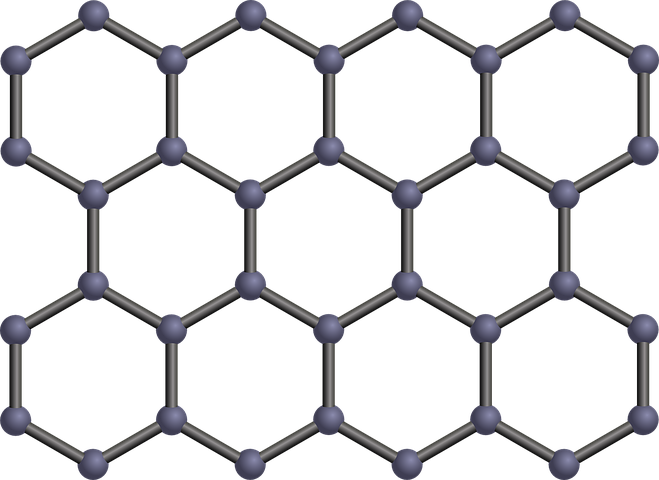
Using graphene ribbons and carbon nanotubes, engineers have created and tested a new type of computing logic structure based on spintronics that could one day make computers 1,000 times faster and use 100 times less power.
A paper on the work was published recently in the journal Nature Communications.
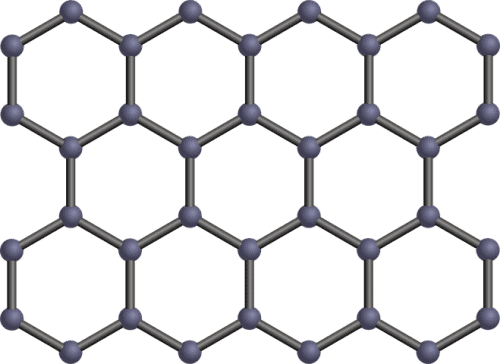 With the help of graphene, engineers believe that they can develop a new type of digital circuit that uses electron spin to vastly improve processing speed and reduce power consumption. Image: pixabay-161773
Whereas electronics is limited by the fact that it uses only one property of electrons, their (negative) electric charge, spintronics adds the use of another property, electron spin.
Digital circuits and cascade of logic
Today’s digital circuits are made of transistors that act as logic gates that work in a binary fashion.
For example, an AND gate always outputs “TRUE” or “1” when all of its inputs are set to “TRUE” or “1,” otherwise it outputs “FALSE” or “0”.
In most cases the 1 is represented by high voltage (usually +5V) and the 0 is represented by low voltage (usually 0V).
The transistors are connected to each other by wires so that the output of one becomes the input of another.
In this way, one can envisage that the processing of data flows like a massive cascade of logic through the millions of transistors contained on a computer chip.
Electrons also have spin
But no matter how much you improve the materials and miniaturize the components, the physical speed of such a system is limited by how fast the voltage can flip between the two states of 1 and 0.
This limitation exists because the technology manipulates only one property of the electron, its electrical charge. By creating a voltage potential, it makes the electrons move along to create a current.
But electrons also have another property, aside from their mass and charge, that is called angular momentum, or spin. And spin is to do with magnetism, not electricity.
Imagine an electron as a tiny billiard ball spinning on its axis. Spinning one way produces a magnetic field with the north pole at the top, and spinning the other way creates a north pole at the bottom.
Spintronics is like electronics “with extras,” where the extras are the ability to manipulate electron spin as well as charge.
Carbon gates can cascade directly
There are at least two ways that spintronics increases the range of things you can do with electrons: working at a very small scale, you can use electrons to generate a magnetic field, and you can use a magnetic field to move electrons (like passing a magnet over iron filings).
Already one can see a potential advantage for digital circuits: you could make things happening in one logic gate influence another logic gate without having to connect them physically – you can get rid of the wires. And that is essentially what the engineers in the new study have shown.
They discovered that electrons moving in carbon nanotubes or extremely thin wires made of carbon, generate a magnetic field that affects the flow of electrons in an adjacent graphene nanoribbon (essentially a very flat carbon ribbon that is only one atom thick). Effectively, this is a carbon transistor or gate.
“These carbon gates can be cascaded directly; no additional intermediate devices are required between logic gates,” note the engineers.
Computers working 1,000 times faster
Ryan M. Gelfand, an assistant professor at the University of Central Florida, and one of the team working on the new carbon-based spintronics system, says:
“If you want to continue to push technology forward, we need faster computers to be able to run bigger and better simulations for climate science, for space exploration, for Wall Street. To get there, we can’t rely on silicon transistors anymore.”
While it is early days and a lot more research and testing needs to be done, he and his colleagues believe that their carbon-based spintronics could lead to computers working some 1,000 times faster (at clock speeds measured in terahertz) and using much less power.
