

featured-image-standard-abstract-lines-dots-nodes-connecting

An overview of the US economy in 2014

Written by Joseph Nordqvist

Published: 14:39, August 28, 2014

The United States is showing signs of recovery after the Great Recession. A recession that not only had a hugely devastating economic impact in the US, but also the entire world.

However, despite improvements in many aspects of the economy, there are still lingering effects of the financial crisis that millions of American continue to face.

This article analyzes the economic position of the country in 2014, highlights the areas it has improved in since late 2009, and attempts to provide a general picture of the economy.

Unemployment

In 2009 the unemployment rate in the US reached a high of approximately 10%. This has improved vastly, with a June 2014 statistic released by the Bureau of Labor Statistics revealing that unemployment is at 6.2 percent, which is comparable to the unemployment rate in mid-to-late 2008.

Below is a chart from the Labor Force Statistics from the Current Population Survey, which reveals the unemployment rate for Americans aged 16 years and over since 2004:
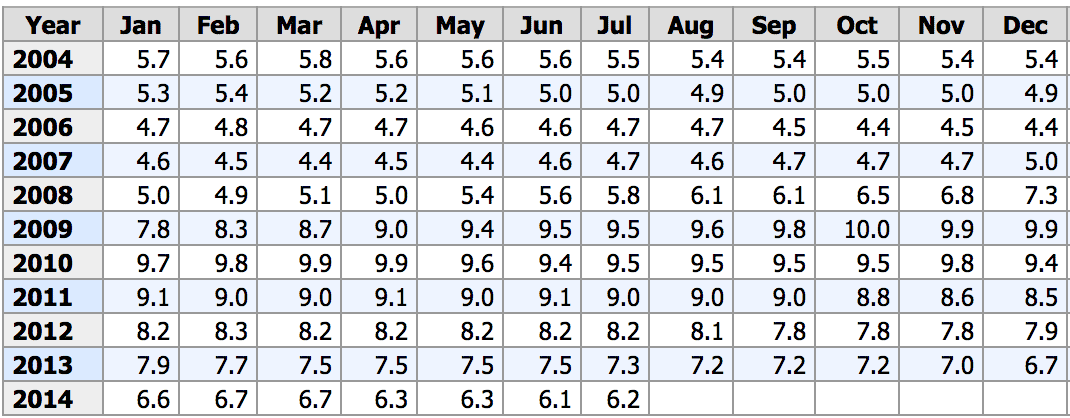
Unemployment in the US

Gross Domestic Product

In the first quarter of 2014 real GDP decreased by 2.1%. In the second quarter real GDP increased by 4.0%. Therefore, there has been no ‘consistent growth’ in the country’s economic output this year so far. The second quarter growth was mainly fueled by an increase in exports, good performance in residential fixed investments, and government spending.

The chart below shows how much the US GDP has changed (on a quarterly basis) since 2010.

It is important to note that since late 2010 the average rate of real GDP growth (on a quarterly basis) is approximately 2%.

US GDP Growth

Personal Income

Personal income has been steadily increasing and for the first time in three years there have been two consecutive quarters of income above $14,400.

Personal income for the first quarter of 2014 was $14,488.3 and for the second quarter it was $14,696.3.

This is promising as personal income is also a major driver of consumer spending, household borrowing and property prices.

Personal Income in the US


Joseph Nordqvist Avatar

Other News

Japan’s household financial assets hit a record ¥2,519 trillion. What that measures

Sep 17, 2026

Canada welcomes EU associate-member proposal, but terms are undefined

Sep 17, 2026

Softcat agrees $1.05B GDT acquisition to expand US data-centre services

Sep 17, 2026

Bank Rate held at 3.75% in the UK as energy prices sharpen inflation risk

Sep 17, 2026

East African Community trade reaches $52.3bn as exports drive surplus

Sep 16, 2026

Canada says its investment summit mobilised nearly C$500bn. What does that actually mean?

Sep 16, 2026

May Mobility agrees $1.4B SPAC deal, bets on asset-light robotaxi model

Sep 16, 2026

Fed raises rates to 3.75% to 4.00% as inflation remains elevated

Sep 16, 2026

IBM-backed Anderon finalizes up to $1B US quantum foundry award

Sep 16, 2026

WTO puts the cost of trade fragmentation at up to 10% of global GDP

Sep 15, 2026

Salesforce launches Koa, a CRM reasoning model built on Nvidia’s Nemotron

Sep 15, 2026

Could humanoid AI companions ever replace human partners?

Sep 15, 2026

IEA forecasts record global coal demand after gas prices climb

Sep 15, 2026

UK government to pursue public acquisition of Speciality Steel UK

Sep 15, 2026

IMF says global current-account gaps widened in 2025, led by China and the United States

Sep 14, 2026

Alan Lovell takes over as British Steel chair as government pursues turnaround

Sep 14, 2026

Plumbing or college: weighing pay, training and AI exposure

Sep 13, 2026

Why more advanced VR equipment does not always feel more real

Sep 13, 2026

VR pilot training shows promise before a student’s first real flight

Sep 13, 2026

Family businesses face a gap between succession plans and readiness

Sep 13, 2026