
business roundtable

Top CEOs are less optimistic about the US economy

Written by Joseph Nordqvist

Published: 22:05, December 2, 2014

Top chief executives across the US are not optimistic about the future of the American economy and are planning on reducing the amount they invest in their businesses over the next six months, according to a recent survey released on Tuesday.

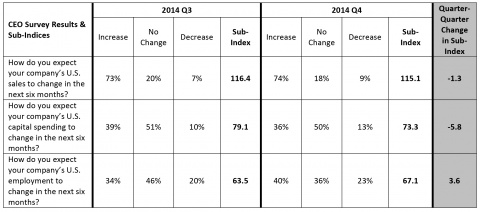
However, the 129 chief executives that were surveyed said that they still expect to boost hiring. Forty percent of CEOs said they planned to increase employment at their businesses over the next six months, compared to 34% in the third quarter.

The Business Roundtable’s economic outlook index dropped from 86.4 down to 85.1 from 86.4 in the third quarter. This is the second straight quarterly drop for the index.

A reading over 50 indicates that the economy is growing.
Q4---Survey-News-Release-FINAL-2

Source: “CEOs Forecast Weak Economic Growth in 2015”

AT&T Inc. CEO Randall Stephenson, the group’s chairman, said:

“The economy ended the year essentially where it started, performing below its potential,”

Economic growth in 2014 is averaging around 2.1%, however this low figure is mainly because of a first-quarter contraction.

Only 36% of CEOs said that they plan on increasing capital spending over the next six months, down 3% from the previous quarter. The percent of executives planning on decreasing spending rose, from 10% in the third quarter to 13%.

“Our CEOs identified U.S. tax policy as the most significant barrier to more investment,” Stephenson said.

It is clear that chief executives in the US want to reduce the current corporate tax rate, which is currently at 35% – the highest of any advanced economy. The group wants corporate tax to be cut down to 25%.

Both Democrats and Republicans agree, for the most part, that corporate tax needs to be lowered. But it is a topic of increasing debate.

Randall Stephenson said:

“Congress and the Administration should act now on tax extenders and Trade Promotion Authority to encourage additional business investment in the United States to help the economy grow and create more jobs.”

Joseph Nordqvist Avatar

Other News

Why cheaper grocery products can face faster inflation when costs rise

Nov 23, 2026

One office day a month was followed by more calls handled in a remote-work experiment

Nov 23, 2026

An AI shopping assistant increased sales in a livestream experiment

Nov 23, 2026

Starting an idea without AI changed employees’ sense of ownership in an H&M test

Nov 23, 2026

Showing the extra cost of a larger pack changed buying choices in an online test

Nov 23, 2026

Looking at products together can help identify competitors, camera study finds

Nov 23, 2026

Removing unauthorized book copies produced an uncertain sales result in a field experiment

Nov 23, 2026

Warnings did not consistently undo the influence of product lineups

Nov 23, 2026

Demographic ad targeting can change how fairly consumers view a brand

Nov 22, 2026

Matching online and store prices had mixed effects at one electronics retailer

Nov 22, 2026

Meal-kit displays showed no clear sales lift for plant-based products in Belgian stores

Nov 22, 2026

High switching costs weakened price competition in a laboratory market

Nov 22, 2026

A digital product passport changed toothbrush valuations in a lab study

Nov 22, 2026

Purchase-linked donations can change direct giving in a small experiment

Nov 22, 2026

Volunteer recruitment emails were followed by more donations in a nonprofit experiment

Nov 22, 2026

Customer-created content was linked to brand perceptions in a survey of Pakistani shoppers

Nov 22, 2026

Shopping games can frustrate customers when rewards and rules are hard to understand

Nov 22, 2026

Text-message business training helped Kenyan entrepreneurs briefly, but gains faded

Nov 22, 2026

Food traceability labels raised stated interest, but ad test found no clear difference

Nov 22, 2026

Letting shoppers keep an item for a partial refund lifted later spending in a field experiment

Nov 22, 2026