

Nationwide Building Society

UK house prices dropped 0.2% after rising for 16 months

Published: 06:38, September 30, 2014

UK house prices fell by 0.2% after 16 successive months of increases, according to a report published on Tuesday by lender Nationwide Building Society. In August, house prices had risen by 0.8%.

House prices increased by 9.4% from September 2013 to September 2014, the smallest annual rise since February 2014. August’s year-on-year growth rate reached 11%.

The UK’s residential property market has been slowing down since early summer, when regulators made lenders carry out more stringent affordability checks on mortgage candidates, and placed a limit on how much could be borrowed.

On Monday, the Bank of England reported that the number of mortgage approvals had fallen to 64,212 in August, compared to the average of 65,738 each month over the previous six months.
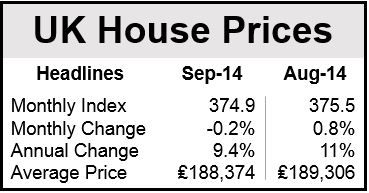
UK house prices

(Data Source: Nationwide Building Society)

Quarterly residential property price growth fell to its lowest level since the middle of 2013, declining to 1.5% during the quarter ending in September compared to 2.2% in the quarter ending in August.

Nationwide predicts that house price growth will slow down further during the last quarter of this year.

Chief Economist at Nationwide, Robert Gardner said:

“While September saw a slowing in house price growth, the picture on a quarterly basis is still relatively strong, with all thirteen UK regions recording annual price gains. There remains significant regional variation however, with the South of England still seeing the strongest rates of growth.”

“Annual house price growth in London slowed somewhat, from 25.8% in Q2 to 21% in Q3. Nevertheless, at £401,072, average prices in the capital reached a record high, 31% above their 2007 peak. In the UK as a whole, prices are around 2% above their pre-crisis peak (excl. London they are less than 1% above their 2007 peak).”

The Centre for Economics and Business Research forecasts a house price increase of 7.8% for 2014, followed by a decline of -0.8% in 2015.

Christian Nordqvist Avatar

Other News

Arrive AI and DXC target autonomous delivery on large manufacturing campuses

Sep 20, 2026

US investment abroad reached $7.1 trillion in 2025, but the figure is not annual spending

Sep 20, 2026

Germany sees early signs of a slowdown as energy costs lift inflation again

Sep 20, 2026

COBOL still runs critical business systems because replacing the system is harder than replacing the language

Sep 20, 2026

Heat stress adds $41 per ton to the estimated cost of carbon, study finds

Sep 20, 2026

UN lifts global growth forecast, but warns energy shock has revived inflation pressure

Sep 20, 2026

HPE lifts outlook after AI servers and networking drive record quarterly revenue

Sep 20, 2026

A missed opportunity can make managers keep weak projects alive

Sep 19, 2026

Surgical robots are gaining autonomy, but surgeons still run the operating room

Sep 18, 2026

Catalonia’s Plan B asks how an economy can meet needs without relying on growth

Sep 18, 2026

Bank of Japan raises policy rates to 1.25%. What higher borrowing costs mean

Sep 18, 2026

UK retail sales rise 0.5% in August as online stores recover

Sep 18, 2026

Mistras agrees $866 million sale to H.I.G. Capital

Sep 18, 2026

US industrial output stalls in August as manufacturing slips

Sep 18, 2026

Japan’s household financial assets hit a record ¥2,519 trillion. What that measures

Sep 17, 2026

Canada welcomes EU associate-member proposal, but terms are undefined

Sep 17, 2026

Softcat agrees $1.05B GDT acquisition to expand US data-centre services

Sep 17, 2026

Bank Rate held at 3.75% in the UK as energy prices sharpen inflation risk

Sep 17, 2026

East African Community trade reaches $52.3bn as exports drive surplus

Sep 16, 2026

Canada says its investment summit mobilised nearly C$500bn. What does that actually mean?

Sep 16, 2026