
California is ripe for a mega earthquake and it desperately needs an early warning system, say Members of the US Congress who are urging President Barack Obama to make funds available to make a prototype system that is currently being used at Caltech (California Institute of Technology).
According to Caltech, their system, which would give people those precious seconds to get somewhere safe, could easily be expanded to cover the West Coast if the funds were there.
Many politicians, scientists and members of the public cannot understand why the US Government cannot spend a few million dollars to create a warning system that could save thousands of lives and billions of dollars in potential damage because people were not prepared.
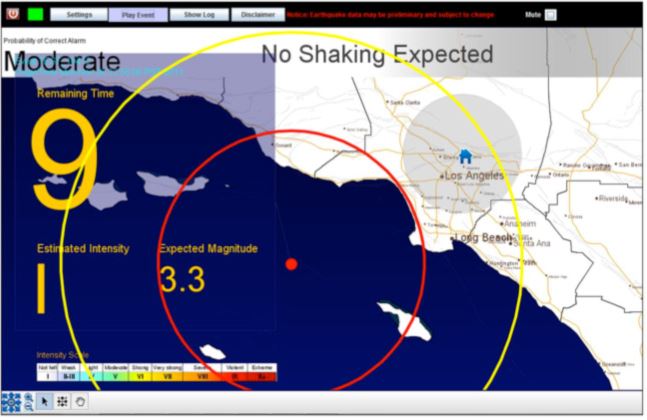 Screenshot of the User Display of CISN ShakeAlert (an early warning system) during the 2011 M3.3 Channel Island earthquake in Southern California. (Image: eew.caltech.edu)
According to members of Congress, all it would take would be an investment of $16m (£10.7m) annually.
Californian seismologists say their state is ‘Ten months pregnant’ as far as the so-called Big One is concerned. A study carried out this year in partnership with the US Geological Survey calculated there is a 7% change of a magnitude 8 earthquake in California within the next 30 years.
A 2008 study forecast that a magnitude 7.8 earthquake along the southern San Andreas Fault could kill about 1,800 people and cause $213 billion in damage.
In an interview with Sky News, Thomas Heaton, Professor of Geophysics and Professor of Civil Engineering, Director of the Earthquake Engineering Research Laboratory at Caltech, said:
“We’re trying to make it so that it is a functioning system but at this point the budget to actually turn it into a system that we would unleash on all Californians has not been approved so it is up to the politicians.”
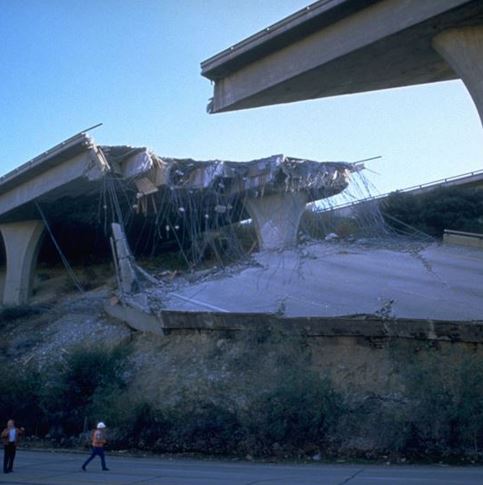
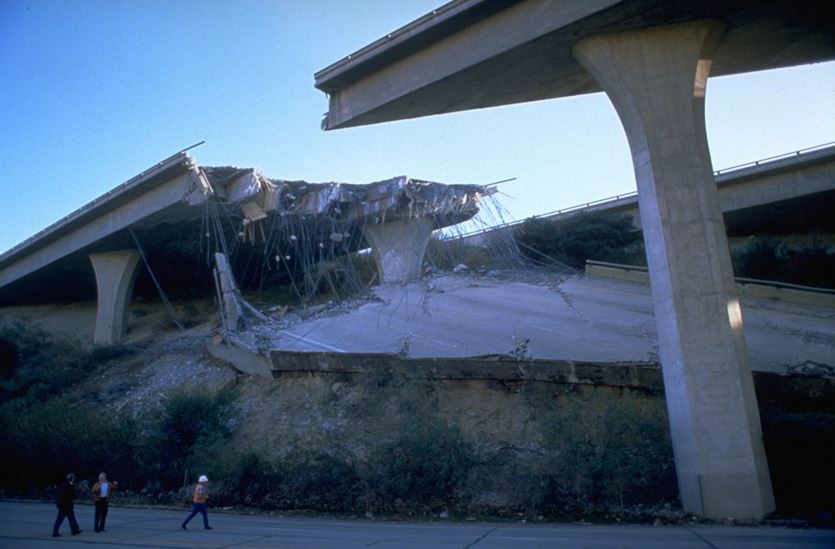 Damaged portion of the Golden State Freeway at Gavin Canyon after the 1994 earthquake that struck the Los Angeles area. An early warning system cannot protect such infrastructure, but could alert motorists to stop their vehicles, thus preventing them from driving off the edge. (Image: Wikipedia)
Prof. Heaton believes that one day people will have sophisticated warning systems in their smartphones.
With an early warning system, there would be time to slow down trains and road vehicles, surgeons would be able to stop sensitive operations, and millions of people could get out of harm’s way.
Regarding not being prepared for such a catastrophe, Prof Heaton said:
“Someday in our future we may have a very serious earthquake out there and I’m sure when that happens all of us will lament the fact that we hadn’t done more to be ready for it.”
 Professor Thomas H. Heaton said: “Clearly, some day in the future, residents of tall buildings will be told by their smartphones about the characteristics of the shaking that they are about to experience.” (Image: heaton.caltech.edu)
Democrat congressman Adam Schiff, U.S. Representative for California’s 28th congressional district, said to Sky News:
“We’ll all be kicking ourselves if we’re pennywise but pound-foolish. Frankly it is mystifying to me to come from a technology centre like California with Silicon Valley and where the US Geological Survey and Caltech have developed a lot of this technology, and we don’t have it in place when it is already working in Mexico and Japan and other countries are far ahead of where we ought to be.”
In January 1994, the Los Angeles area had a major earthquake that measured a magnitude of 6.7. Fifty-seven people died, about 5,000 were injured, and damage to property, possessions and infrastructure was estimated to be approximately $40 billion ( (£27 billion).
Earthquake Early Warning at Caltech
Engineers and scientists at Caltech, the Swiss Federal Institute of Technology (ETH), the University of Southern California (USC/SCEC), USGS Pasadena, and UC Berkeley, are carrying out earthquake early warning (EEW) research and development for California.
The project started in 2007, and includes the development and implementation of the recently-deployed demonstration EEW system called CISN ShakeAlert – created specifically for California.
ShakeAlert uses data from the California Integrated Seismic Network (CISN, Caltech/UC Berkeley/USGS), including real-time waveform data streams from stations across California.
The project was initially funded by the US Geological Survey (USGS), which is formally responsible for earthquake alerting across the United States. The Gordon and Betty Moore Foundation provided three years of new funding in 2012.
In its FAQ web page regarding the question – What is Earthquake Early Warning? – Caltech writes:
“When an earthquake occurs seismic waves radiate from the epicenter like waves on a pond. It is these waves we feel as earthquake shaking and cause damage to structures. The technology exists to detect moderate to large earthquakes so quickly that a warning can be sent to locations outside the area where the earthquake begins before these destructive waves arrive.”
Depending on how far from the earthquake’s epicentre they were, the early warning system would tell people from a few seconds to a number of minutes before it hit them, which could save many lives.

Comments are closed.