

Germany

German investor sentiment falls again

Published: 15:29, September 16, 2014

German investor sentiment in September fell again, the ninth successive month of decline, according to ZEW (Zentrum für Europäische Wirtschaftsforschung – Center for European Economic Research) in Mannheim, Germany, a non-profit independent institute.

A total of 222 analysts and institutional investors took part in the survey. The participants were asked about their expectations for the German economy for the next six months.

Following September’s 1.7 point fall, the ZEW Indicator of Economic Sentiment for Germany is currently at 6.9 points, compared to a long-term average of 24.6. A Wall Street Journal poll of economists had expected the ZEW Index to fall to 5 points.

German economic sentiment is now at its lowest point since December 2012. On a positive note, however, ZEW points out that September’s decline was much lighter than August’s.

ZEW President, Professor Clemens Fuest, said:

“The downward trend of the ZEW Indicator of Economic Sentiment for Germany has slowed significantly. However, the economic climate is still characterized by great uncertainty.”

“The risk of a sanction spiral with Russia continues to exist and economic activity in the Eurozone remains disappointing. Last but not least, it is difficult to assess potential consequences of Scottish independence.”

ZEW’s assessment of Germany’s current economic situation has declined by 18.9 points and now stands at 25.4.

The ZEW Indicator of Economic Sentiment for the Eurozone fell 9.5 points in September to 14.2, while the indicator for the Eurozone’s current economic situation fell 10 points to (minus) -42.8.

The survey results raise questions about the fragility of Germany’s economic recovery. German GDP shrank in the second quarter of 2014.
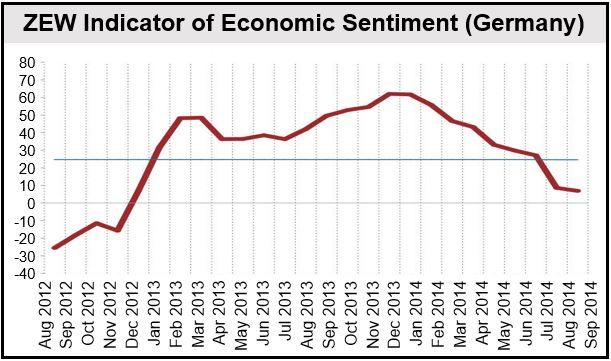
German Economic Sentiment (ZEW)

(Data source: ZEW)

In a short briefing, a ZEW economist said sentiment improved slightly after the ECB (European Central Bank) announced cuts in interest rates and the planned purchases of assets.

Veronica Salvador Avatar

Other News

Showing the extra cost of a larger pack changed buying choices in an online test

Nov 23, 2026

Looking at products together can help identify competitors, camera study finds

Nov 23, 2026

Removing unauthorized book copies produced an uncertain sales result in a field experiment

Nov 23, 2026

Warnings did not consistently undo the influence of product lineups

Nov 23, 2026

Demographic ad targeting can change how fairly consumers view a brand

Nov 22, 2026

Matching online and store prices had mixed effects at one electronics retailer

Nov 22, 2026

Meal-kit displays showed no clear sales lift for plant-based products in Belgian stores

Nov 22, 2026

High switching costs weakened price competition in a laboratory market

Nov 22, 2026

A digital product passport changed toothbrush valuations in a lab study

Nov 22, 2026

Purchase-linked donations can change direct giving in a small experiment

Nov 22, 2026

Volunteer recruitment emails were followed by more donations in a nonprofit experiment

Nov 22, 2026

Customer-created content was linked to brand perceptions in a survey of Pakistani shoppers

Nov 22, 2026

Shopping games can frustrate customers when rewards and rules are hard to understand

Nov 22, 2026

Text-message business training helped Kenyan entrepreneurs briefly, but gains faded

Nov 22, 2026

Food traceability labels raised stated interest, but ad test found no clear difference

Nov 22, 2026

Letting shoppers keep an item for a partial refund lifted later spending in a field experiment

Nov 22, 2026

Skincare claims that look scientific changed shopping choices in an online experiment

Nov 21, 2026

Crowded settings can make unfamiliar products less appealing in consumer experiments

Nov 21, 2026

Words that describe texture can affect online clothing choices, study finds

Nov 21, 2026

Impact measurement support helped Indian social enterprises grow in a field experiment

Nov 21, 2026