
UK manufacturing increased marginally in November, driven by strong demand at home while new export orders remained subdued, says a new report published by Markit Economics on Monday. The result surprised most economist, who had expected to see a slight fall in growth.
Although manufacturing growth has increased more moderately in recent months compared to the first half of the year, November saw further solid expansions of output, employment and new orders.
November’s Markit/CIPS Purchasing Manager’s Index (PMI) was 53.5 compared to 53.3 in October. Any reading above 50 points to growth.
Manufacturing output increased in the UK in November for the 20th consecutive month. According to the authors “Solid domestic market conditions, promotional activity and new client wins were all factors driving the latest rise in new work.”
Despite being slower than in the first months of the year, manufacturing production growth remained broad based in November. Expansion was seen in the consumer, intermediate and investment goods sectors, as well as across small, medium and large-sized companies.
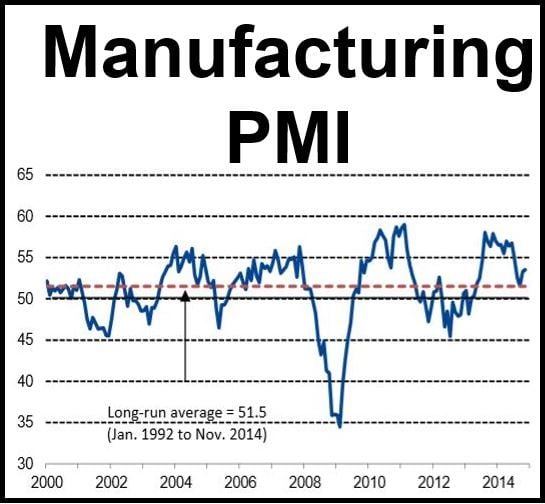
Source: “Markit/CIPS UK Manufacturing PMI,” Markit Economics.
Employment in manufacturing increased in November for the 19th successive month. The rate of job creation was at a four-month high. While large companies posted modest gains, SMEs saw sharp increases in employment.
Rob Dobson, Senior Economist at Markit, said:
“In the lead-up to the Chancellor’s Autumn Statement, the November PMI survey shows the UK manufacturing sector continuing its solid expansion. Despite easing from the stellar pace set in the first half of the year, growth is still coming from a broad-base that will aid its sustainability.”
Mr. Dobson added that a great deal of focus continues to be on price trends, which remain subdued. Input costs fell for the third successive month while output charges hardly grew at all in November. Recent declines in oil prices will help reduce manufacturers’ costs further.
“Waning inflationary pressures in industry will continue to provide some leeway for the Bank of England to hold off from raising interest rates even as solid growth persists,” Dobson said.
