

The Fed says rates will stay low for a “considerable time” after the stimulus program has been wound down in October. However, it also added that it may raise rates higher than it had previously expected.
Investors and economists had expected the US Federal Reserve to change its rate guidance which has stood since March, given that unemployment continues falling and overall the country’s economic performance has been strong.
However, the central bank assured that interest rates would remain at near-zero rates for quite some time. A further $10 billion reduction in monthly bond purchases was announced after a two-day meeting of the Federal Open Market Committee (FOMC).
In other words, the Fed took steps toward wrapping up the easy-money policies that have defined its response to the global financial crisis and Great Recession that followed, but really gave us no idea of when rates will start to increase.
Investors wondered what exactly the Fed meant when low rates would remain for a “considerable time” after the stimulus program is wrapped up, but rates may rise earlier than expected. Was it trying to tell everybody what they wanted to hear?
Labor market slack
The FOMC pointed out that there is still a considerable amount of slack in the labor market, a sign that it will postpone considering raising interest rates until that component of the economy tightens up.
The FOMC wrote, regarding employment:
“On balance, labor market conditions improved somewhat further; however, the unemployment rate is little changed and a range of labor market indicators suggests that there remains significant underutilization of labor resources.”
The FOMC added that business fixed investment is advancing while household spending is increasing moderately. However, the recovery in the property market remains slow.
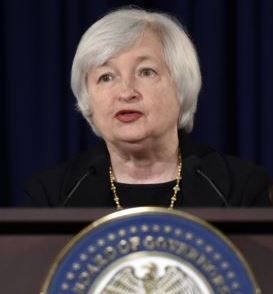
Ms. Yellen said rates will stay low for some considerable time, but might go up sooner than expected. Meaning “Anything can happen!”
Fiscal policy is holding back economic growth, although the extent of the restraint is falling. FOMC’s long-term inflation expectations remain stable, although price rises are still below its 2% target.
The Committee says it sees the risks to the outlook for economic activity and the labor market “as nearly balanced”, and believes that since early this year signs point to inflation edging up soon.
There was a split within the FOMC, with Philadelphia’s Fed chief Charles Plosser and Dallas’ Richard Fisher dissenting. They are concerned that the Fed’s interest rate guidance would tie its hands if it suddenly had to move more rapidly.
In a news conference after the two-day FOMC meeting, Fed Chairwoman Janet Yellen sought to give the central bank elbow room in the months ahead, with the following words:
“I want to emphasize that there is no mechanical interpretation of what the term ‘considerable time’ means. If the pace of progress in achieving our goals were to quicken, if it were to accelerate, it’s likely that the Fed would begin raising its target for the federal funds rate sooner than is now anticipated …. and the opposite is also true.”
Confounding employment and GDP data
The Fed is searching for a path within an economic environment fraught with conflicting data. GDP growth has consistently come in below the Fed’s expectations. In fact, it has reduced its growth forecasts for the next three years. It now expects the economy to grow below 3% annually until the end of 2017.
Employment data, on the other hand, have persistently exceeded Fed expectations. Even with August’s 6.1% unemployment rate, the central bank would prefer to see it settle at a lower long-term rate. With millions of baby boomers retiring, unemployment can fall more rapidly now without strong economic growth.
A baby boomer is a man or woman who was born between 1945 and the mid-1960s.
